
 CA
 NZ
 UK
 US
 IND

 AU

 Share
 X (Formerly Twitter)
 Whatsapp
 Facebook
 LinkedIn
 Telegram
 Email This Article
 Copy Link
 Summarize with AI
 Chat GPT
 Perplexity

Key Highlights
- Information Technology (XIJ) surged 4.61%, recording the strongest performance among the twelve ASX sectors.
- Materials (XMJ) advanced 1.02%, while Resources (XJR) gained 0.81%.
- Consumer Discretionary (XDJ) rose 0.72%, with Industrials and Health Care also finishing higher.
- Six of the twelve sectors advanced and six declined, indicating a highly divergent session.
- Utilities (XUJ) fell 0.82%, recording the weakest performance, followed by Energy (XEJ), which declined 0.72%.
- Financials (XFJ) slipped 0.13% despite the Reserve Bank of Australia raising the cash rate by 25 basis points.
- Real Estate (XPJ) declined 0.21%, while Consumer Staples (XSJ) edged down just 0.06%.
- The gap between the strongest and weakest sectors reached 5.43 percentage points.
The Australian Equity market displayed a sharply divergent sector performance on 29 September 2026, with technology stocks leading a strong rebound while several rate-sensitive and energy-related sectors remained under pressure. The S&P/ASX 200 gained 0.34% to close at 8,709.3 points, with strength in technology and materials helping offset weakness in utilities, energy and several other sectors.
The session also coincided with the Reserve Bank of Australia raising the cash rate by 25 basis points to 4.60%, its fourth increase of 2026. The decision had been broadly anticipated by markets, resulting in a mixed response across interest-rate-sensitive sectors.
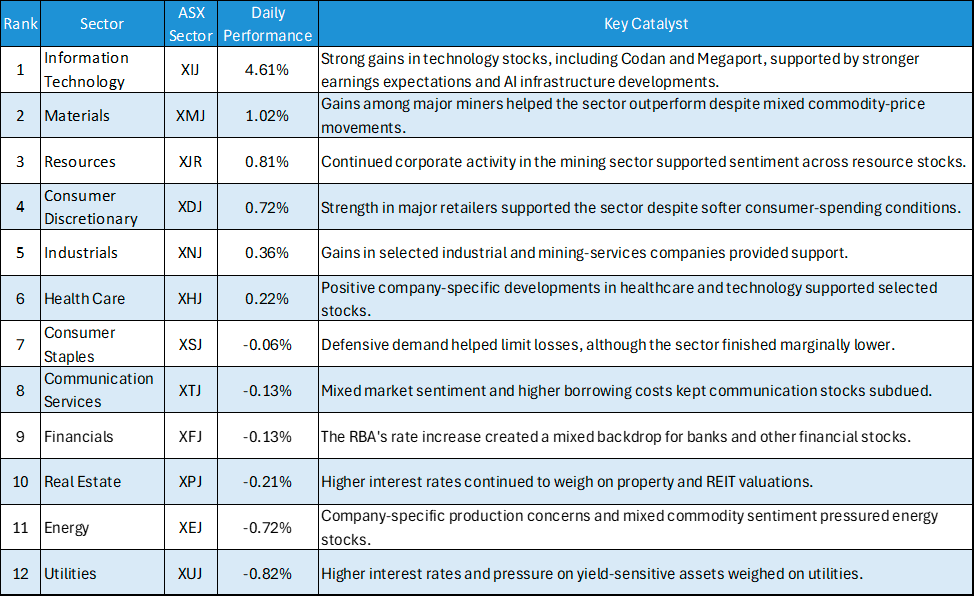
Daily ASX Sector Performance Summary
Technology Leads a Strong Sector Rebound
Information Technology was by far the strongest-performing sector, climbing 4.61%. The advance represented a significant Reversal from the recent weakness seen across technology stocks and placed XIJ well ahead of every other ASX sector during the session.
Several technology companies recorded substantial gains, with Codan and Megaport among the notable contributors. Stronger profit expectations and developments related to artificial intelligence infrastructure provided additional support for technology sentiment.
The sector's performance was particularly notable given that the Reserve Bank of Australia raised interest rates during the session. Technology companies are generally sensitive to changes in interest rates because higher discount rates can place pressure on the valuation of growth-oriented businesses. Nevertheless, company-specific catalysts dominated the session.
Materials and Resources Gain Ground
Materials advanced 1.02%, while Resources gained 0.81%, placing both sectors near the top of the daily ranking. Gains among major Mining companies provided support, helping commodity-related equities outperform despite mixed movements across individual commodities.
The resource sector also remained influenced by corporate activity. Takeover and consolidation developments among major mining companies continued to attract investor attention and contributed to interest across the broader resources complex.
The performance of Materials and Resources contrasted with Energy, suggesting that Commodity exposure was not uniformly treated across the Australian market.
Consumer Discretionary and Industrials Move Higher
Consumer Discretionary gained 0.72%, supported by strength among major retailers and consumer-facing companies. The advance occurred despite concerns that higher borrowing costs could eventually weigh on household spending.
Industrials rose 0.36%, with selected industrial and mining-services companies providing support. The sector's positive performance reflected strength in individual companies rather than a broad-based move across all economically sensitive stocks.
Health Care also edged higher by 0.22%, making it the sixth sector to finish in positive territory.
Utilities and Energy Lead the Declines
Utilities recorded the largest decline, falling 0.82%. The sector remained particularly sensitive to the higher interest-rate environment following the RBA's decision to lift the cash rate to 4.60%.
Higher interest rates can increase financing costs for utilities and reduce the relative attractiveness of their income-oriented characteristics compared with fixed-income investments. This contributed to continued pressure on the sector.
Energy declined 0.72%, making it the second-weakest sector. Company-specific production developments and changing commodity-market conditions contributed to the weakness.
Financials slipped 0.13%, while Real Estate declined 0.21%. The relatively modest losses in these sectors indicate that the RBA decision did not result in an equally strong sell-off across all rate-sensitive areas of the market.
Bottom Line
The Australian equity market displayed significant sector divergence on 29 September 2026. Information Technology dominated the session with a 4.61% gain, followed by Materials at 1.02% and Resources at 0.81%.
At the other end of the ranking, Utilities declined 0.82%, followed by Energy at 0.72%. Financials and Real Estate also finished lower, while Consumer Staples and Communication Services recorded only marginal declines.
With six sectors rising and six falling, the overall market performance remained balanced beneath the surface. However, the 5.43 percentage-point difference between Information Technology and Utilities highlighted the substantial variation in sector performance during the session.


 Nov 12, 2026





 Please wait processing your request...