
 CA
 NZ
 UK
 US
 IND

 AU

 Share
 X (Formerly Twitter)
 Whatsapp
 Facebook
 LinkedIn
 Telegram
 Email This Article
 Copy Link
 Summarize with AI
 Chat GPT
 Perplexity

Key Highlights
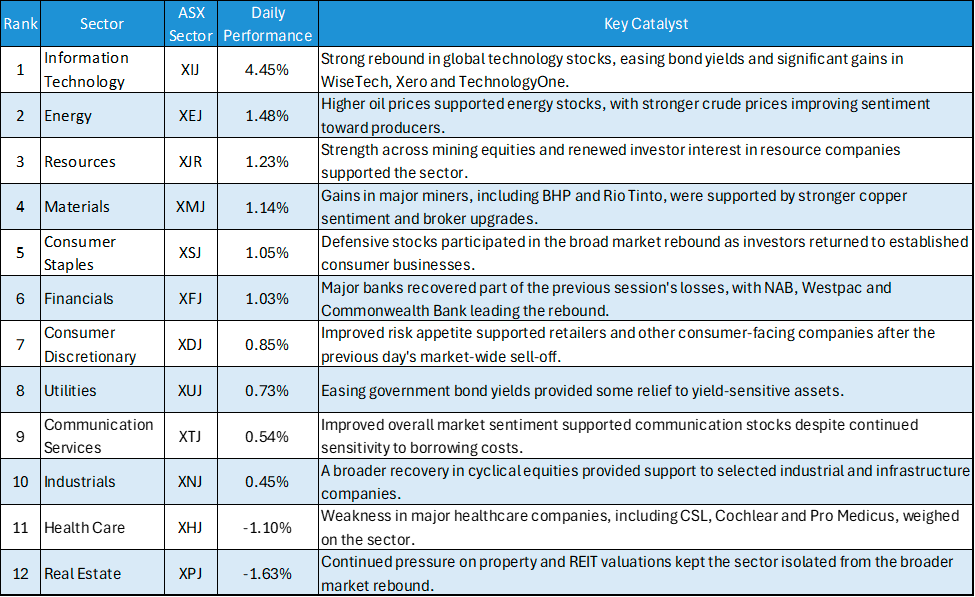
- Information Technology (XIJ) surged 4.45%, recording the strongest performance among the twelve ASX sectors.
- Energy (XEJ) gained 1.48%, while Resources (XJR) and Materials (XMJ) advanced 1.23% and 1.14%, respectively.
- Consumer Staples and Financials also performed strongly, rising 1.05% and 1.03%.
- Ten of the twelve sectors finished higher, highlighting a broad-based recovery across the Australian Equity market.
- Health Care (XHJ) declined 1.10%, while Real Estate (XPJ) fell 1.63%, making them the two weakest sectors.
- The gap between the strongest and weakest sectors reached 6.08 percentage points.
- The rebound was supported by easing bond yields, a recovery in global technology stocks and renewed strength across major banks and miners.
The Australian equity market staged a broad recovery on 2 October 2026, with technology stocks leading a sharp rebound following the heavy sell-off in the previous session. The S&P/ASX 200 rose 0.79% to 8,682.1 points, while ten of the twelve sectors in the supplied sector dataset finished higher. The strongest gains were concentrated in Information Technology, Energy, Materials, Resources and Financials, while Health Care and Real Estate remained under pressure.
Daily ASX Sector Performance Summary
Technology Leads a Broad Market Recovery
Information Technology was by far the strongest-performing sector, climbing 4.45%. The sharp advance followed a difficult previous session and reflected a strong rebound in global technology stocks as bond yields eased.
Several major technology companies contributed to the recovery. WiseTech Global gained 6.67%, while Xero and TechnologyOne also recorded substantial advances. Megaport was another notable technology performer after receiving renewed investor attention following developments involving artificial intelligence infrastructure and cloud connectivity.
The decline in US Treasury yields was particularly supportive for growth-oriented technology stocks. Lower yields can reduce the discount-rate pressure applied to companies whose valuations depend heavily on future Earnings growth. The technology sector therefore benefited from both improved global sentiment and company-specific catalysts.
Energy, Resources and Materials Gain Ground
Energy advanced 1.48%, making it the second-best-performing sector in the supplied dataset. The recovery followed a rise in international oil prices, providing support for Australian energy producers.
Resources and Materials also recorded solid gains of 1.23% and 1.14%, respectively. Major Mining companies helped lift sentiment, with BHP and Rio Tinto among the notable contributors. Copper strength and renewed broker interest in selected mining companies added further support.
The performance of these commodity-related sectors indicated that investors were willing to increase exposure to cyclical Assets despite continued concerns about global growth and elevated interest rates.
Financials and Consumer Sectors Rebound
Financials rose 1.03%, with Australia's major banks recovering part of the losses suffered during the previous session. NAB, Westpac and Commonwealth Bank all recorded gains, helping the financial sector make a meaningful contribution to the broader market rebound.
Consumer Staples gained 1.05%, while Consumer Discretionary advanced 0.85%. The simultaneous strength across both defensive and economically sensitive consumer stocks suggests that Friday's recovery was relatively broad rather than concentrated in only one market segment.
Utilities also rose 0.73% as government bond yields eased. However, the sector remains sensitive to the higher interest-rate environment, meaning the improvement may require further confirmation before being viewed as a sustained change in relative strength.
Health Care and Real Estate Remain Under Pressure
Health Care was one of only two sectors to decline, falling 1.10%. Major companies including CSL, Cochlear and Pro Medicus experienced weakness, weighing on the broader sector.
Real Estate recorded the weakest performance, declining 1.63%. Property and REIT stocks continued to face pressure from elevated borrowing costs and the broader interest-rate environment. The sector's underperformance was particularly notable because the wider market rebounded strongly.
The divergence suggests that Friday's recovery did not benefit all interest-rate-sensitive assets equally. While lower bond yields helped technology and some defensive sectors, concerns surrounding property valuations remained significant.
Bottom Line
The Australian equity market staged a broad rebound on 2 October 2026, with Information Technology dominating the sector rankings after rising 4.45%. Energy, Resources, Materials, Consumer Staples and Financials also delivered gains above 1%, demonstrating strong participation across several major areas of the market.
At the other end of the ranking, Health Care declined 1.10% and Real Estate fell 1.63%. With ten of twelve sectors advancing, the session represented a substantial improvement in Market Breadth following the previous day's sharp sell-off. However, the 6.08-percentage-point difference between Information Technology and Real Estate highlights continued sector dispersion and suggests that investors remained selective despite the broader recovery.


 Nov 12, 2026





 Please wait processing your request...