
 CA
 NZ
 UK
 US
 IND

 AU

 Share
 X (Formerly Twitter)
 Whatsapp
 Facebook
 LinkedIn
 Telegram
 Email This Article
 Copy Link
 Summarize with AI
 Chat GPT
 Perplexity

Key Highlights
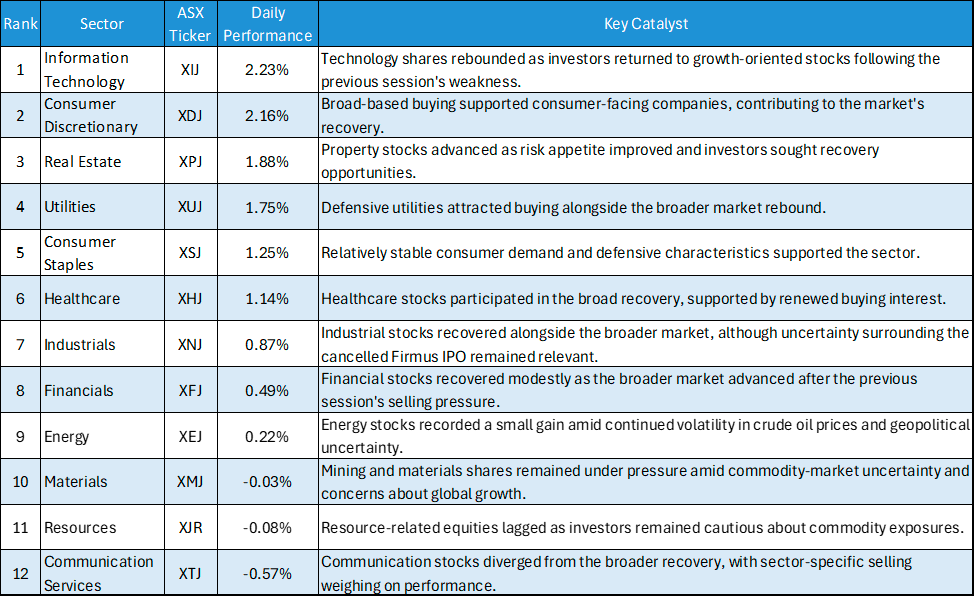
- Information Technology (XIJ) surged 2.23%, leading all twelve supplied sector indices on 9 October 2026.
- Consumer Discretionary (XDJ) gained 2.16%, reflecting renewed investor Demand for consumer-facing businesses.
- Real Estate (XPJ) advanced 1.88%, while Utilities (XUJ) rose 1.75%, highlighting broad-based buying across growth and defensive sectors.
- Consumer Staples (XSJ) increased 1.25%, while Healthcare (XHJ) added 1.14%.
- Industrials (XNJ) and Financials (XFJ) posted smaller gains of 0.87% and 0.49%, respectively.
- Materials (XMJ) slipped 0.03%, while Resources (XJR) fell 0.08%, indicating relative weakness across commodity-related equities.
- Communication Services (XTJ) declined 0.57%, making it the weakest-performing supplied sector index.
- The 2.80-percentage-point gap between Information Technology and Communication Services highlighted a clear divergence in sector performance.
The Australian Equity market staged a broad recovery on 9 October 2026, with Information Technology, Consumer Discretionary and Real Estate leading the advance. The strongest-performing sector gained more than 2%, while only two of the twelve supplied indices finished in negative territory. The session indicated a recovery in risk appetite following the previous day's market weakness, although the divergence between sectors suggested that investors remained selective.
The broader S&P/ASX 200 rose 0.64% to close at 8,716.6 points, supported by gains across nine of the eleven major market sectors. Technology and consumer discretionary stocks led the rebound, while the cancellation of the highly anticipated Firmus Technologies initial public offering continued to highlight concerns about valuations and investor appetite for capital-intensive artificial intelligence projects.
Daily ASX Sector Performance Summary
Technology Leads as Investors Return to Growth Stocks
Information Technology was the strongest-performing supplied sector, advancing 2.23%. The rebound followed a difficult period for technology shares, which had faced pressure from elevated bond yields and concerns about the valuation of companies associated with artificial intelligence.
The cancellation of Firmus Technologies' proposed multibillion-dollar IPO remained an important development for Australia's technology Investment landscape. The Withdrawal raised questions about investor appetite for large capital-intensive projects and the valuation assumptions underpinning the AI infrastructure boom. Nevertheless, the technology sector's strong daily advance demonstrated that uncertainty surrounding individual transactions did not prevent a broad recovery in listed technology shares.
Consumer Discretionary and Real Estate Rebound
Consumer Discretionary gained 2.16%, ranking second among the supplied indices. The advance reflected stronger buying interest across consumer-facing equities as investors moved back into risk-sensitive areas of the market. However, the sustainability of the recovery will depend partly on household spending, employment conditions and borrowing costs.
Real Estate climbed 1.88%, making it the third-strongest sector. The gain was notable given the sensitivity of property companies and real estate investment trusts to interest rates and financing expenses. An improvement in market sentiment can support valuations in the sector, although persistently high bond yields and refinancing costs could limit further gains.
Utilities, Consumer Staples and Healthcare Support the Recovery
Utilities advanced 1.75%, while Consumer Staples gained 1.25% and Healthcare increased 1.14%. These gains demonstrated that the session's recovery extended beyond growth-oriented equities into traditionally defensive areas.
Consumer Staples benefited from their relatively stable demand characteristics, while Healthcare stocks participated in the broader improvement in investor sentiment. Utilities also attracted buying despite their sensitivity to interest rates. However, these sectors could face renewed valuation pressure if bond yields rise again.
Materials and Resources Remain Weak
Materials edged down 0.03%, while Resources declined 0.08%. Although the losses were small compared with the previous session's weakness, both indices underperformed most other sectors. Investors remained attentive to Commodity prices, global growth expectations and the outlook for major Mining companies.
The contrasting performance between technology and resources highlighted a shift in daily market leadership. While investors bought growth-oriented and consumer-facing equities, commodity-linked sectors struggled to generate positive momentum. A sustained recovery in mining shares may require firmer commodity prices and improved confidence in global industrial demand.
Financials and Communication Services Show Mixed Performance
Financials advanced 0.49%, recovering modestly after recent pressure on major banks. However, the sector's relatively limited gain suggested that investors remained cautious about financing conditions, household borrowing costs and the economic outlook.
Communication Services was the only sector to record a substantial negative performance, declining 0.57%. Its weakness contrasted with gains across most of the market, suggesting that sector-specific factors continued to influence investor positioning. The divergence also reinforced the importance of distinguishing broad market direction from individual sector performance.
Bottom Line
The Australian equity market rebounded on 9 October 2026, with Information Technology, Consumer Discretionary and Real Estate leading the advance. The ASX 200 gained 0.64%, while ten of the twelve supplied sector indices finished higher.
The 2.80-percentage-point spread between Information Technology and Communication Services illustrated a market characterised by selective buying rather than uniform strength. Technology's recovery was encouraging, but uncertainty surrounding AI investment valuations and the cancelled Firmus IPO remained important considerations. Meanwhile, the subdued performance of Materials and Resources suggested that commodity-related equities had yet to participate meaningfully in the rebound.
Going forward, investor attention is likely to remain focused on bond yields, commodity prices, corporate Earnings expectations and developments affecting technology investment. Whether the rebound develops into a more sustained advance will depend on improving market confidence and broader participation across sectors.


 Nov 12, 2026





 Please wait processing your request...