
 CA
 NZ
 UK
 US
 IND

 AU

 Share
 X (Formerly Twitter)
 Whatsapp
 Facebook
 LinkedIn
 Telegram
 Email This Article
 Copy Link
 Summarize with AI
 Chat GPT
 Perplexity

Key Highlights
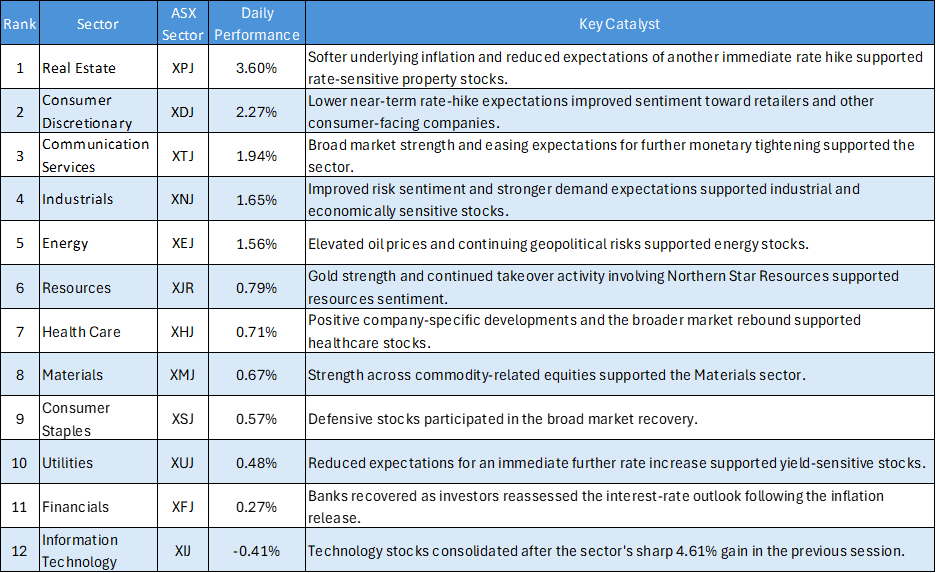
- Real Estate (XPJ) surged 3.60%, recording the strongest performance among the twelve ASX sectors.
- Consumer Discretionary (XDJ) advanced 2.27%, while Communication Services (XTJ) gained 1.94%.
- Industrials (XNJ) rose 1.65%, followed by Energy (XEJ), which advanced 1.56%.
- Eleven of the twelve sectors finished higher, indicating broad-based strength across the Australian Equity market.
- Resources (XJR) gained 0.79%, while Health Care (XHJ) and Materials (XMJ) rose 0.71% and 0.67%, respectively.
- Consumer Staples (XSJ) and Utilities (XUJ) also advanced, gaining 0.57% and 0.48%.
- Financials (XFJ) edged higher by 0.27% following the RBA's 25-basis-point rate increase to 4.60% on 29 September.
- Information Technology (XIJ) was the only declining sector, falling 0.41% after its strong gain in the previous session.
The Australian equity market staged a broad rebound on 30 September 2026, with rate-sensitive sectors leading the recovery. The move followed the release of August Inflation data, which showed annual headline inflation rising to 4.0% from 3.5% in July, while trimmed-mean inflation remained unchanged at 3.6%. The underlying inflation result was broadly in line with expectations, helping reduce immediate expectations for another RBA rate increase.
Daily ASX Sector Performance Summary
Real Estate Leads a Strong Sector Rebound
Real Estate was by far the strongest-performing sector, surging 3.60%. The advance represented a sharp recovery in a segment that had been under pressure from higher borrowing costs and elevated bond yields.
The major catalyst was the latest inflation release. Although annual headline inflation increased to 4.0%, trimmed-mean inflation remained at 3.6% for the third consecutive month. The result suggested that underlying domestic inflation pressures had not accelerated further following the RBA's rate increase on 29 September.
Financial-market pricing subsequently reduced expectations for another rate hike at the RBA's November meeting. This change in interest-rate expectations provided particularly strong support for property and other yield-sensitive stocks.
Consumer Discretionary and Communication Services Advance
Consumer Discretionary climbed 2.27%, ranking second among the twelve sectors. The sector benefited from the improved interest-rate outlook because retailers and other consumer-facing businesses are sensitive to household borrowing costs and disposable income.
Communication Services advanced 1.94%, extending the rebound across growth-sensitive areas of the Australian market. The move occurred alongside broad strength across the ASX, with eleven of the twelve sectors finishing in positive territory.
Industrials and Energy Gain Ground
Industrials rose 1.65%, supported by improved market sentiment and reduced expectations for immediate additional monetary tightening.
Energy gained 1.56% as elevated oil prices remained supportive. Brent Crude was trading above US$100 a barrel, while geopolitical uncertainty continued to influence global energy markets. Higher fuel prices were also an important contributor to Australia's August inflation increase.
Resources and Materials Remain Positive
Resources advanced 0.79%, while Materials gained 0.67%. Gold remained a key source of support for the resources sector, while corporate activity involving Northern Star Resources continued to attract investor attention.
Gold Fields was considering whether to improve its Takeover proposal for Northern Star after the Australian miner rejected the initial offer. The proposed transaction valued Northern Star at about A$38.7 billion and remained an important source of interest across the gold-mining sector.
Technology Consolidates After Previous-Day Surge
Information Technology was the only sector to decline, falling 0.41%. The decline followed a substantial 4.61% gain on 29 September, when technology was the strongest-performing sector.
The previous session's rally was supported by company-specific developments, including Codan's upgraded profit outlook following stronger Demand for its communications technology and Megaport's announcements regarding AI infrastructure contracts.
The modest decline on 30 September therefore occurred after a significant previous-day advance, while Capital rotated toward sectors more directly sensitive to changes in interest-rate expectations.
Bottom Line
The Australian equity market recorded a broad-based rebound on 30 September 2026, with eleven of the twelve sectors advancing. Real Estate led the market with a 3.60% gain, followed by Consumer Discretionary at 2.27% and Communication Services at 1.94%.
The key catalyst was the August inflation release, which showed headline CPI rising to 4.0% while underlying inflation remained stable at 3.6%. The absence of a further acceleration in underlying inflation reduced immediate expectations for another RBA rate increase and provided significant support for rate-sensitive sectors.
At the other end of the ranking, Information Technology declined 0.41% following its sharp gain in the previous session. Overall, the 4.01-percentage-point spread between Real Estate and Information Technology, together with gains in eleven sectors, highlighted the broad nature of the sector rebound.


 Nov 12, 2026





 Please wait processing your request...