
 CA
 NZ
 UK
 US
 IND

 AU

 Share
 X (Formerly Twitter)
 Whatsapp
 Facebook
 LinkedIn
 Telegram
 Email This Article
 Copy Link
 Summarize with AI
 Chat GPT
 Perplexity

Key Highlights
- Real Estate Leads: Real Estate (ASX:XPJ) rose 2.85%, the strongest supplied sector, as markets interpreted the RBA statement as potentially signalling that further rate hikes may not be needed.
- Consumer Discretionary Advances: Consumer Discretionary (ASX:XDJ) gained 1.87%, supported by a rally in rate-sensitive retailers after the RBA decision.
- Communication Services and Staples Rise: Communication Services (ASX:XTJ) added 1.72%, while Consumer Staples (ASX:XSJ) rose 1.22%.
- Technology and Industrials Finish Higher: Information Technology (ASX:XIJ) gained 0.77% and Industrials (ASX:XNJ) advanced 0.67%; Financials (ASX:XFJ) rose 0.42%.
- Energy Records the Largest Decline: Energy (ASX:XEJ) fell 3.45% as a sharp drop in crude prices pressured oil, gas and coal stocks.
- Mixed Commodity and Defensive Performance: Utilities and Materials slipped 0.16% and 0.17%; Healthcare fell 0.58%, while Resources declined 0.77%.
Australian equities finished higher on Tuesday, 3 November, but sector performance was uneven. Real Estate and Consumer Discretionary led as investors responded to the Reserve Bank of Australia’s 25-basis-point cash-rate increase to 4.85% and interpreted the accompanying statement as less hawkish than feared. Communication Services and Consumer Staples also advanced. Energy was the clear outlier on the downside, falling 3.45% as oil prices dropped sharply on hopes for diplomatic progress in the Middle East. The 6.30-percentage-point gap between Real Estate and Energy highlights the scale of sector rotation during the session.
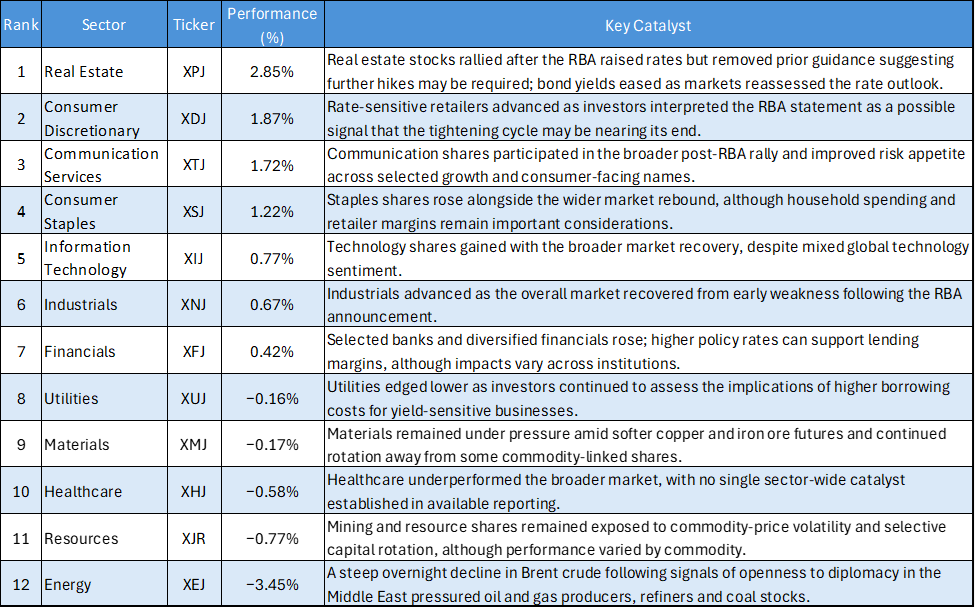
Daily ASX Sector Performance Summary
Real Estate and Consumer Discretionary Lead the Rebound
Real Estate (ASX:XPJ) rose 2.85%, topping the supplied sector results. The rally followed the RBA’s decision to raise the cash rate by 25 basis points to 4.85%. Although the increase was widely anticipated, investors focused on the removal of earlier language suggesting further hikes might be required. Government bond yields eased, improving the valuation outlook for property companies whose future cash flows are sensitive to discount rates and financing costs. Listed property groups including Lendlease, Stockland, Scentre Group and GPT Group recorded strong gains.
Consumer Discretionary (ASX:XDJ) gained 1.87%, also benefiting from the market’s reassessment of the rate outlook. Lower expected future borrowing costs can support consumer confidence and reduce pressure on discretionary spending, although the higher cash rate still poses a challenge for households. Communication Services (ASX:XTJ) rose 1.72%, while Consumer Staples (ASX:XSJ) added 1.22%. The positive performance across these consumer-facing groups suggests the rebound extended beyond property, but one session is insufficient to confirm a sustained improvement in demand.
Energy Retreats as Commodity Performance Diverges
Energy (ASX:XEJ) fell 3.45%, the largest decline among the supplied indices. Brent Crude had plunged overnight amid signs that Iran’s Leadership was open to diplomatic engagement over the Middle East conflict. Lower oil prices weighed on major producers, including Woodside Energy and Santos, while coal-related names also weakened. The move demonstrates the sector’s sensitivity to changes in perceived Supply risk and global energy pricing. A sustained recovery in crude could ease the pressure, but further diplomatic progress or weaker Demand expectations could keep energy shares volatile.
Materials (ASX:XMJ) slipped 0.17% and Resources (ASX:XJR) declined 0.77%, showing that commodity-linked sectors did not move uniformly. Copper and iron ore futures were lower in Asian trade, while selected Mining shares remained under pressure. Information Technology (ASX:XIJ) rose 0.77% and Industrials (ASX:XNJ) gained 0.67%, while Financials (ASX:XFJ) advanced 0.42%. Utilities (ASX:XUJ) eased 0.16%, and Healthcare (ASX:XHJ) fell 0.58%, leaving the session characterised by selective rather than broad-based strength.
Market Outlook and Risks
The market’s response to the RBA decision will remain important, particularly whether bond yields and rate-sensitive sectors maintain their gains. Real Estate and Consumer Discretionary may remain sensitive to changes in rate expectations, while Energy will continue to track crude prices and geopolitical developments. Materials and Resources will be influenced by global demand, commodity pricing and producer updates. The cash rate is now at an 18-year high, and persistent Inflation could limit the scope for policy easing even if markets interpret the latest statement as a signal that further hikes are less likely. Daily sector moves should therefore be considered alongside Earnings outlooks and economic data.
Bottom Line
Real Estate led ASX sector performance on 3 November 2026, gaining 2.85%, followed by Consumer Discretionary at 1.87% and Communication Services at 1.72%. Energy was the weakest sector, falling 3.45% as a sharp drop in oil prices weighed on energy producers and coal stocks. The RBA’s rate increase to 4.85% drove a notable rotation into property and consumer-facing shares, while Materials, Resources, Healthcare and Utilities finished lower. Investors will be watching bond yields, the RBA’s inflation outlook, crude prices and commodity demand to assess whether the sector rotation can persist.


 Nov 12, 2026





 Please wait processing your request...