
 CA
 NZ
 UK
 US
 IND

 AU

 Share
 X (Formerly Twitter)
 Whatsapp
 Facebook
 LinkedIn
 Telegram
 Email This Article
 Copy Link
 Summarize with AI
 Chat GPT
 Perplexity

Key Highlights
- Real Estate (XPJ) led the supplied sector indices, gaining 1.00% on 14 October 2026.
- Communication Services (XTJ) rose 0.85%, while Energy (XEJ) advanced 0.80%.
- Information Technology (XIJ) added 0.35%, and Healthcare (XHJ) edged up 0.02%.
- Consumer Discretionary (XDJ) was nearly unchanged, slipping 0.04%; Utilities (XUJ) fell 0.06%.
- Consumer Staples (XSJ) declined 0.31%, while Resources (XJR) lost 0.62%.
- Industrials (XNJ) fell 0.71%, and Materials (XMJ) dropped 0.88%.
- Financials (XFJ) was the weakest supplied index, declining 1.41%, as major banks came under pressure.
- The 2.41-percentage-point spread between Real Estate and Financials highlighted divergent sector performance.
The Australian share market fell on 14 October, with the S&P/ASX 200 declining 0.64% to 8,727.9 points. The supplied sector data showed a mixed picture beneath the benchmark’s decline: Real Estate, Communication Services and Energy advanced, while Financials, Materials and Industrials weakened. News coverage attributed the broader market pressure to a sell-off in major banks, weaker gold and Mining shares, and investor reassessment of the outlook for interest rates after disappointing US bank earnings.
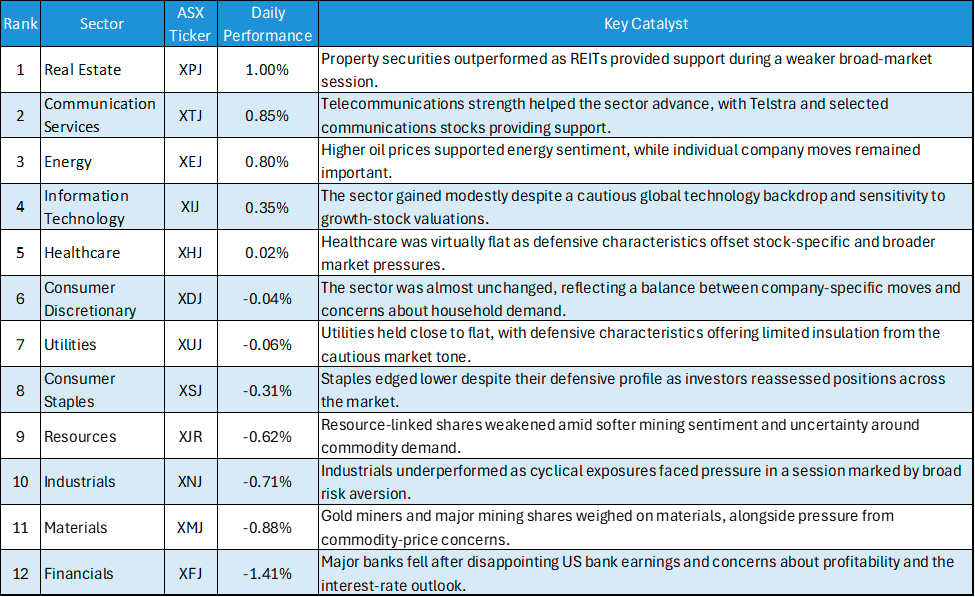
Daily ASX Sector Performance Summary
Real Estate, Communication Services and Energy Lead
Real Estate was the strongest supplied index, gaining 1.00% as listed property securities outperformed a falling benchmark. Market reporting indicated that REITs were among the better-performing sectors. The advance may reflect relative positioning rather than a broad improvement in property fundamentals: listed real estate remains sensitive to bond yields, financing costs, refinancing requirements and expectations for interest-rate policy.
Communication Services rose 0.85%, supported by strength in telecommunications and selected communications stocks. This result contrasted with weakness in several heavyweight sectors and suggests investors continued to find opportunities in individual companies. Energy added 0.80%, with higher oil prices providing a more supportive backdrop. Nevertheless, Commodity prices alone do not determine sector returns, as production outlooks, operating costs and company-specific developments can lead to divergent share-price moves.
Technology and Defensive Sectors Offer Mixed Signals
Information Technology advanced 0.35%, while Healthcare was almost unchanged at 0.02%. These modest gains indicate that the session’s selling pressure was not uniform across all growth-oriented or defensive exposures. Technology shares remain sensitive to global risk appetite, Earnings expectations and valuations, while healthcare performance can be shaped by company-specific news and changes in expectations for Demand and costs.
Consumer Discretionary slipped just 0.04%, and Utilities declined 0.06%, leaving both close to flat. Consumer Staples fell 0.31%. The small moves suggest limited directional conviction in these sectors, rather than a decisive rotation into or out of defensive assets. Consumer-facing companies remain exposed to household budgets and borrowing costs, while utilities can be affected by financing needs, regulation and yield comparisons.
Financials, Materials and Industrials Weigh on Sentiment
Financials was the weakest supplied index, falling 1.41%. News reports identified selling across the major banks after disappointing earnings from US counterparts. Investors were also weighing the profitability outlook for financial institutions in a challenging interest-rate environment. The performance of large banks matters disproportionately to the Australian benchmark, so weakness in this group can outweigh gains in smaller sectors.
Materials declined 0.88%, while Resources lost 0.62%. Reports highlighted pressure on gold and mining shares, with commodity-price uncertainty and concerns about demand contributing to a weaker tone. BHP also announced plans to cut around 300 jobs across several Pilbara iron ore operations, adding a company-specific development to the sector’s news flow. Industrials fell 0.71%, extending the weakness across cyclical areas of the market.
Bottom Line
The 14 October 2026 session showed clear divergence across the supplied ASX sector indices as the S&P/ASX 200 fell 0.64%. Real Estate led with a 1.00% gain, followed by Communication Services at 0.85% and Energy at 0.80%. Financials declined 1.41%, followed by Materials at -0.88% and Industrials at -0.71%.
The 2.41-percentage-point gap between Real Estate and Financials underlined selective rather than broad-based buying. Investors will likely focus on bank earnings and profitability, interest-rate expectations, commodity prices and whether recent strength in property and communications shares can persist. Sector performance may remain uneven while macroeconomic uncertainty and company-specific catalysts continue to shape market leadership.


 Nov 12, 2026





 Please wait processing your request...