
 CA
 NZ
 UK
 US
 IND

 AU

 Share
 X (Formerly Twitter)
 Whatsapp
 Facebook
 LinkedIn
 Telegram
 Email This Article
 Copy Link
 Summarize with AI
 Chat GPT
 Perplexity

Key Highlights
- Materials Leads: Materials (XMJ) gained 1.57%, recording the strongest performance among the twelve ASX sectors.
- Real Estate Advances: Real Estate (XPJ) increased 1.31%, ranking second.
- Resources Strengthen: Resources (XJR) advanced 1.02%, placing third.
- Four Sectors Advance: Four of the twelve sectors recorded gains, while eight declined.
- Consumer Staples Stable: Consumer Staples (XSJ) edged 0.10% higher.
- Technology Weakens: Information Technology (XIJ) declined 0.61% after leading the market in the previous session.
- Energy and Utilities Lag: Energy (XEJ) fell 1.70%, while Utilities (XUJ) recorded the largest decline at 2.21%.
- Wide Sector Divergence: The gap between the strongest and weakest sectors reached 3.78 percentage points.
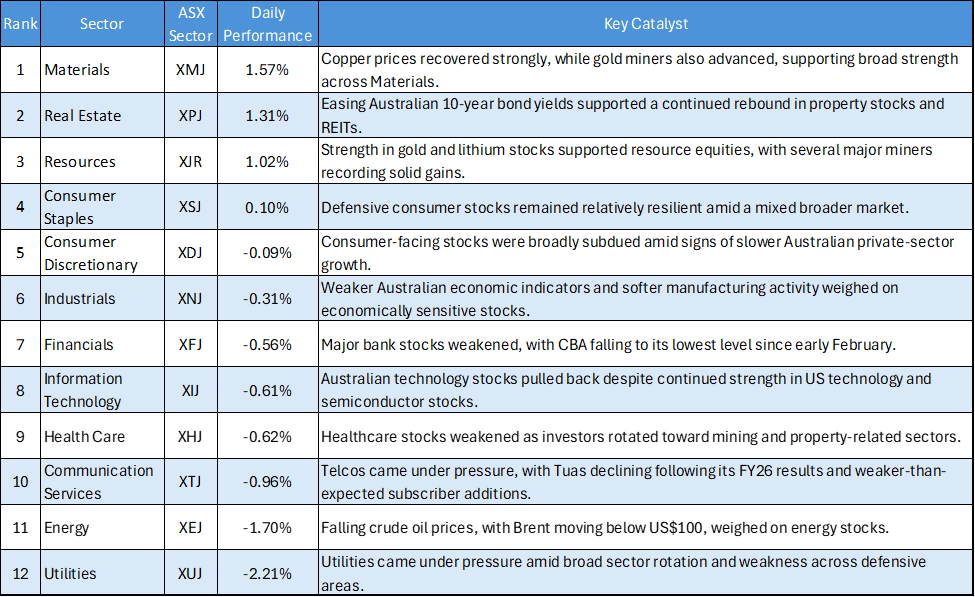
The Australian Equity market delivered a sharply divergent sector performance on 23 September 2026. Materials gained 1.57%, followed by Real Estate at 1.31% and Resources at 1.02%. Consumer Staples was the only other sector to finish higher, while eight sectors declined. The session marked a significant change in Leadership from the previous session, when Information Technology was the strongest-performing sector.
Daily ASX Sector Performance Summary
Materials Leads the Market
Materials recorded the strongest performance on 23 September, rising 1.57%. The sector moved clearly ahead of the other groups, establishing a sizeable lead over Real Estate and Resources.
The result represented a notable change in relative sector leadership compared with the previous session, when Information Technology surged 3.01% and Materials gained 0.70%. The latest performance therefore indicates a rotation toward Materials and resource-related areas of the market. The reference article similarly highlights the importance of monitoring changes in sector leadership and the spread between the strongest and weakest groups.
Real Estate ranked second with a 1.31% gain, while Resources advanced 1.02%. Together, the three leading sectors accounted for the strongest positive performances across the market, with each recording a gain of more than 1%.
Real Estate and Resources Also Strengthen
Real Estate delivered a strong 1.31% increase, placing it second among the twelve sectors. Resources followed with a 1.02% gain, reinforcing the strength across property- and resource-related areas.
Consumer Staples was the only other sector to finish higher, increasing 0.10%. Its modest gain contrasts with the much stronger performances of Materials, Real Estate and Resources, indicating that positive participation remained relatively concentrated.
Market Breadth Turns Negative
Only four of the twelve sectors recorded gains, while eight declined. This represented a deterioration in Market Breadth compared with the previous session, when seven sectors advanced and five declined.
Consumer Discretionary remained almost unchanged, slipping just 0.09%, while Industrials declined 0.31%. Financials fell 0.56%, and Information Technology declined 0.61%. The weakness in Information Technology was particularly notable because it had been the strongest sector in the previous session, gaining 3.01%.
Utilities and Energy Lead Declines
Utilities recorded the weakest performance, falling 2.21%. The sector moved to the bottom of the daily ranking, creating a substantial contrast with Materials at the top.
Energy also weakened significantly, declining 1.70%. Communication Services fell 0.96%, while Health Care declined 0.62%. Information Technology and Financials recorded smaller losses of 0.61% and 0.56%, respectively.
The difference between Materials and Utilities reached 3.78 percentage points, highlighting the substantial divergence across the twelve ASX sectors during the session.
Bottom Line
The Australian equity market delivered a strongly divergent sector performance on 23 September 2026. Materials led with a 1.57% gain, followed by Real Estate at 1.31% and Resources at 1.02%.
Only four of the twelve sectors advanced, indicating weaker market breadth than in the previous session. Consumer Staples posted a marginal gain, while Consumer Discretionary remained close to unchanged.
At the other end of the ranking, Utilities declined 2.21%, followed by Energy at 1.70% and Communication Services at 0.96%. The 3.78 percentage-point gap between Materials and Utilities highlights the significant divergence across the sector groups. Overall, the session was characterised by a pronounced rotation toward Materials, Real Estate and Resources, while Utilities and Energy came under substantial pressure.


 Nov 12, 2026





 Please wait processing your request...