
 CA
 NZ
 UK
 US
 IND

 AU

 Share
 X (Formerly Twitter)
 Whatsapp
 Facebook
 LinkedIn
 Telegram
 Email This Article
 Copy Link
 Summarize with AI
 Chat GPT
 Perplexity

Key Highlights
- Information Technology (XIJ) led the supplied sector indices, gaining 5.62% on 16 October 2026.
- Materials (XMJ) advanced 3.18%, while Resources (XJR) increased 2.65%.
- Healthcare (XHJ) rose 2.49%, supported by a recovery in healthcare shares.
- Consumer Discretionary (XDJ) gained 1.07%, and Industrials (XNJ) advanced 0.89%.
- Utilities (XUJ) increased 0.72%, while Communication Services (XTJ) was virtually unchanged, slipping 0.01%.
- Energy (XEJ) declined 0.26%, Real Estate (XPJ) fell 0.28%, and Financials (XFJ) lost 0.52%.
- Consumer Staples (XSJ) was the weakest supplied index, declining 0.53%.
- The 6.15-percentage-point gap between Information Technology and Consumer Staples highlighted a pronounced divergence in sector performance.
The Australian share market rebounded on 16 October, with the S&P/ASX 200 rising approximately 1.00% to 8,806.7 points. The supplied sector data showed a strong recovery in technology, materials and healthcare, reversing some of the pressure experienced in the previous session. However, financials and consumer staples declined, demonstrating that the market's recovery was uneven. Company-specific developments, renewed buying in technology and Mining shares, and improving sentiment across selected Growth Stocks helped support the advance.
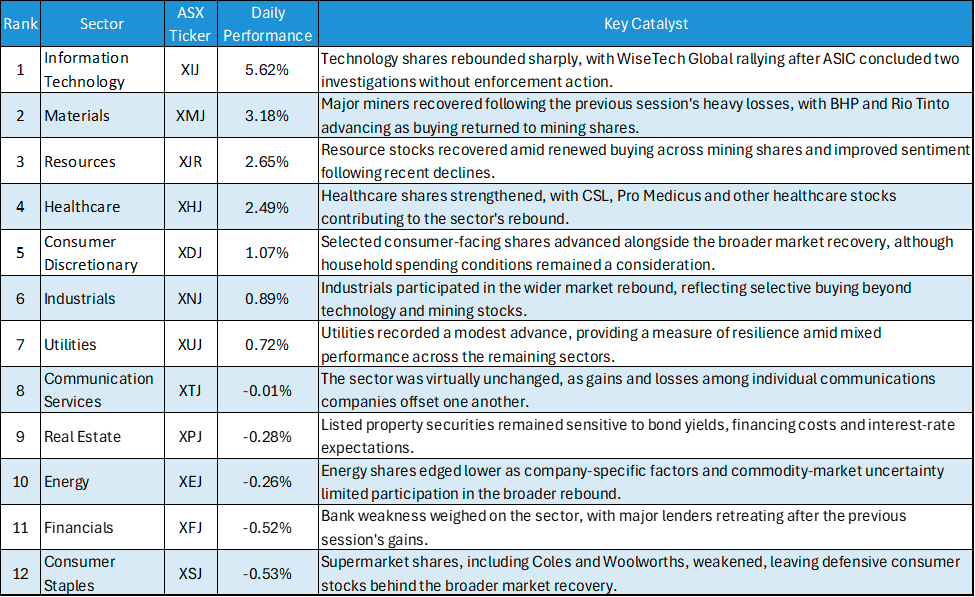
Daily ASX Sector Performance Summary
Information Technology and Materials Lead the Recovery
Information Technology was the strongest supplied index on 16 October, gaining 5.62%. The rebound followed a difficult session for technology shares and coincided with renewed buying in software and technology-related companies. WiseTech Global attracted particular attention after the Australian Securities and Investments Commission concluded its governance investigation and issued no-action letters in relation to its investigation involving the company's founder and two employees. The regulatory developments helped improve sentiment, although a separate investigation involving another individual remained ongoing.
Materials advanced 3.18%, while Resources gained 2.65%. Major mining companies participated in the recovery, with BHP and Rio Tinto rebounding after substantial losses in the previous session. The improvement suggested that investors were willing to return to selected resource stocks following the recent sell-off. However, the rebound did not eliminate concerns about Commodity demand, global economic conditions or the sustainability of technology-related investment. The simultaneous strength in technology and mining shares helped support the broader Australian market, although the supplied sector figures indicate that the recovery was not uniform.
Healthcare and Other Advancers Show Selective Strength
Healthcare rose 2.49%, making it the fourth-strongest supplied index. Gains in major healthcare companies, including CSL and Pro Medicus, supported the sector's performance. The advance indicated renewed interest in healthcare shares alongside technology and resources, broadening the sources of market support. Nevertheless, a single session of gains does not necessarily establish a sustained improvement in Earnings expectations or investor confidence.
Consumer Discretionary increased 1.07%, while Industrials advanced 0.89% and Utilities gained 0.72%. These positive performances suggested that buying extended beyond the leading technology and materials sectors. Consumer-facing companies and industrial businesses nevertheless remain exposed to household spending, economic growth and operating-cost pressures. Utilities recorded a smaller advance, while Communication Services was virtually unchanged, slipping 0.01%. The relatively modest movements in these sectors contrasted with the stronger rebounds in technology, materials and healthcare.
Real Estate declined 0.28%, while Energy slipped 0.26%. The relatively small losses indicated limited weakness rather than a severe sector-wide sell-off. Listed property securities remain sensitive to borrowing costs and bond yields, while energy companies continue to face fluctuations in commodity prices and Demand expectations. Their underperformance suggests that the market recovery did not extend equally to all interest-rate-sensitive and commodity-linked businesses.
Financials and Consumer Staples Remain Under Pressure
Financials declined 0.52%, reversing part of the previous session's advance. Weakness among major banks weighed on the sector despite the broader market recovery. Bank earnings expectations, funding costs and changing interest-rate forecasts remain important influences on investor sentiment. The sector's negative performance also demonstrated that the market's rebound was not broad enough to lift all major industries.
Consumer Staples was the weakest supplied index, falling 0.53%. Shares in major supermarket operators, including Coles and Woolworths, were among the companies weighing on the sector. The decline was notable because consumer staples are often regarded as defensive investments during periods of market uncertainty. However, defensive characteristics do not prevent share prices from falling when investors reassess valuations, earnings prospects or sector-specific competitive pressures.
Bottom Line
The 16 October 2026 session revealed a strong but uneven recovery across the supplied ASX sector indices. Information Technology led with a 5.62% gain, followed by Materials at 3.18% and Resources at 2.65%. Healthcare also advanced strongly, while Financials and Consumer Staples recorded modest losses. The 6.15-percentage-point difference between the strongest and weakest sectors highlighted continued divergence in market leadership. Investors are likely to remain focused on technology-sector sentiment, regulatory developments, commodity demand, bank earnings and interest-rate expectations when assessing whether the recovery can be sustained.


 Nov 12, 2026





 Please wait processing your request...