
 CA
 NZ
 UK
 US
 IND

 AU

 Share
 X (Formerly Twitter)
 Whatsapp
 Facebook
 LinkedIn
 Telegram
 Email This Article
 Copy Link
 Summarize with AI
 Chat GPT
 Perplexity

Key Highlights
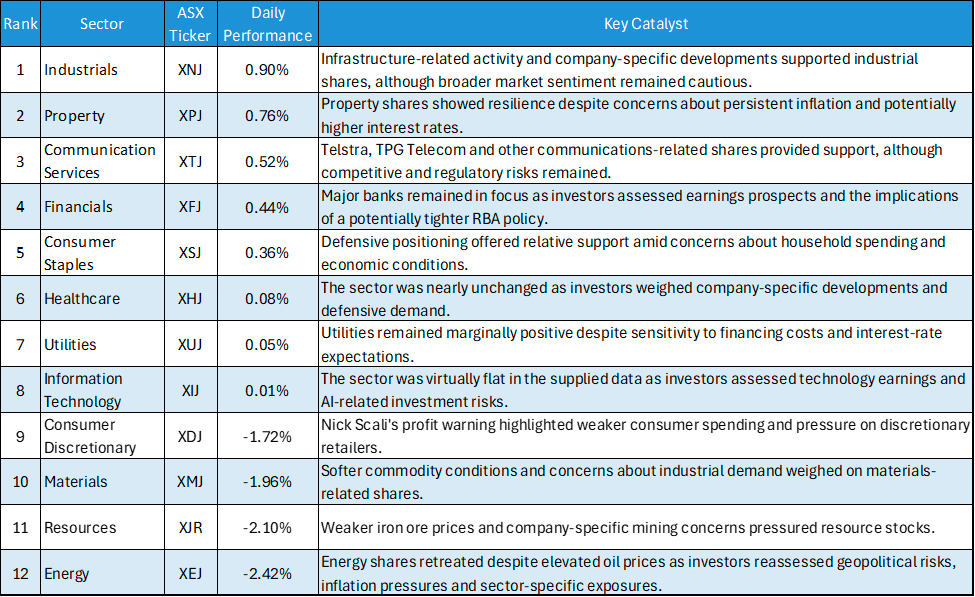
- Industrials (XNJ) led the supplied sector indices, gaining 0.90% on 22 October 2026, followed by Property (XPJ), which advanced 0.76%.
- Communication Services (XTJ) rose 0.52%, while Financials (XFJ) gained 0.44%, providing support amid broader market weakness.
- Consumer Staples (XSJ) increased 0.36%, while Healthcare (XHJ), Utilities (XUJ) and Information Technology (XIJ) recorded marginal gains.
- Consumer Discretionary (XDJ) fell 1.72%, while Materials (XMJ) declined 1.96% and Resources (XJR) dropped 2.10%.
- Energy (XEJ) was the weakest supplied index, falling 2.42%, highlighting substantial pressure across commodity-linked sectors.
Australian shares faced renewed pressure on 22 October as investors weighed Inflation concerns, corporate Earnings and weakness across several cyclical industries. The supplied sector data showed a clear divergence: Industrials, Property and Communication Services advanced, while Consumer Discretionary, Materials, Resources and Energy recorded substantial losses. News reporting highlighted a difficult trading environment, including a sharp sell-off in furniture retailer Nick Scali following a profit warning, falling iron ore prices and continued uncertainty surrounding inflation and interest rates. The performance pattern indicated selective strength rather than a broad-based market advance.
Daily ASX Sector Performance Summary
Industrials, Property and Communication Services Lead
Industrials was the strongest supplied index, gaining 0.90%. The sector's advance contrasted with weakness in commodity-sensitive industries, suggesting that investors continued to distinguish between individual Business prospects rather than selling all cyclical shares indiscriminately. Infrastructure activity and company-specific developments provided potential support, although the broader economic outlook remained uncertain.
Property advanced 0.76%, an unexpected point of resilience given continuing concerns about borrowing costs and the possibility of tighter monetary policy. The Reserve Bank of Australia's warning that the inflation outlook had deteriorated increased attention on the potential for another interest-rate increase. Higher financing costs can affect property valuations, refinancing conditions and development activity, making the sector's positive daily performance insufficient on its own to establish a sustained recovery.
Communication Services gained 0.52%, while Financials advanced 0.44%. Communications shares benefited from support among established telecommunications businesses, while major banks remained important contributors to market sentiment. However, the outlook for financial stocks remains sensitive to Credit quality, funding costs and borrower resilience. Persistent inflation could complicate the operating environment for both sectors.
Consumer Weakness and Commodity Pressure Weigh on Performance
Consumer Staples rose 0.36%, while Healthcare and Utilities recorded small gains of 0.08% and 0.05%, respectively. Information Technology was virtually unchanged at +0.01%. These modest results suggest relative stability rather than strong sector-wide buying interest.
Consumer Discretionary fell 1.72%, with Nick Scali's profit warning providing a prominent example of pressure on household-facing businesses. The furniture retailer warned that first-half net profit would fall short of the previous year's result as consumers remained cautious. The announcement highlighted how reduced discretionary spending can affect retailers even when broader market conditions appear relatively stable.
Materials declined 1.96%, while Resources dropped 2.10%. Softer iron ore prices and concerns about commodity Demand contributed to the challenging backdrop. Performance within these sectors can vary considerably according to individual commodity exposures, production costs, operational delivery and demand from China. Investors therefore need to distinguish between broad sector weakness and company-specific developments.
Energy recorded the largest decline, falling 2.42%, despite elevated international oil prices. This divergence illustrates that sector returns do not necessarily move in line with headline commodity prices. Equity valuations can also reflect production expectations, operating costs, geopolitical uncertainty and broader risk appetite.
Bottom Line
The 22 October 2026 session showed substantial divergence across Australian sectors. Industrials led with a 0.90% gain, followed by Property and Communication Services, while Energy, Resources and Materials suffered the largest declines. Consumer Discretionary also weakened as Nick Scali's profit warning highlighted pressure on household spending. The performance spread between the strongest and weakest supplied indices reached 3.32 percentage points, indicating pronounced sector-level divergence. Investors should monitor RBA policy expectations, commodity prices, consumer demand and upcoming corporate earnings to assess whether the weakness in resources and discretionary shares persists. The relative resilience of industrials, property and communications warrants attention, but one session is insufficient to confirm a durable change in market leadership.


 Nov 12, 2026





 Please wait processing your request...