
 CA
 NZ
 UK
 US
 IND

 AU

 Share
 X (Formerly Twitter)
 Whatsapp
 Facebook
 LinkedIn
 Telegram
 Email This Article
 Copy Link
 Summarize with AI
 Chat GPT
 Perplexity

Key Highlights
- Healthcare (XHJ) gained 1.49%, recording the strongest performance among the twelve ASX sectors.
- Utilities (XUJ) advanced 1.17%, while Financials (XFJ) rose 1.16%.
- Consumer Staples (XSJ) increased 0.83%, supported by continued defensive positioning.
- Real Estate (XPJ) gained 0.57%, while Communication Services (XTJ) advanced 0.32%.
- Materials (XMJ) declined 1.34%, recording the weakest performance among the sectors.
- Resources (XJR) fell 1.28%, while Information Technology (XIJ) declined 0.74%.
- Energy (XEJ) and Industrials (XNJ) also finished lower, declining 0.22% and 0.19%, respectively.
- The gap between the strongest and weakest sectors reached 2.83 percentage points.
The Australian Equity market recorded a mixed sector performance on 28 September 2026, with defensive and financial sectors leading the advance while commodity-related sectors came under pressure. The performance showed a notable divergence between Healthcare, Utilities and Financials on the positive side and Materials and Resources on the negative side.
Daily ASX Sector Performance Summary
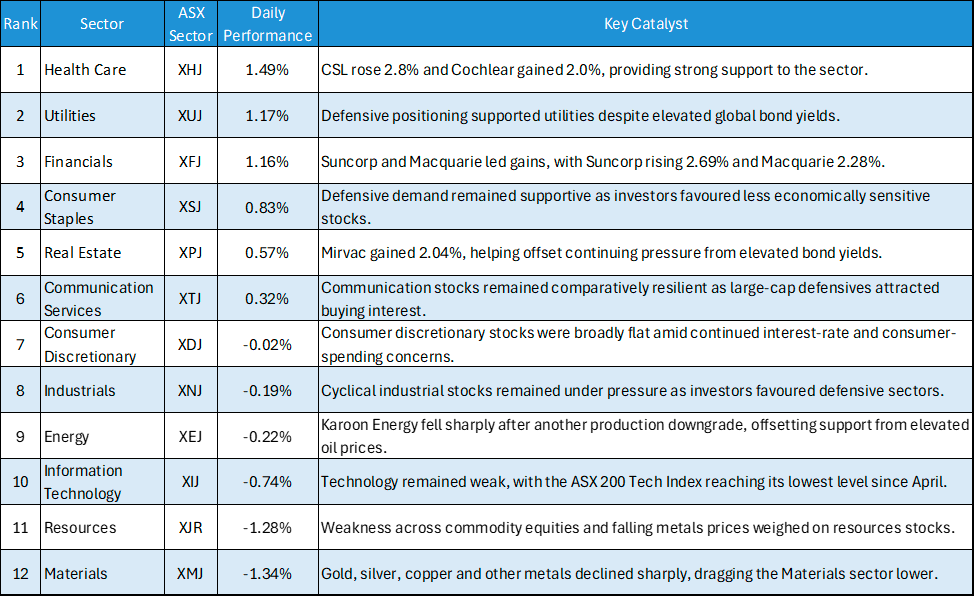
Healthcare, Utilities and Financials Lead the Gains
Healthcare was the strongest-performing sector on 28 September, gaining 1.49%. The sector received significant support from large-cap stocks, with CSL rising 2.8% and Cochlear gaining 2.0%. CSL's advance extended its strong recovery from its June low, while Cochlear reached its highest closing level since April.
Utilities also performed strongly, advancing 1.17%. The gain reflected the broader defensive tone of the market, with investors favouring relatively defensive sectors while Commodity and technology stocks weakened.
Financials rose 1.16%, with several major financial companies contributing to the advance. Suncorp gained 2.69%, while Macquarie Group increased 2.28%. The sector's strength helped offset weakness elsewhere in the market and reinforced the relatively strong performance of large-cap financial stocks.
Consumer Staples gained 0.83%, while Real Estate and Communication Services advanced 0.57% and 0.32%, respectively. The broad strength across these sectors indicated that buying interest was not limited to a single defensive group.
Materials and Resources Lead the Declines
Materials recorded the largest decline, falling 1.34%. The sector came under pressure as several major metals weakened during the session, including gold, silver, copper, palladium and platinum. The weakness in metals prices weighed on Mining and materials companies and contributed to the sector's underperformance.
Resources also declined 1.28%, reflecting broader weakness across commodity-related equities. Northern Star Resources attracted attention after receiving a $27 per share Takeover proposal from Gold Fields, representing a reported 22% premium to its previous close. Despite the positive corporate development for Northern Star, broader weakness in metals markets weighed on the resources complex.
Information Technology fell 0.74%, with the technology index extending its recent weakness. The ASX 200 Technology Index reached its lowest level since April, highlighting continued pressure across the technology segment.
Energy declined 0.22% despite elevated oil prices. Karoon Energy fell sharply after reducing its 2026 production guidance for the second time in four months, illustrating the impact of company-specific operational concerns within the sector.
Bottom Line
The Australian equity market displayed a clear divergence between defensive sectors and commodity-related stocks on 28 September 2026. Healthcare led the market with a 1.49% gain, followed by Utilities at 1.17% and Financials at 1.16%.
At the other end of the ranking, Materials declined 1.34%, followed by Resources at 1.28% and Information Technology at 0.74%. The 2.83 percentage-point gap between Healthcare and Materials highlighted the significant difference in sector performance during the session.
Overall, the session was characterised by strong performance from Healthcare, Utilities, Financials and Consumer Staples, while falling metals prices, weakness in technology and company-specific energy developments weighed on several sectors. The performance highlighted continued sector rotation within the Australian equity market, with defensive and large-cap areas attracting stronger buying interest than commodity-sensitive segments.


 Nov 12, 2026





 Please wait processing your request...