
 CA
 NZ
 UK
 US
 IND

 AU

 Share
 X (Formerly Twitter)
 Whatsapp
 Facebook
 LinkedIn
 Telegram
 Email This Article
 Copy Link
 Summarize with AI
 Chat GPT
 Perplexity

Key Highlights
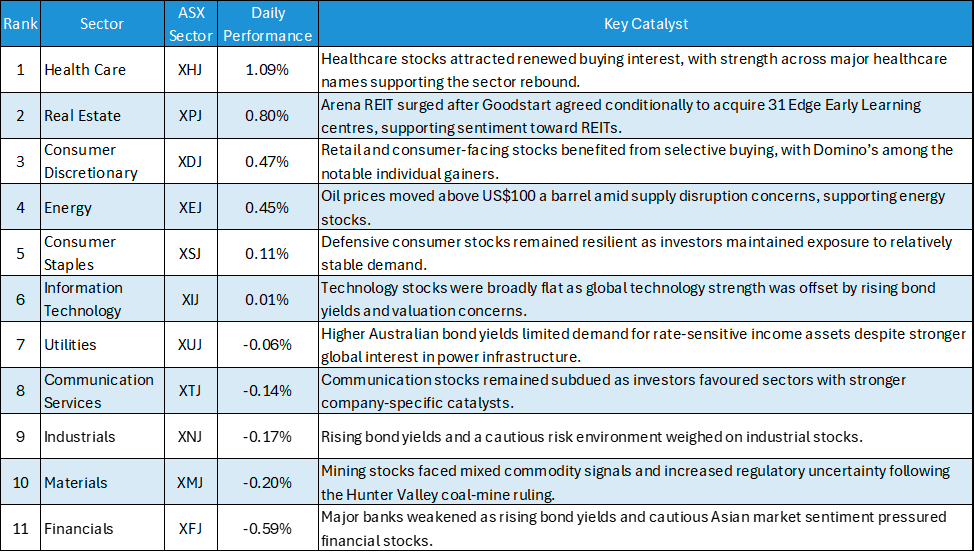
- Health Care (XHJ) gained 1.09%, recording the strongest performance among the twelve sectors.
- Real Estate (XPJ) advanced 0.80%, supported by renewed strength across REITs.
- Consumer Discretionary (XDJ) rose 0.47%, while Energy (XEJ) increased 0.45%.
- Consumer Staples (XSJ) edged 0.11% higher and Information Technology (XIJ) gained just 0.01%.
- Utilities (XUJ), Communication Services (XTJ), Industrials (XNJ), Materials (XMJ) and Financials (XFJ) all declined.
- Financials fell 0.59%, making it the weakest-performing sector in the supplied dataset.
- The gap between the strongest and weakest sectors reached 1.68 percentage points.
- The mixed sector performance reflected continued rotation, with investors favouring Health Care and selected defensive and property stocks while reducing exposure to banks and materials.
The Australian Equity market delivered a mixed sector performance on 7 October 2026, with Health Care and Real Estate leading the advance while Financials and Materials came under pressure. The session reflected a more selective market environment, with only six of the twelve sectors recording gains.
The divergence was relatively moderate compared with the previous session, but the Leadership change was notable. Health Care emerged as the strongest sector, while Financials moved to the bottom of the ranking. Rising bond yields, higher oil prices and stock-specific developments contributed to a cautious backdrop for cyclical sectors.
Daily ASX Sector Performance Summary
Health Care Leads as Investors Return to Defensive Growth
Health Care was the strongest-performing sector on 7 October, gaining 1.09% and moving clearly ahead of the rest of the market. The sector's performance indicated renewed investor interest in healthcare companies following recent volatility.
The strength was supported by gains across several major healthcare names, including Telix Pharmaceuticals and other large companies. Healthcare stocks benefited from their combination of defensive characteristics and company-specific growth opportunities, making the sector attractive while financial and commodity-linked areas weakened.
The leadership of Health Care also represented an important shift from the previous session, when Real Estate had been the strongest sector. The move suggests that investors remained selective rather than committing broadly to a single market theme.
Real Estate Maintains Strong Momentum
Real Estate advanced 0.80%, ranking second among the twelve sectors. The sector continued to benefit from renewed interest in REITs, with company-specific developments providing an additional catalyst.
Arena REIT was one of the market's strongest individual performers after Goodstart Early Learning conditionally agreed to acquire 31 centres operated by Edge Early Learning. Twenty of those centres are located in properties owned by Arena REIT. The development provided greater visibility around the future of a significant portion of Arena's Edge-related property exposure.
The broader property sector nevertheless remains sensitive to Australian bond yields. With longer-term yields remaining elevated, sustained sector momentum will depend on whether investors continue to look beyond higher financing costs and focus on valuations and rental income.
Consumer Discretionary and Energy Add to the Advance
Consumer Discretionary gained 0.47%, supported by selective buying across consumer-facing companies. Domino's Pizza Enterprises was among the notable individual gainers, helping reinforce the sector's positive performance.
Energy also advanced 0.45% as Crude Oil prices remained above US$100 a barrel. Supply disruption concerns linked to geopolitical tensions and production risks provided support for oil prices, improving the near-term backdrop for Australian energy producers.
However, higher oil prices also present a broader inflationary risk. If elevated energy prices persist, they could contribute to higher Inflation expectations and complicate the interest-rate outlook, creating an offsetting risk for rate-sensitive sectors.
Financials and Materials Weigh on the Market
Financials was the weakest sector, declining 0.59%. Major banks came under pressure as rising Australian bond yields and cautious regional sentiment weighed on the sector. Higher yields can also influence expectations for borrowing costs, Credit growth and household demand.
Materials declined 0.20%, with Mining stocks facing a combination of weaker sentiment and company-specific pressures. The High Court ruling against the expansion of the Mount Pleasant coal mine in the Hunter Valley introduced additional regulatory uncertainty for Australia's coal industry and potentially other future mining developments.
Resources were also affected by mixed Commodity signals, although uranium-related stocks performed strongly following Google's major long-term nuclear power agreement. This helped highlight the significant divergence within the broader resources complex.
Technology and Other Sectors Remain Mixed
Information Technology was virtually unchanged, gaining only 0.01%. The subdued result contrasted with strong recent gains in global technology markets. Rising bond yields continued to create valuation pressure for long-duration growth stocks, while investor attention remained focused on the sustainability of AI-related investment.
Utilities slipped 0.06% despite strong global interest in nuclear power and electricity infrastructure. Communication Services and Industrials also declined modestly, while Consumer Staples gained 0.11%, reflecting the continued appeal of relatively defensive businesses.
The narrow movements across these sectors suggest that investors were not making an aggressive market-wide rotation, but instead were reallocating selectively toward sectors with stronger individual catalysts.
Bottom Line
The Australian equity market delivered a mixed sector performance on 7 October 2026, with Health Care rising 1.09% to become the strongest-performing sector, followed by Real Estate at 0.80% and Consumer Discretionary at 0.47%.
Energy also gained as oil prices remained elevated, while Consumer Staples and Information Technology recorded only marginal increases. At the other end of the ranking, Financials declined 0.59%, followed by Materials at 0.20% and Industrials at 0.17%.
The 1.68-percentage-point gap between Health Care and Financials was considerably narrower than the previous session's extreme sector dispersion. Nevertheless, the contrasting performance confirms that sector rotation remains an important feature of the Australian market.
Overall, investors appeared to favour healthcare, property and selected consumer and energy stocks while reducing exposure to banks and materials. The market therefore remained selective, with company-specific catalysts and changing bond-yield and commodity conditions continuing to influence sector leadership.


 Nov 12, 2026





 Please wait processing your request...