
 CA
 NZ
 UK
 US
 IND

 AU

 Share
 X (Formerly Twitter)
 Whatsapp
 Facebook
 LinkedIn
 Telegram
 Email This Article
 Copy Link
 Summarize with AI
 Chat GPT
 Perplexity

Key Highlights
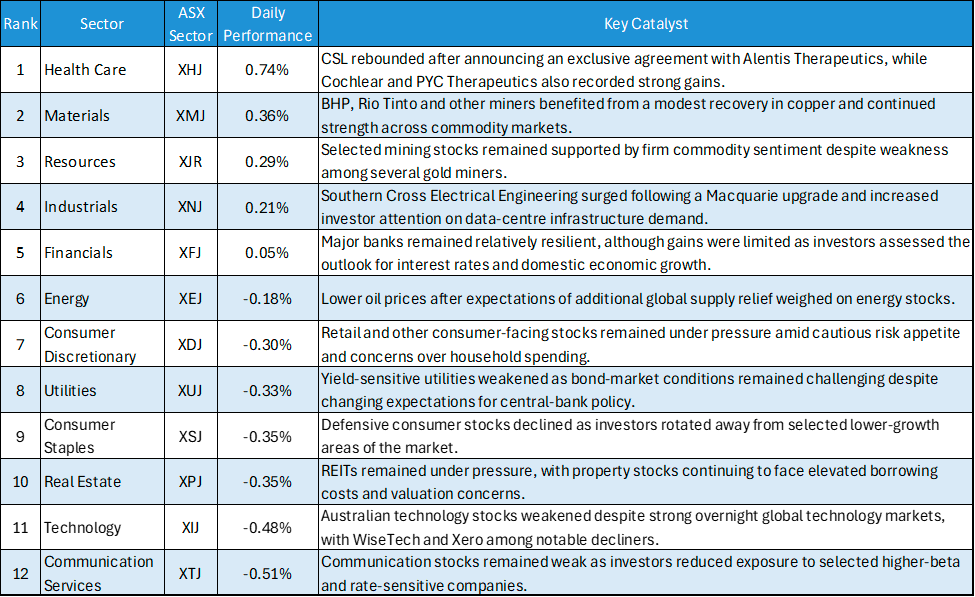
- Health Care (XHJ) gained 0.74%, recording the strongest performance among the twelve ASX sectors.
- Materials (XMJ) rose 0.36%, while Resources (XJR) advanced 0.29%.
- Industrials (XNJ) and Financials (XFJ) also finished higher, although their gains were limited to 0.21% and 0.05%.
- Six sectors declined, with Consumer Discretionary (XDJ) falling 0.88% to record the weakest performance.
- Communication Services (XTJ) and Technology (XIJ) also remained under pressure, declining 0.51% and 0.48%, respectively.
- The gap between the strongest and weakest sectors reached 1.62 percentage points.
- Health Care strength was supported by gains in major companies, while weakness in retailers, technology stocks and property-related names weighed on market breadth.
The Australian Equity market delivered a mixed performance on 5 October 2026, with the strongest gains concentrated in Health Care, Materials and Industrials while several growth-oriented and consumer-facing sectors declined. The S&P/ASX 200 finished almost unchanged, highlighting a cautious session in which investors continued to rotate between sectors rather than establish a broad market direction.
Daily ASX Sector Performance Summary
Health Care Leads as CSL Rebounds
Health Care was the strongest-performing sector on 5 October, gaining 0.74% and outperforming every other sector in the supplied dataset. The advance was supported by gains among several major healthcare companies, helping the sector recover after recent weakness.
CSL was a particularly important contributor after announcing an exclusive agreement with Swiss biotechnology company Alentis Therapeutics to co-develop a treatment targeting rare kidney and liver diseases. The agreement included an initial payment of US$355 million to Alentis and helped CSL rebound after declining during the previous two sessions.
Cochlear and PYC Therapeutics also recorded strong gains, providing additional support to the sector. The combination of company-specific catalysts and renewed buying interest helped Health Care maintain its position as the strongest area of the market.
Materials and Resources Maintain Relative Strength
Materials rose 0.36%, while Resources advanced 0.29%, making commodity-linked sectors the next strongest areas of the market. BHP, Rio Tinto and other major Mining companies benefited from a modest recovery in copper prices and continued investor interest in resource equities.
However, the performance was not uniform across the mining complex. Some gold producers retreated as the gold price declined and the US dollar remained firm. This divergence indicates that investors continued to distinguish between individual commodities rather than applying a broad bullish view across the entire resources sector.
The relative strength of Materials and Resources nevertheless suggests that Commodity exposure remained attractive despite the cautious overall market environment.
Industrials and Financials Edge Higher
Industrials gained 0.21%, with Southern Cross Electrical Engineering standing out after receiving a positive Macquarie broker upgrade. The company also benefited from growing attention surrounding data-centre infrastructure investment, providing a company-specific catalyst for the sector.
Financials increased just 0.05%, indicating a much more subdued recovery. Major banks remained relatively resilient, but investors continued to assess the implications of interest rates, domestic economic conditions and household borrowing costs.
The limited gain suggests that financial stocks were supported by defensive positioning rather than strong sector-wide momentum.
Technology, Consumer and Property Sectors Under Pressure
Technology declined 0.48%, despite a stronger overnight performance from US technology stocks. Australian technology shares therefore failed to maintain the positive momentum seen in global markets, with several major companies experiencing renewed selling pressure.
Communication Services was even weaker, falling 0.51%, while Consumer Discretionary declined 0.30%. Retailers and other consumer-facing businesses remained vulnerable to concerns over household spending and the broader economic outlook.
Real Estate also fell 0.35%, extending its period of relative weakness. REITs remained sensitive to borrowing costs and bond yields, while concerns over property valuations continued to restrict investor demand.
Energy declined 0.18% as oil prices weakened following expectations of additional Supply relief. Utilities and Consumer Staples also fell, demonstrating that defensive sectors did not provide consistent protection during the session.
Bottom Line
The Australian equity market remained broadly mixed on 5 October 2026, with Health Care leading the sector rankings after rising 0.74%. Materials, Resources and Industrials also advanced, but the gains were modest and failed to establish a broad-based market rally.
At the other end of the ranking, Consumer Discretionary fell 0.88%, followed by Communication Services and Technology. The 1.62-percentage-point gap between Health Care and Consumer Discretionary highlights a relatively narrow range of sector dispersion compared with previous volatile sessions.
The market therefore remained characterised by selective rotation rather than a clear directional trend. Health Care and commodity-related sectors showed the strongest relative momentum, while Technology, Consumer Discretionary, Communication Services and Real Estate remained areas of weakness.


 Nov 12, 2026





 Please wait processing your request...