
 CA
 NZ
 UK
 US
 IND

 AU

 Share
 X (Formerly Twitter)
 Whatsapp
 Facebook
 LinkedIn
 Telegram
 Email This Article
 Copy Link
 Summarize with AI
 Chat GPT
 Perplexity

Key Highlights
- Financials Lead the Market: Financials (XFJ) gained 1.42%, recording the strongest performance among the twelve ASX sectors.
- Health Care Also Advances: Health Care (XHJ) rose 0.98%, ranking second among the advancing sectors.
- Real Estate and Industrials Strengthen: Real Estate (XPJ) increased 0.65%, while Industrials (XNJ) advanced 0.57%.
- Only Four Sectors Finish Higher: Four of the twelve sectors recorded positive performances, while eight declined.
- Consumer Staples and Communication Services Remain Stable: Both XSJ and XTJ declined only 0.03%.
- Resource-Related Sectors Weaken: Materials (XMJ) fell 0.38%, while Resources (XJR) declined 0.62%.
- Information Technology Comes Under Pressure: Information Technology (XIJ) fell 0.98%.
- Energy Records the Largest Decline: Energy (XEJ) dropped 1.10%, making it the weakest-performing sector of the session.
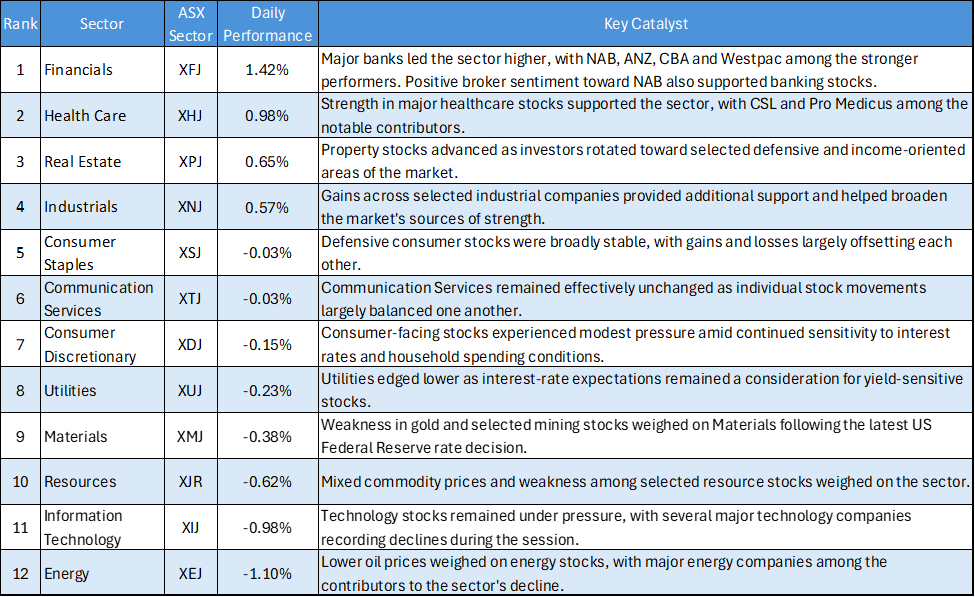
The Australian Equity market delivered a mixed sector performance on 17 September 2026. Financials recorded the strongest gain at 1.42%, followed by Health Care at 0.98%, Real Estate at 0.65% and Industrials at 0.57%. In contrast, eight of the twelve sectors finished lower, highlighting the relatively narrow breadth behind the market's advance.
The performance showed a clear divergence between Financials and several cyclical and growth-oriented sectors. While the banking sector attracted strong buying interest, Energy, Information Technology and resource-related sectors remained under pressure.
Daily ASX Sector Performance Summary
Financials Lead the Market
Financials recorded the strongest performance on 17 September, gaining 1.42%. The sector was significantly ahead of the broader market and represented the clearest source of upward momentum during the session.
Major Australian banks were particularly strong. NAB, ANZ, Commonwealth Bank and Westpac all advanced, with NAB recording the strongest gain among the major banks. Positive broker sentiment toward NAB also helped support the banking sector.
The strength in Financials was notable given the broader global interest-rate environment. The sector nevertheless attracted substantial buying interest, helping offset weakness in several other major areas of the Australian market.
The strong performance of Financials also had a meaningful influence on the broader market because banks represent a substantial component of the Australian equity market.
Health Care Provides Additional Support
Health Care was the second-best-performing sector, gaining 0.98%. The sector benefited from gains across several major healthcare companies, providing another significant source of strength alongside Financials.
CSL and Pro Medicus were among the notable contributors. The positive performance across major healthcare stocks helped the sector maintain its position near the top of the daily ranking.
The strength in Health Care also meant that the market's gains were not exclusively concentrated in Financials. However, the relatively small number of advancing sectors indicates that overall Market Breadth remained limited.
Real Estate and Industrials Advance
Real Estate gained 0.65%, making it the third-strongest sector of the session. The advance added another source of support to the broader market despite the continuing sensitivity of property stocks to interest rates and bond yields.
Industrials followed with a 0.57% gain. The sector's positive performance provided additional breadth and helped offset declines across Energy, Information Technology and resource-related sectors.
Together, Financials, Health Care, Real Estate and Industrials accounted for the main areas of positive sector momentum during the session.
Market Breadth Remains Narrow
The defining feature of the 17 September session was the limited breadth of the sector advance. Only four of the twelve sectors recorded gains, while eight declined.
Consumer Staples and Communication Services were effectively unchanged, each declining just 0.03%. Consumer Discretionary fell 0.15%, while Utilities declined 0.23%.
The difference between the strongest and weakest sectors was also substantial. Financials gained 1.42%, while Energy declined 1.10%, producing a 2.52 percentage-point gap between the two extremes.
This distribution indicates that the market's positive performance was driven primarily by selected sectors rather than broad-based buying across the Australian equity market.
Resource-Related Sectors Remain Under Pressure
Materials declined 0.38%, while Resources fell 0.62%. Both sectors underperformed the stronger areas of the market despite the positive performance of Financials and Health Care.
Weakness in gold-related stocks contributed to pressure across Materials, while mixed Commodity prices weighed on the broader Resources sector.
The performance also demonstrates that commodity-related sectors were not moving uniformly. Energy recorded the largest sector decline, while Materials and Resources also finished lower.
Information Technology Declines
Information Technology fell 0.98%, making it one of the weakest-performing sectors during the session.
The decline reflected weakness among several major technology stocks. Xero fell 1.34%, WiseTech Global declined 1.18%, Macquarie Technology Group dropped 1.11%, and Nextdc fell 2.90%.
The performance of these companies contributed to the broader weakness in Information Technology and created a significant contrast with the strong gains recorded by Financials and Health Care.
The sector's decline also meant that the latest market advance lacked broad participation from growth-oriented technology stocks.
Energy Records the Largest Decline
Energy was the weakest-performing sector on 17 September, falling 1.10%. The decline came as lower oil prices weighed on major energy companies.
Santos and Woodside Energy were among the energy stocks under pressure during the session. The weakness in these large companies contributed to Energy finishing at the bottom of the twelve-sector ranking.
The sector's decline was particularly notable given its previous sensitivity to oil prices and geopolitical developments. The latest performance indicates that commodity-price movements remained an important driver of sector-level performance.
Bottom Line
The Australian equity market delivered a narrow and uneven sector performance on 17 September 2026. Financials led the market with a 1.42% gain, followed by Health Care at 0.98%, Real Estate at 0.65% and Industrials at 0.57%.
Only four of the twelve sectors advanced, while eight declined or remained close to unchanged. Financials and Health Care provided the primary sources of upward momentum, while Real Estate and Industrials added further support.
At the opposite end of the ranking, Energy declined 1.10%, followed by Information Technology at 0.98%, Resources at 0.62% and Materials at 0.38%. The 2.52 percentage-point gap between Financials and Energy highlights the significant divergence across sectors.
Overall, the latest sector performance reflects a selective market advance rather than broad-based strength. Financials and Health Care were the main sources of positive momentum, while Energy, Information Technology and resource-related sectors remained under pressure.


 Nov 12, 2026





 Please wait processing your request...