
 CA
 NZ
 UK
 US
 IND

 AU

 Share
 X (Formerly Twitter)
 Whatsapp
 Facebook
 LinkedIn
 Telegram
 Email This Article
 Copy Link
 Summarize with AI
 Chat GPT
 Perplexity

Key Highlights
- Financials (ASX:XFJ) led the supplied sector indices, rising 1.86%, as major banks rebounded and investors rotated back into financial shares.
- Real Estate (ASX:XPJ) gained 1.84%, supported by a broad advance in property stocks despite expectations of another Reserve Bank of Australia rate increase.
- Energy (ASX:XEJ) rose 1.36%, while Communication Services (ASX:XTJ) added 0.94% and Utilities (ASX:XUJ) advanced 0.76%.
- Consumer Discretionary (ASX:XDJ) was the weakest sector, falling 1.98%, as soft retail updates and household-spending concerns weighed on consumer-facing shares.
- Consumer Staples (ASX:XSJ) dropped 1.77% and Information Technology (ASX:XIJ) declined 1.11%, while seven of the 12 supplied sector indices finished higher.
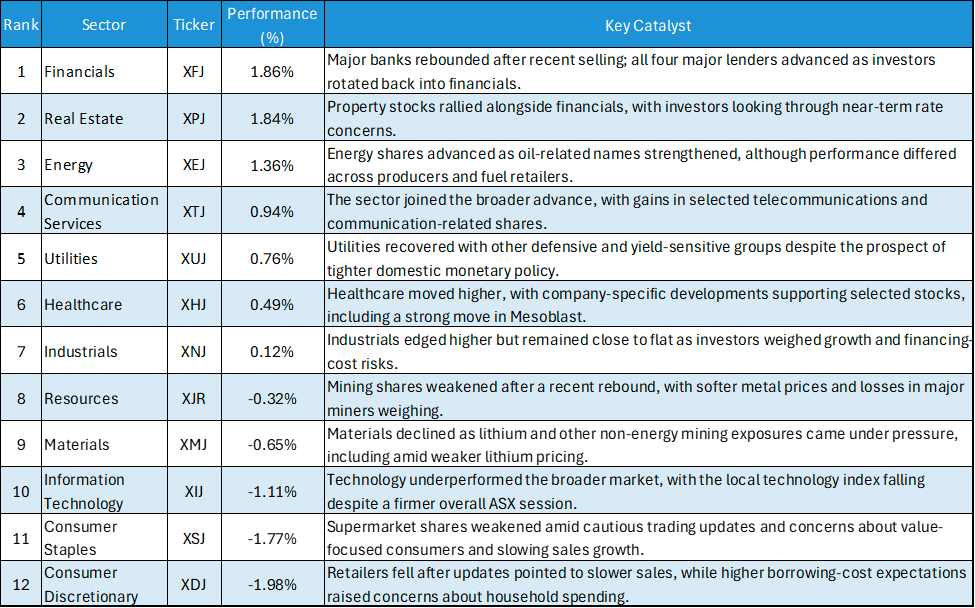
Australian equities advanced on 29 October as strong gains in financials and real estate helped the broader market shrug off concerns about elevated Inflation and a potential Reserve Bank of Australia rate increase. The sector performance was uneven: banks, property, energy and communication services rose, while consumer-facing shares and technology lagged. The 3.84-percentage-point gap between the strongest and weakest supplied indices highlighted a pronounced rotation beneath the market’s overall gain.
Daily ASX Sector Performance Summary
Financials and Real Estate Lead the Advance
Financials was the strongest supplied sector, rising 1.86% as investors returned to bank shares after recent selling. The four major banks all advanced, helping the financial sector provide the largest contribution to the broader market’s gain. The move came despite a sharp increase in expectations for another RBA rate rise after inflation data surprised to the upside. The session’s recovery suggests that investors were willing to re-enter financials, although the outlook remains sensitive to policy expectations and upcoming economic releases.
Real Estate followed closely with a 1.84% gain. Property shares advanced alongside banks, indicating that investors were prepared to look beyond the immediate rate-hike risk. The move also contrasted with the pressure typically placed on rate-sensitive property valuations when borrowing costs rise. Energy gained 1.36%, while Communication Services and Utilities added 0.94% and 0.76%, respectively. Healthcare rose 0.49%, supported by stock-specific strength, including a sharp advance in Mesoblast following positive company developments. Industrials edged 0.12% higher, leaving its performance close to flat.
Consumer Sectors Face Pressure as Rate Risks Persist
Consumer Discretionary was the weakest supplied sector, falling 1.98%, as several retailers reported slower sales growth and shoppers continued to focus on value. Wesfarmers, JB Hi-Fi and Super Retail Group were among the names under pressure after trading updates pointed to softer demand. Higher interest-rate expectations added to concerns about household budgets and discretionary spending, particularly ahead of key seasonal sales periods.
Consumer Staples declined 1.77%, with supermarket shares also weaker. Woolworths and Coles came under pressure despite updates indicating continued sales activity, as investors assessed consumer sensitivity to prices and the cost-of-living environment. The weakness across both consumer groups suggests that concerns about household spending were more influential than the broader market’s advance. Information Technology fell 1.11%, making it the third-weakest supplied sector, while Materials lost 0.65% and Resources slipped 0.32% as Mining shares retreated after a recent rebound and lithium pricing remained under pressure.
Market Gains Mask a Divided Sector Picture
The sector spread shows that Thursday’s advance was not broad-based. Financials and Real Estate drove the gains, supported by recoveries in Energy, Communication Services, Utilities and Healthcare. By contrast, consumer-facing sectors continued to weaken, while technology and mining-related shares also finished lower. This divergence points to selective rotation rather than uniform risk appetite. Investors appear to be balancing opportunities in banks and property against the risks of persistent inflation, a possible RBA rate increase and signs of more cautious consumer behaviour.
Bottom Line
The 29 October session was led by Financials, up 1.86%, and Real Estate, up 1.84%, with Energy adding 1.36%. Consumer Discretionary was the weakest sector at -1.98%, followed by Consumer Staples at -1.77% and Information Technology at -1.11%. The results indicate a strong rebound in banks and property alongside continued pressure on consumer-facing stocks. Investors will be watching RBA communications, inflation indicators, retail updates and Commodity prices to assess whether this rotation persists. One session alone, however, does not establish a durable sector trend.


 Nov 12, 2026





 Please wait processing your request...