
 CA
 NZ
 UK
 US
 IND

 AU

 Share
 X (Formerly Twitter)
 Whatsapp
 Facebook
 LinkedIn
 Telegram
 Email This Article
 Copy Link
 Summarize with AI
 Chat GPT
 Perplexity

Key Highlights
- Financials (XFJ) led the twelve supplied sector indices, gaining 1.56% on 12 October 2026.
- Materials (XMJ) advanced 1.52%, supported by stronger metals prices and renewed buying interest in major Mining stocks.
- Resources (XJR) rose 1.32%, highlighting strength across commodity-related equities.
- Information Technology (XIJ) gained 0.85%, while Healthcare (XHJ) advanced 0.75%.
- Industrials (XNJ) and Utilities (XUJ) slipped 0.08% and 0.15%, respectively, as market performance diverged across sectors.
- Energy (XEJ), Consumer Discretionary (XDJ) and Consumer Staples (XSJ) declined by 0.41%, 0.42% and 0.56%, respectively.
- Real Estate (XPJ) fell 1.39%, while Communication Services (XTJ) dropped 1.94%, making it the weakest-performing supplied sector index.
- The 3.50-percentage-point gap between Financials and Communication Services highlighted a pronounced divergence in sector performance.
The Australian share market advanced on 12 October 2026, with the S&P/ASX 200 rising approximately 0.76% to close at 8,783.2 points. However, the supplied sector indices revealed a selective recovery rather than a broad-based advance. Financials, Materials and Resources led the gains, while Communication Services and Real Estate experienced substantial selling pressure.
Investor sentiment benefited from optimism ahead of the US corporate Earnings season and improved metals prices, which supported major mining stocks. Nevertheless, concerns about competition in telecommunications, property-sector weakness and uneven Demand across industries limited participation in the rally.
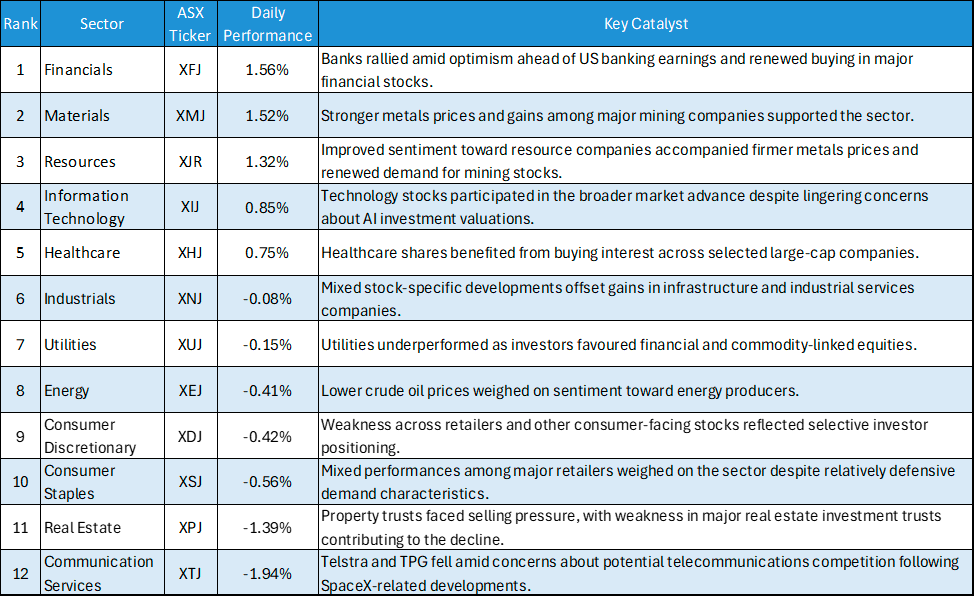
Daily ASX Sector Performance Summary
Financials and Materials Drive Market Leadership
Financials was the strongest-performing supplied sector, gaining 1.56%. The advance reflected renewed buying in major banks as investors positioned ahead of the US corporate earnings season. Westpac was among the prominent contributors to the banking rally, while Bank of Queensland attracted attention ahead of its FY26 results.
The financial sector's Leadership was significant because banks carry considerable weight in the Australian Equity market. Improved sentiment toward major financial institutions can provide meaningful support to the broader index. However, investors must continue to assess lending growth, net interest margins, household borrowing conditions and Credit quality when evaluating the sustainability of the advance.
Materials gained 1.52%, supported by stronger performances across major mining companies. Rising spot prices for gold, copper and iron ore helped improve sentiment toward selected resource producers. BHP, Fortescue, Northern Star and South32 were among the mining companies benefiting from the session's positive momentum.
Resources advanced 1.32%, reinforcing the improvement in commodity-linked equities. Nevertheless, gains were not universal across the mining industry. Lithium and rare earths companies faced selling pressure, demonstrating that Commodity exposure alone was insufficient to guarantee positive performance.
Technology and Healthcare Support the Advance
Information Technology climbed 0.85%, placing it fourth among the supplied indices. The gain indicated that technology shares participated in the broader market recovery, although their performance remained below that of Financials, Materials and Resources.
Investors continued to assess technology valuations, earnings prospects and expenditure on artificial intelligence infrastructure. The cancellation of Firmus Technologies' proposed multibillion-dollar initial public offering remained relevant to discussions about investor appetite for capital-intensive AI projects. The sector's positive performance suggested that concerns surrounding individual transactions did not prevent buying across listed technology companies.
Healthcare advanced 0.75%, benefiting from the broader improvement in selected large-cap shares. Its relatively moderate gain indicated participation without matching the leadership displayed by financial and commodity-linked stocks. Future performance will depend on company earnings, regulatory developments and investors' appetite for defensive growth opportunities.
Communication Services and Real Estate Face Pressure
Communication Services was the weakest-performing sector, declining 1.94%. Telecommunications stocks came under pressure amid concerns about competition following SpaceX's low-band spectrum deal. Telstra fell 2.5%, while TPG declined 4.9%, contributing to weakness across the industry.
The decline highlighted how technological developments and potential changes to competitive conditions can affect established telecommunications businesses. Investors will likely remain focused on pricing power, customer retention, infrastructure Investment and the potential impact of new market entrants.
Real Estate fell 1.39%, making it the second-weakest supplied sector. Property trusts faced selling pressure, with Goodman Group among the notable decliners. The sector's sensitivity to financing expenses, bond yields and property valuations remains an important consideration. Higher borrowing costs or uncertainty about funding conditions could continue to constrain performance.
Mixed Performance Across Other Sectors
Consumer Staples declined 0.56%, while Consumer Discretionary fell 0.42%. The weakness suggested that consumer-facing shares did not participate fully in the broader market advance. Investors remain attentive to household spending, employment conditions and the pressure of borrowing costs on discretionary purchases.
Energy slipped 0.41% as Crude Oil prices retreated, contrasting with the strength in metals-related equities. Utilities edged down 0.15%, while Industrials lost 0.08%. These relatively modest declines indicated limited weakness compared with the sharper losses in telecommunications and property stocks.
The overall distribution of returns illustrated a market in which investors favoured selected banks and mining companies rather than buying indiscriminately across industries.
Bottom Line
The Australian equity market advanced on 12 October 2026, but sector performance remained uneven. Financials led with a 1.56% gain, followed by Materials at 1.52% and Resources at 1.32%. Meanwhile, Communication Services fell 1.94%, and Real Estate declined 1.39%.
The 3.50-percentage-point performance gap between the strongest and weakest supplied indices highlighted pronounced sector rotation. Stronger metals prices and optimism surrounding corporate earnings supported selected equities, while telecommunications competition concerns and property-sector pressures weighed on other areas.
Going forward, investors should monitor bank earnings, commodity prices, bond yields, telecommunications competition and developments affecting AI investment. Sustained market strength will depend on whether leadership broadens beyond financial and commodity-linked stocks.


 Nov 12, 2026





 Please wait processing your request...