
 CA
 NZ
 UK
 US
 IND

 AU

 Share
 X (Formerly Twitter)
 Whatsapp
 Facebook
 LinkedIn
 Telegram
 Email This Article
 Copy Link
 Summarize with AI
 Chat GPT
 Perplexity

Key Highlights
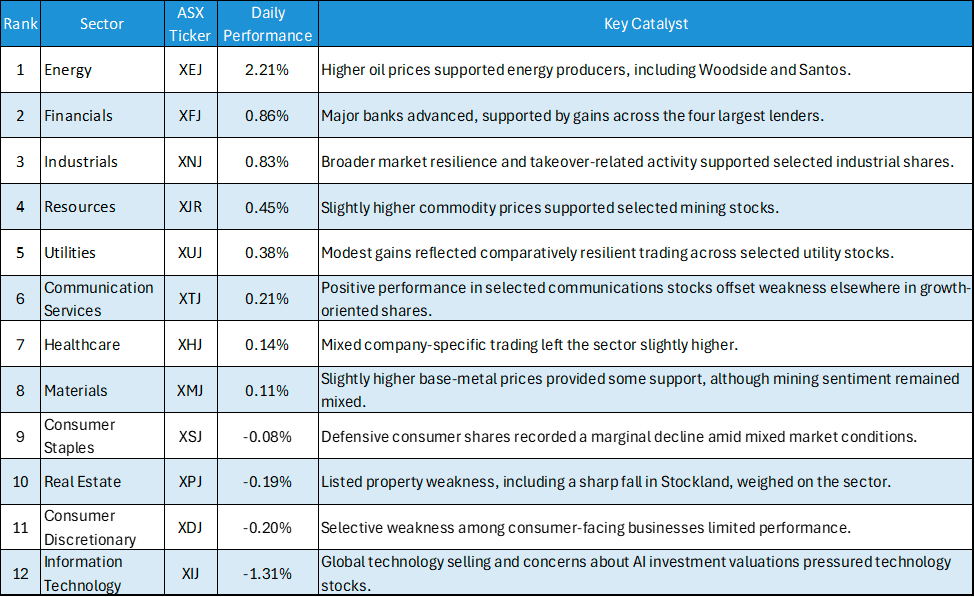
- Energy (XEJ) led the supplied sector indices, gaining 2.21% on 19 October 2026.
- Financials (XFJ) advanced 0.86%, while Industrials (XNJ) rose 0.83%.
- Resources (XJR) increased 0.45%, followed by Utilities (XUJ), which gained 0.38%.
- Communication Services (XTJ), Healthcare (XHJ) and Materials (XMJ) recorded modest gains.
- Consumer Staples (XSJ) slipped 0.08%, while Consumer Discretionary (XDJ) declined 0.20%.
- Real Estate (XPJ) lost 0.19%, while Information Technology (XIJ) was the weakest supplied index, falling 1.31%.
- The 3.52-percentage-point gap between Energy and Information Technology highlighted divergent sector performance.
The Australian share market advanced on 19 October, with the S&P/ASX 200 gaining 0.44% to close at 8,845.70 points. Energy producers and major banks supported the market, while technology shares weakened amid international concerns about artificial intelligence Investment and falling US technology stocks. Takeover activity involving Cleanaway Waste Management and Challenger also attracted investor attention. The supplied sector data showed that gains were concentrated in energy-related businesses and selected cyclical sectors, while technology and property-related investments remained under pressure.
Daily ASX Sector Performance Summary
Energy, Financials and Industrials Lead the Advance
Energy was the strongest supplied index on 19 October, rising 2.21%. Higher oil prices and Demand for energy producers supported the sector, with Woodside Energy gaining 2.69% and Santos advancing 2.31%. Coal producers also recorded notable gains, while Karoon Energy benefited from continued interest in oil and gas stocks. Brent Crude had traded near US$110 per barrel before easing during the session, reflecting concerns about Supply disruptions and geopolitical tensions. The sector's performance demonstrated how commodity-price movements can influence investor positioning even when international Equity markets face pressure.
Financials advanced 0.86%, supported by gains among Australia's major banks. Commonwealth Bank, National Australia Bank, Westpac and ANZ all finished higher, helping offset weakness elsewhere in the market. Takeover interest involving Challenger also contributed to financial-sector activity, with Japanese insurer Daiichi Life pursuing a potential transaction involving the Wealth manager. However, the gains were not universal, as Bendigo and Adelaide Bank fell following a quarterly update that highlighted weaker-than-expected Revenue and a decline in its net interest margin. The divergence illustrated the importance of company-specific Earnings and valuation considerations within the banking industry.
Industrials increased 0.83%, making it the third-strongest supplied index. The advance reflected selective buying beyond the energy and financial sectors, while takeover activity involving Cleanaway Waste Management provided an additional source of corporate-market interest. Cleanaway shares surged after accepting a takeover offer from Swedish Private Equity firm EQT. Nevertheless, a single company's transaction-related gains should not be interpreted as evidence of uniform strength across the broader industrial sector.
Resources and Other Advancers Show Moderate Strength
Resources gained 0.45%, while Utilities advanced 0.38%. The resources sector benefited from slightly higher prices for selected commodities, including iron ore and copper. BHP rose 0.7%, indicating continued investor interest in major Mining companies. However, concerns about China's economic outlook remained relevant, particularly given persistent weakness in domestic demand and the country's property market. Although China's third-quarter economic growth accelerated to 4.5% year on year, the recovery remained uneven, limiting confidence in a sustained improvement in Commodity demand.
Communication Services rose 0.21%, Healthcare gained 0.14%, and Materials advanced 0.11%. These relatively modest gains indicated that buying interest extended beyond the three leading sectors, but the magnitude of the advances suggested limited momentum. Technology-related selling internationally also highlighted the distinction between traditional communications businesses and companies more directly exposed to growth-stock valuations and artificial intelligence investment expectations.
The small gain in Materials contrasted with the stronger performance of Resources, suggesting that investor demand was selective rather than broad-based across commodity-linked industries. Commodity prices, Chinese industrial activity and global growth expectations are likely to remain important influences on the relative performance of these sectors.
Technology and Property Remain Under Pressure
Information Technology was the weakest supplied index, falling 1.31%. The decline followed a sell-off in US technology shares, with the Nasdaq losing 2.1% in the preceding session amid concerns about the financing and profitability of artificial intelligence infrastructure investment. Investors continued to question whether substantial spending on data centres and related technologies would generate sufficient returns. Weakness among Australian technology companies reflected this broader reassessment of growth-stock valuations, although individual company developments also influenced share prices.
Real Estate declined 0.19%, while Consumer Discretionary fell 0.20%. Listed property securities faced pressure from company-specific developments, including a sharp decline in Stockland following a disappointing quarterly update. Property trusts also remain sensitive to financing costs, bond yields and expectations for economic growth. Meanwhile, the consumer discretionary sector's marginal decline suggested that investors remained selective toward businesses exposed to household spending and changing consumer confidence.
Consumer Staples slipped 0.08%, making it the second-weakest supplied index. Its modest decline contrasted with the larger fall in Information Technology and indicated that defensive consumer businesses were comparatively resilient. However, defensive characteristics do not guarantee positive returns when company earnings, competitive conditions or market valuations come under pressure.
Bottom Line
The 19 October 2026 session demonstrated a divergence in Australian sector performance, with Energy leading at 2.21%, followed by Financials at 0.86% and Industrials at 0.83%. Resources and several other sectors recorded smaller gains, while Information Technology fell 1.31% as international concerns about artificial intelligence investment weighed on technology shares. The 3.52-percentage-point difference between the strongest and weakest supplied indices highlighted the market's uneven leadership. Investors are likely to remain focused on oil prices, bank earnings, takeover developments, commodity demand and technology-sector valuations when assessing the sustainability of the market advance.


 Nov 12, 2026





 Please wait processing your request...