
 CA
 NZ
 UK
 US
 IND

 AU

 Share
 X (Formerly Twitter)
 Whatsapp
 Facebook
 LinkedIn
 Telegram
 Email This Article
 Copy Link
 Summarize with AI
 Chat GPT
 Perplexity

Key Highlights
- Consumer Staples (XSJ) led the supplied sector indices, gaining 1.14% on 20 October 2026.
- Healthcare (XHJ) advanced 0.87%, while Consumer Discretionary (XDJ) rose 0.76%.
- Real Estate (XPJ) gained 0.70%, followed by Utilities (XUJ), which increased 0.49%.
- Information Technology (XIJ) added 0.36%, despite a weaker overall market session.
- Communication Services (XTJ) slipped 0.12%, while Industrials (XNJ) declined 0.18%.
- Financials (XFJ) fell 0.48%, and Materials (XMJ) lost 1.16%.
- Resources (XJR) declined 1.26%, while Energy (XEJ) was the weakest supplied index, falling 1.31%.
Australian shares retreated on 20 October, with the S&P/ASX 200 falling 0.33% to close at 8,816.9 points after recovering from deeper intraday losses. The supplied sector figures show a defensive tilt: Consumer Staples and Healthcare led the gains, while Energy, Resources and Materials weakened. News flow around BHP’s lower quarterly copper production, National Australia Bank’s planned Job cuts and strength in selected healthcare and consumer stocks shaped the session. The pattern points to selective rotation rather than a broad-based advance.
Daily ASX Sector Performance Summary
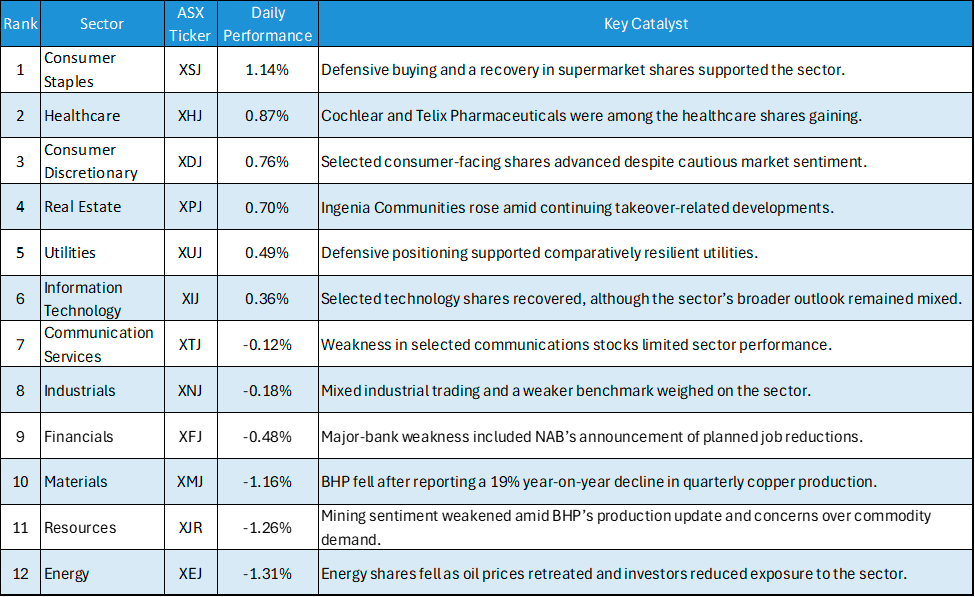
Consumer Staples and Healthcare Lead Defensive Gains
Consumer Staples was the strongest supplied index, rising 1.14%. The gain came as investors favoured defensive businesses during a session in which the S&P/ASX 200 fell. Supermarket shares helped support the sector, reflecting Demand for businesses whose products are part of everyday household spending. Nevertheless, one positive session does not establish a sustained trend, and consumer companies remain exposed to competition, cost pressures and changes in household purchasing behaviour.
Healthcare advanced 0.87%, with Cochlear and Telix Pharmaceuticals among the notable gainers reported during the session. The performance was consistent with a broader preference for selected defensive stocks while cyclical areas weakened. However, healthcare companies have different Earnings drivers, including product demand, clinical and regulatory developments, and operating costs. The sector’s advance therefore should not be interpreted as uniform strength across all healthcare businesses.
Consumer Discretionary increased 0.76%, while Real Estate gained 0.70% and Utilities rose 0.49%. The gains in consumer-facing shares suggest that buying was selective rather than confined to traditionally defensive industries. Real estate performance also reflected company-specific developments, including continuing attention on Ingenia Communities and its takeover-related situation. Utilities’ advance was consistent with investors seeking comparatively resilient earnings, although financing costs and regulatory settings remain important considerations for the sector.
Information Technology added 0.36%, making it the only other supplied sector to record a gain after Utilities. The modest rise suggests some stabilisation in selected technology stocks, but it was not strong enough to offset declines elsewhere in the market. Technology valuations remain sensitive to earnings expectations, financing conditions and the commercial returns expected from artificial intelligence investment. The day’s positive return should therefore be viewed as a limited recovery rather than confirmation of a broad technology-sector rebound.
Energy, Resources and Materials Weigh on the Market
Energy was the weakest supplied index, falling 1.31%, while Resources declined 1.26% and Materials lost 1.16%. The declines came as the broader market gave back much of the previous session’s gains and oil prices retreated. This reversed the pattern seen on some recent sessions, when energy stocks had benefited from higher crude prices and geopolitical Supply concerns. The move highlights the sensitivity of energy producers to Commodity prices and changing expectations for global demand.
Resources and Materials were pressured by mining-related news, particularly BHP’s September-quarter production update. BHP shares fell after the company reported a 19% year-on-year drop in copper production, raising questions about near-term output and its effect on earnings. Copper remains important to the longer-term energy transition and electrification themes, but a positive structural demand outlook does not remove the risks associated with operational performance, commodity-price Volatility or China’s economic trajectory.
Financials declined 0.48%, with National Australia Bank announcing plans to cut 2,500 jobs as part of an operational simplification programme. The announcement drew attention to cost management and efficiency across the banking industry, although workforce reductions alone do not determine future profitability. Industrials slipped 0.18%, and Communication Services eased 0.12%, both relatively modest declines compared with the falls in commodity-linked sectors. The mixed results underline how company-specific developments can outweigh broader sector narratives in individual sessions.
Bottom Line
The 20 October 2026 session showed clear divergence across Australian sector indices. Consumer Staples led with a 1.14% gain, followed by Healthcare at 0.87% and Consumer Discretionary at 0.76%. At the other end, Energy fell 1.31%, Resources lost 1.26% and Materials declined 1.16%, with BHP’s copper production update and retreating oil prices weighing on commodity-linked shares. The 2.45-percentage-point gap between the strongest and weakest supplied indices highlights selective defensive demand amid a weaker benchmark. Investors are likely to watch commodity prices, Mining output, bank cost initiatives and the durability of defensive-sector strength.


 Nov 12, 2026





 Please wait processing your request...