
 CA
 NZ
 UK
 US
 IND

 AU

 Share
 X (Formerly Twitter)
 Whatsapp
 Facebook
 LinkedIn
 Telegram
 Email This Article
 Copy Link
 Summarize with AI
 Chat GPT
 Perplexity

Key Highlights
- Staples Suffer Historic Shock: The supposedly "safe" Consumer Staples sector (XSJ) suffered a catastrophic -4.98% collapse. A daily plunge of this magnitude in a defensive Yield proxy signals an extreme Margin squeeze or a devastating fundamental repricing of a major index heavyweight.
- Miners Crushed: The heavy distribution in the Mining complex accelerated violently. Materials (XMJ) plunged -2.65% and Resources (XJR) dropped -2.02%, cementing the structural breakdown that began earlier in the week.
- Financials Bounce: Providing the only counterbalance to the Mining drag, the major banks caught a strong bid. Financials (XFJ) rallied +0.96%, stepping up to prevent a broader benchmark wipeout.
- Cyclicals and Duration Catch a Bid: Capital fleeing the miners and staples found a home in secondary cyclicals and duration Assets. Energy (XEJ), Communications (XTJ), Real Estate (XPJ), and Industrials (XNJ) all posted strong gains exceeding 1%.
Introduction
Thursday’s Trading session delivered one of the most fractured and volatile sectoral tape readings of the year. The Australian Equity market was ripped in opposite directions as the two foundational pillars—the banks and the miners—diverged aggressively. However, the true shockwave of the session was the unprecedented, near-5% Capitulation in Consumer Staples. This violent repricing shatters the illusion of defensive safety, suggesting that sticky Inflation and crushed consumer purchasing power are now decisively eating into the Earnings of the most insulated retail giants. Meanwhile, nimble institutional Capital actively rotated back into beaten-down cyclicals and duration plays to find Yield.
ASX Sector Performance Table (30/04/2026)
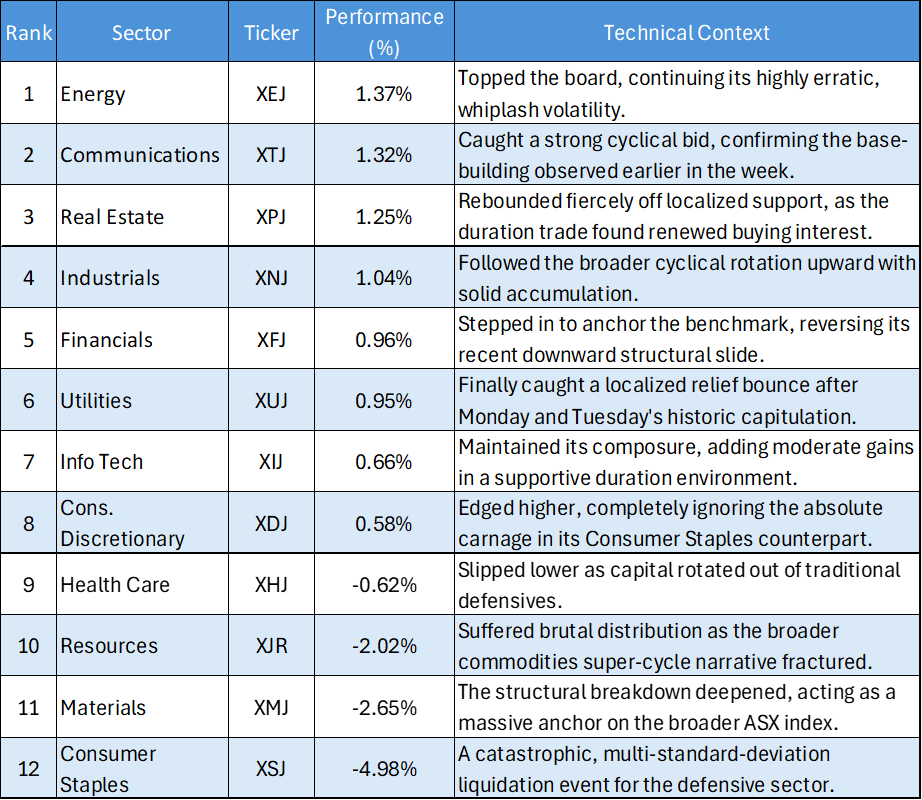
Sector Performance Breakdown
The Defensive Disaster
- Consumer Staples (XSJ | -4.98%): This is the undisputed story of the session. A daily drop approaching 5% for a low-Beta, defensive sector like Staples is exceedingly rare. This indicates a massive institutional rug-pull, likely triggered by a toxic combination of Margin compression, Supply chain realities, and tapped-out consumers finally impacting the Bottom Line of the major supermarket oligopolies. It proves that in this current macro environment, there are no unassailable hiding places.
The Heavyweight Tug-of-War
- Materials (XMJ | -2.65%) vs. Financials (XFJ | +0.96%): The internal mechanics of the ASX 200 are actively tearing themselves apart. The Mining complex suffered a brutal extension of its recent breakdown, with XMJ shedding over two and a half percent as global growth fears triggered an exodus from iron ore and base metals. Conversely, the Financials stepped in to buy the dip, catching a near 1% bid. This exact opposite positioning between the two largest sectors creates a choppy, untradable quagmire for passive index investors.
The Cyclical Relief Rally
- Communications (XTJ | +1.32%) & Industrials (XNJ | +1.04%): The coordinated base-building we tracked earlier in the week is paying off. As Capital violently fled Staples and Materials, a significant portion rotated directly into these secondary cyclicals, confirming that active managers are hunting for relative value rather than moving entirely to cash.
- Real Estate (XPJ | +1.25%): The property sector roared back to life, reversing its recent weakness. This suggests that despite the chaos in defensive Yield (like Staples and Utilities), institutional appetite for long-duration real Assets remains highly opportunistic.
Strategic Summary
The price action on April 30, 2026, forces a complete recalculation of risk. The devastating -4.98% wipeout in Consumer Staples (XSJ) effectively destroys the traditional "flight to safety" playbook. Investors can no longer blindly hide in supermarkets to weather a storm. Simultaneously, the vicious -2.65% drop in Materials (XMJ) confirms the Mining sector is currently toxic to institutional Capital. While the impressive rotation into Financials, Real Estate, and secondary cyclicals offers lucrative pockets of momentum, the broader market remains a minefield. Active investors must maintain strict stop-losses, as the speed and severity of sector rotation currently on display is punishing to anyone caught on the wrong side of the tape.


 Nov 12, 2026





 Please wait processing your request...