
 CA
 NZ
 UK
 US
 IND

 AU

 Share
 X (Formerly Twitter)
 Whatsapp
 Facebook
 LinkedIn
 Telegram
 Email This Article
 Copy Link
 Summarize with AI
 Chat GPT
 Perplexity

Key Highlights
- Consumer Staples (XSJ) led the supplied sector indices, gaining 3.47% on 15 October 2026.
- Financials (XFJ) rose 2.19%, while Utilities (XUJ) advanced 2.09%.
- Communication Services (XTJ) gained 1.54%, and Healthcare (XHJ) added 0.68%.
- Consumer Discretionary (XDJ) increased 0.63%, while Industrials (XNJ) rose 0.28%.
- Energy (XEJ) edged down 0.04%, and Real Estate (XPJ) declined 0.74%.
- Information Technology (XIJ) fell 3.41%, while Resources (XJR) lost 3.51%.
- Materials (XMJ) was the weakest supplied index, dropping 3.95%.
- The 7.42-percentage-point gap between Consumer Staples and Materials highlighted sharp sector divergence.
The Australian share market finished almost flat on 15 October, with the S&P/ASX 200 slipping around 0.1% to approximately 8,719.7 points. The supplied sector data revealed a pronounced split beneath the headline: Consumer Staples, Financials and Utilities advanced, while Materials, Resources and Information Technology came under heavy pressure. Softer Australian employment data helped ease some concerns about further near-term monetary tightening, but hotter US Inflation and a global sell-off in technology and AI-related shares weighed on risk sentiment.
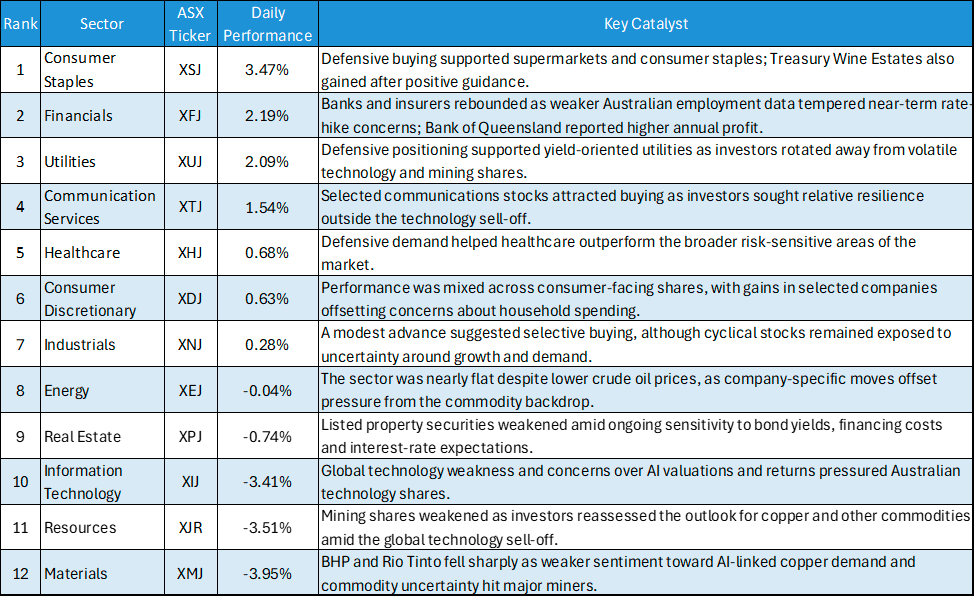
Daily ASX Sector Performance Summary
Consumer Staples, Financials and Utilities Lead
Consumer Staples was the strongest supplied index, rising 3.47%. The advance points to Demand for defensive exposure during a session shaped by global technology weakness and uncertainty over inflation and interest rates. Treasury Wine Estates was among the individual companies reporting a notable gain after providing positive guidance, while supermarket shares also contributed to the sector’s resilience. Even so, one strong session does not by itself establish a sustained improvement in consumer demand or company earnings.
Financials advanced 2.19%, supported by a recovery in major banks and insurers. The softer Australian employment report showed employment falling by 39,300 in September and the Unemployment rate rising to 4.7%. That data eased some pressure on interest-rate expectations, although economists continued to caution that persistent inflation could keep further tightening in play. Bank of Queensland also reported an 88% increase in statutory annual net profit, providing a company-specific positive catalyst. Utilities gained 2.09%, consistent with a broader preference for defensive and income-oriented exposures.
Communication Services and Other Advancers Show Selective Strength
Communication Services rose 1.54%, while Healthcare added 0.68%. Consumer Discretionary gained 0.63% and Industrials edged up 0.28%. The spread of modest gains beyond the three leading sectors indicates that buying was not confined to a single industry. However, the moves should be interpreted as relative resilience rather than evidence of a broad-based rally, given the benchmark’s near-flat close and the sharp losses recorded in technology and mining-related indices.
Energy was virtually unchanged, slipping 0.04%, despite Brent Crude trading lower during the session. This muted performance suggests that company-level factors helped offset the softer oil backdrop. Real Estate fell 0.74%, making it the weakest sector outside the larger declines in technology and resources. Listed property remains sensitive to financing costs, bond yields and expectations for monetary policy, leaving the sector exposed when rate expectations shift.
Materials, Resources and Technology Weigh on Sentiment
Materials dropped 3.95%, the largest decline among the supplied indices, while Resources lost 3.51%. BHP and Rio Tinto recorded sharp falls as global investors reassessed the outlook for Mining and copper demand. BHP’s copper exposure had linked the company to the AI and data-centre Investment theme; as technology shares sold off amid concerns about AI returns and inflation, that association became a source of pressure. Uncertainty around Commodity demand added to the negative tone across resource-linked stocks.
Information Technology declined 3.41%, reflecting the global retreat in technology and AI-related shares after hotter-than-expected US inflation data renewed concern about interest rates and valuations. The contrast between strong defensive-sector performance and sharp losses in technology and mining suggests a clear rotation rather than uniform market weakness. Nevertheless, the resilience of selected sectors may remain vulnerable if global risk aversion intensifies or interest-rate expectations move higher again.
Bottom Line
The 15 October 2026 session showed pronounced divergence across the supplied ASX sector indices, even as the S&P/ASX 200 finished only marginally lower. Consumer Staples led with a 3.47% gain, followed by Financials at 2.19% and Utilities at 2.09%. Materials fell 3.95%, Resources declined 3.51% and Information Technology lost 3.41%. The 7.42-percentage-point gap between the strongest and weakest sectors underlined the extent of sector rotation. Investors are likely to remain focused on Australian labour-market data, central-bank rate expectations, global technology valuations and commodity demand as they assess whether defensive Leadership can persist.


 Nov 12, 2026





 Please wait processing your request...