
 CA
 NZ
 UK
 US
 IND

 AU

 Share
 X (Formerly Twitter)
 Whatsapp
 Facebook
 LinkedIn
 Telegram
 Email This Article
 Copy Link
 Summarize with AI
 Chat GPT
 Perplexity

Key Highlights
- Consumer Staples (XSJ) gained 0.73%, recording the strongest performance among the twelve ASX sectors.
- Financials (XFJ) advanced 0.27%, supported by gains across the major Australian banks.
- Energy (XEJ) declined 0.30% despite strength in Crude Oil prices.
- Nine of the twelve sectors declined, highlighting broad selling pressure across the market.
- Information Technology (XIJ) fell 1.66%, the largest sector decline, amid heavy selling in technology and wealth-platform stocks.
- Consumer Discretionary (XDJ) dropped 1.36% as expectations of higher interest rates weighed on rate-sensitive consumer stocks.
- Utilities (XUJ) declined 1.25%, while Materials (XMJ) and Industrials (XNJ) also came under pressure.
- The gap between the strongest and weakest sectors reached 2.39 percentage points.
The Australian Equity market experienced broad-based selling on 25 September 2026, with only Consumer Staples and Financials finishing higher. The sector performance showed a clear defensive rotation, with Consumer Staples and Financials providing the main pockets of resilience while Technology, Consumer Discretionary and Utilities bore the heaviest selling pressure. The attached reference article follows the same structure of sector ranking, catalyst table and thematic analysis.
Daily ASX Sector Performance Summary
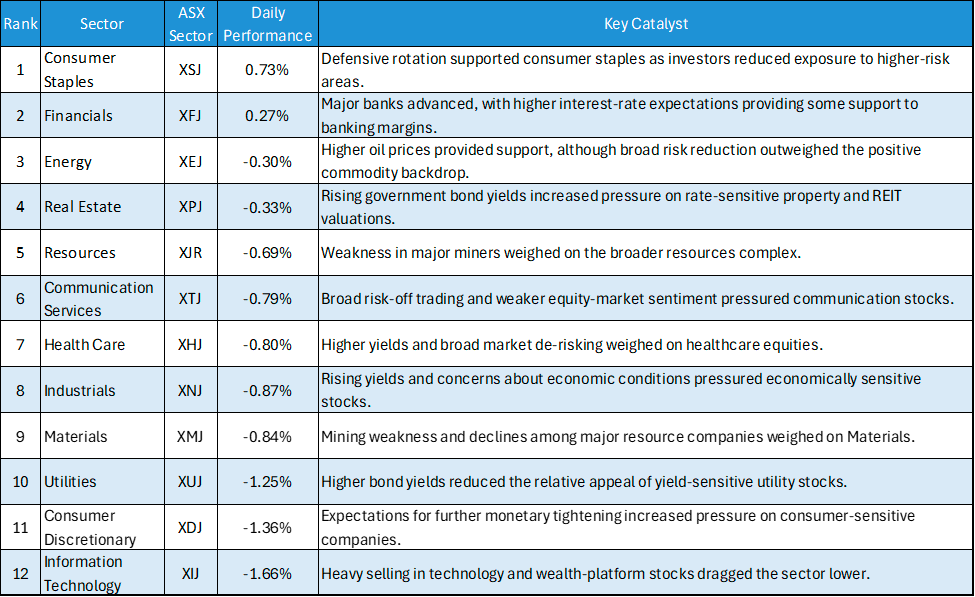
Consumer Staples and Financials Show Resilience
Consumer Staples was the strongest-performing sector on 25 September, gaining 0.73%. The sector benefited from a defensive shift as investors reduced exposure to higher-beta areas amid rising yields and renewed Inflation concerns.
Financials also finished higher, advancing 0.27%. The major Australian banks were particularly resilient, with gains across several large banking stocks. Expectations for higher interest rates can provide some support to bank margins, although weaker property conditions could offset part of this benefit.
Energy was comparatively resilient but still declined 0.30%. Higher crude oil prices provided a supportive Commodity backdrop for Australian energy producers. However, the broader risk-off environment prevented the sector from translating the stronger oil-price environment into a positive daily performance.
Technology and Consumer Discretionary Lead the Declines
Information Technology recorded the largest decline, falling 1.66%. The weakness was concentrated in several major technology and wealth-platform names. Selling pressure across technology stocks contributed significantly to the sector's underperformance.
Consumer Discretionary dropped 1.36%, reflecting heightened sensitivity to expectations of further interest-rate increases. Consumer-facing companies remained vulnerable to concerns that higher borrowing costs could affect household spending and economic activity.
Utilities fell 1.25%, while Industrials and Healthcare also recorded notable losses. Rising government bond yields remained an important macroeconomic headwind, increasing the relative attractiveness of fixed-income Assets and placing pressure on equity valuations.
Materials, Resources and Real Estate Under Pressure
Materials declined 0.84%, while Resources fell 0.69%. Major Mining companies remained under pressure, contributing to weakness across the broader resources complex. The performance indicated that commodity-related sectors were unable to provide meaningful support despite continued strength in selected commodity markets.
Real Estate declined 0.33%, making it one of the relatively stronger performers among the twelve declining sectors. Nevertheless, higher bond yields remained a significant challenge for property and REIT valuations because rising yields can increase financing costs and required returns.
The relatively modest decline in Real Estate compared with Technology and Consumer Discretionary suggests that the selling pressure was not evenly distributed across rate-sensitive sectors.
Bottom Line
The Australian equity market displayed broad-based weakness on 25 September 2026, with only Consumer Staples and Financials recording gains. Consumer Staples led with a 0.73% increase, followed by Financials at 0.27%.
At the other end of the ranking, Information Technology declined 1.66%, followed by Consumer Discretionary at 1.36% and Utilities at 1.25%. The 2.39 percentage-point gap between Consumer Staples and Information Technology highlighted the significant divergence between defensive and higher-beta sectors.
Overall, the session was characterised by defensive positioning, elevated bond yields and renewed commodity-market concerns, with investors reducing exposure to technology, consumer discretionary and other economically sensitive areas of the Australian market.


 Nov 12, 2026





 Please wait processing your request...