
 CA
 NZ
 UK
 US
 IND

 AU

 Share
 X (Formerly Twitter)
 Whatsapp
 Facebook
 LinkedIn
 Telegram
 Email This Article
 Copy Link
 Summarize with AI
 Chat GPT
 Perplexity

Key Highlights
- Consumer Discretionary (ASX:XDJ) led the supplied sector indices, rising 2.73% as retailers rebounded after recent selling.
- Industrials (ASX:XNJ) gained 1.14%, while Energy (ASX:XEJ) advanced 0.97% amid strength in oil and gas shares.
- Healthcare (ASX:XHJ) rose 0.84%, and Communication Services (ASX:XTJ) and Utilities (ASX:XUJ) added 0.79% and 0.67%, respectively.
- Information Technology (ASX:XIJ) was the weakest sector, falling 1.34%, as global technology-market weakness weighed on local technology shares.
- Consumer Staples (ASX:XSJ) declined 0.97% after Coles reported softer-than-expected first-quarter sales, while Materials (ASX:XMJ) fell 0.87% and Resources (ASX:XJR) lost 0.72%.
Australian equities finished modestly higher on Friday, 30 October, but the close masked substantial rotation between sectors. Consumer Discretionary staged the strongest rebound, while Industrials, Energy and Healthcare also advanced. Technology and mining-related shares weakened as global technology jitters and pressure across resource names weighed on sentiment. The 4.07-percentage-point spread between the strongest and weakest supplied indices highlighted the uneven nature of the session.
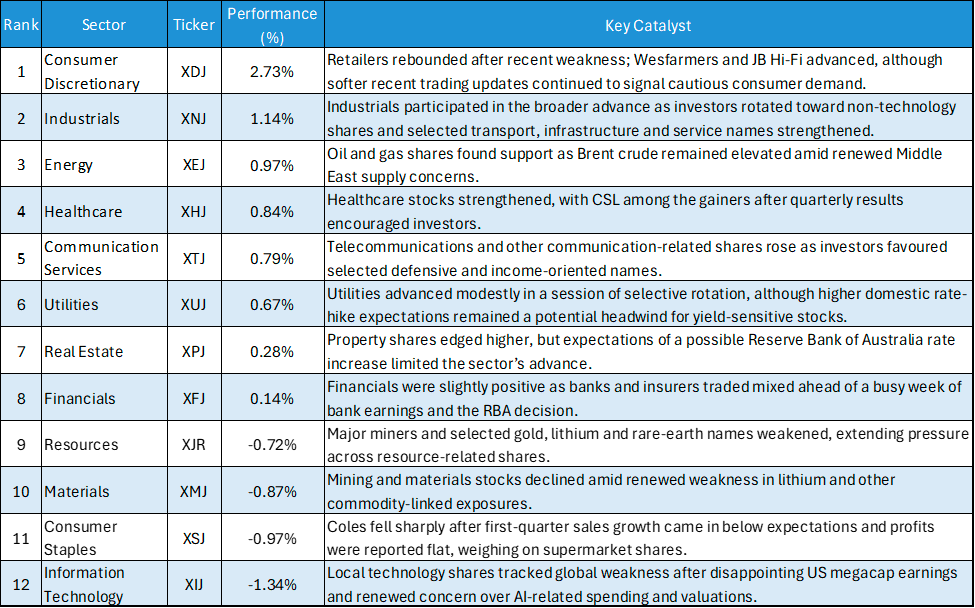
Daily ASX Sector Performance Summary
Consumer Discretionary Leads the Rebound
Consumer Discretionary was the strongest supplied sector, rising 2.73% as investors bought back into retailers after recent losses. Wesfarmers and JB Hi-Fi were among the stronger names, reversing some of the pressure that followed cautious trading commentary earlier in the week. The rebound was notable because concerns about household budgets and higher interest rates have not disappeared. Recent updates from retailers, including slower comparable sales at JB Hi-Fi and subdued like-for-like growth at Super Retail Group, suggest that consumer Demand remains uneven. Friday’s move therefore looks more like a recovery from oversold conditions than clear evidence that the sector’s fundamental outlook has improved.
Industrials gained 1.14%, while Energy rose 0.97% as oil and gas shares drew support from elevated crude prices and renewed Middle East Supply concerns. Healthcare advanced 0.84%, with CSL among the stocks helping the sector. Communication Services and Utilities added 0.79% and 0.67%, respectively. Real Estate and Financials were positive but subdued, rising 0.28% and 0.14%, as investors weighed the prospect of another Reserve Bank of Australia rate increase.
Technology, Staples and Resources Weigh on the Market
Information Technology was the weakest supplied sector, falling 1.34%. The decline followed a sharp sell-off in major US technology stocks after Earnings and outlook commentary from large companies intensified questions about the returns on substantial artificial-intelligence spending. That weakness carried into Australian technology shares, leaving the sector under pressure despite modest gains in the broader local market.
Consumer Staples fell 0.97%, with Coles a key drag after first-quarter sales growth came in below analyst expectations and reported profits were flat. The company’s shares suffered a sharp decline, reinforcing concerns about supermarket competition, value-conscious consumers and Margin pressure. Materials dropped 0.87% and Resources lost 0.72% as miners and selected lithium, rare-earth and gold-related names weakened. The declines show that commodity-linked shares remained vulnerable even as oil-related stocks supported Energy.
Sector Rotation Remains Selective
The session’s pattern was not a uniform risk-on move. Consumer Discretionary rebounded sharply, while Industrials, Energy and Healthcare also advanced. In contrast, Technology, Consumer Staples and mining-related sectors declined. Financials and Real Estate posted only modest gains, suggesting that investors remained cautious about interest-rate-sensitive Assets ahead of the RBA’s next policy decision. The broader market also surrendered much of its intraday advance, consistent with continued uncertainty following Volatility in global technology shares.
For investors, the key distinction is between short-term price recovery and a sustained improvement in fundamentals. Retail shares may continue to recover if sentiment stabilises, but recent sales updates remain a risk. Technology performance will likely remain sensitive to global earnings and AI-spending expectations, while Resources and Materials will depend on Commodity prices and company-specific developments.
Bottom Line
Consumer Discretionary led the ASX sector performance on 30 October 2026, rising 2.73%, followed by Industrials at 1.14% and Energy at 0.97%. Information Technology was the weakest sector at -1.34%, with Consumer Staples down 0.97% and Materials down 0.87%. Retail shares rebounded after recent weakness, but Coles’ disappointing sales update and ongoing concerns about global technology valuations kept the market’s sector picture mixed. Investors will be watching the RBA decision, upcoming bank earnings, retail demand signals, global technology results and commodity prices for evidence that Friday’s rotation can persist. One session alone does not establish a durable trend.


 Nov 12, 2026





 Please wait processing your request...