
 CA
 NZ
 UK
 US
 IND

 AU

 Share
 X (Formerly Twitter)
 Whatsapp
 Facebook
 LinkedIn
 Telegram
 Email This Article
 Copy Link
 Summarize with AI
 Chat GPT
 Perplexity

Key Highlights
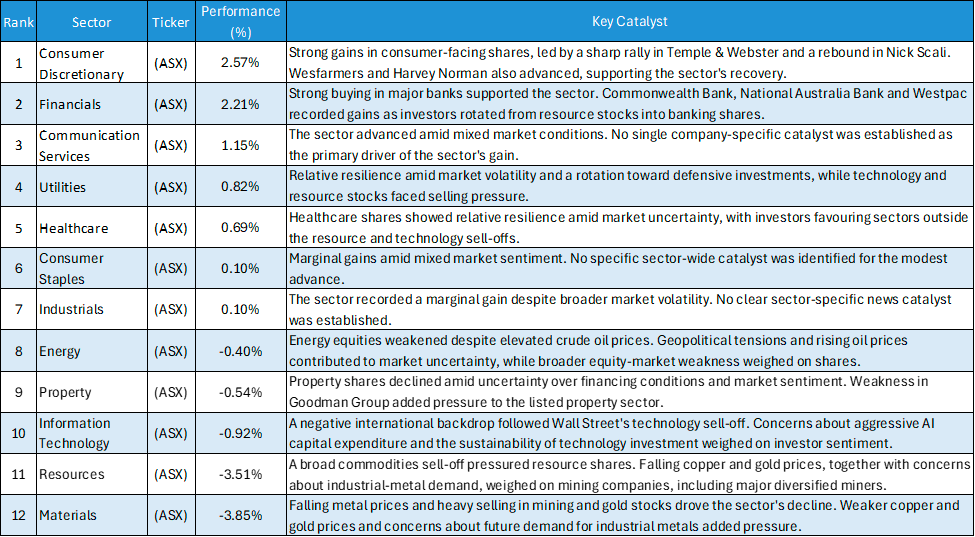
- Consumer Discretionary (ASX) led the supplied sector indices, gaining 2.57%, supported by a strong rebound in consumer-facing shares and positive trading news from Temple & Webster.
- Financials (ASX) advanced 2.21%, benefiting from renewed Demand for banking stocks as investors sought relative stability amid commodity-market weakness.
- Communication Services (ASX) rose 1.15%, while Utilities (ASX) gained 0.82%, contributing to the session's positive performance across several sectors.
- Healthcare (ASX) increased 0.69%, while Industrials (ASX) and Consumer Staples (ASX) each gained 0.10%.
- Energy (ASX) declined 0.40%, Property (ASX) fell 0.54%, and Information Technology (ASX) lost 0.92%.
- Resources (ASX) dropped 3.51%, while Materials (ASX) fell 3.85%, making them the weakest supplied indices amid pressure on Mining and gold shares.
Australian equities displayed pronounced sector divergence on 23 October, with gains in consumer-facing businesses and financial stocks offset by substantial weakness in resource-linked sectors. Market reporting highlighted stronger buying in banks, utilities and healthcare, alongside a rebound in consumer discretionary shares following positive company-specific developments. In contrast, falling Commodity prices and elevated oil prices weighed on mining and materials stocks. The supplied data showed a 6.42-percentage-point gap between the strongest and weakest sectors, illustrating the scale of the day's rotation.
Daily ASX Sector Performance Summary
Consumer Discretionary and Financials Lead the Advance
Consumer Discretionary was the strongest supplied sector, rising 2.57%. A positive trading update from online retailer Temple & Webster helped support sentiment toward consumer-facing businesses. The rebound followed the previous session's concerns about household spending, highlighting the importance of company-specific developments in shaping daily sector performance.
Financials climbed 2.21%, making the sector the second-strongest performer. Buying interest in major banks helped counterbalance weakness elsewhere in the market. Nevertheless, financial-sector performance remains sensitive to Credit quality, funding costs, household resilience and the broader economic outlook. One strong session does not necessarily establish a sustained upward trend.
Communication Services gained 1.15%, while Utilities advanced 0.82%. Healthcare also rose 0.69%. These gains indicate that buying extended beyond consumer and banking shares, with defensive sectors contributing to the market's relative resilience.
Mixed Performance Across Defensive and Cyclical Sectors
Consumer Staples and Industrials each gained 0.10%, recording only modest advances. Their performance suggests limited upward momentum rather than broad-based strength. Investors continued to distinguish between sectors and individual Business prospects as global market uncertainty persisted.
Energy declined 0.40%, while Property fell 0.54%. Energy shares remained under pressure despite elevated international oil prices, demonstrating that equity-sector returns do not necessarily track commodity prices directly. Production expectations, operating costs and broader investor sentiment can also influence share valuations. Property's decline reflected a softer session for the sector amid continuing sensitivity to borrowing costs and financing conditions.
Information Technology dropped 0.92%, with the previous night's sharp sell-off in US technology shares providing a difficult backdrop. The decline was more moderate than those recorded by the resource-linked sectors but still placed technology among the weaker performers.
Resources and Materials Face Heavy Selling Pressure
Resources fell 3.51%, while Materials recorded the largest decline among the supplied indices, dropping 3.85%. These losses reflected substantial pressure across mining and gold shares as commodity markets weakened. Falling iron ore and metal prices raised concerns about near-term Earnings prospects for exposed producers.
The divergence between the strongest consumer and financial sectors and the weakest mining-related indices highlights the uneven nature of market sentiment. Resource-sector performance remains sensitive to global industrial demand, Chinese economic activity, commodity prices and company-specific production costs.
Bottom Line
The 23 October session showed a clear rotation toward Consumer Discretionary and Financials, which gained 2.57% and 2.21%, respectively. Communication Services, Utilities and Healthcare also finished higher, while Resources and Materials suffered substantial declines. The 6.42-percentage-point spread between Consumer Discretionary and Materials underscores the pronounced sector divergence. Investors should monitor commodity-price movements, banking-sector resilience, consumer demand and upcoming corporate updates to determine whether the rotation persists. A single session, however, is insufficient to confirm a lasting change in market leadership.


 Nov 12, 2026





 Please wait processing your request...