
 CA
 NZ
 UK
 US
 IND

 AU

 Share
 X (Formerly Twitter)
 Whatsapp
 Facebook
 LinkedIn
 Telegram
 Email This Article
 Copy Link
 Summarize with AI
 Chat GPT
 Perplexity

Key Highlights
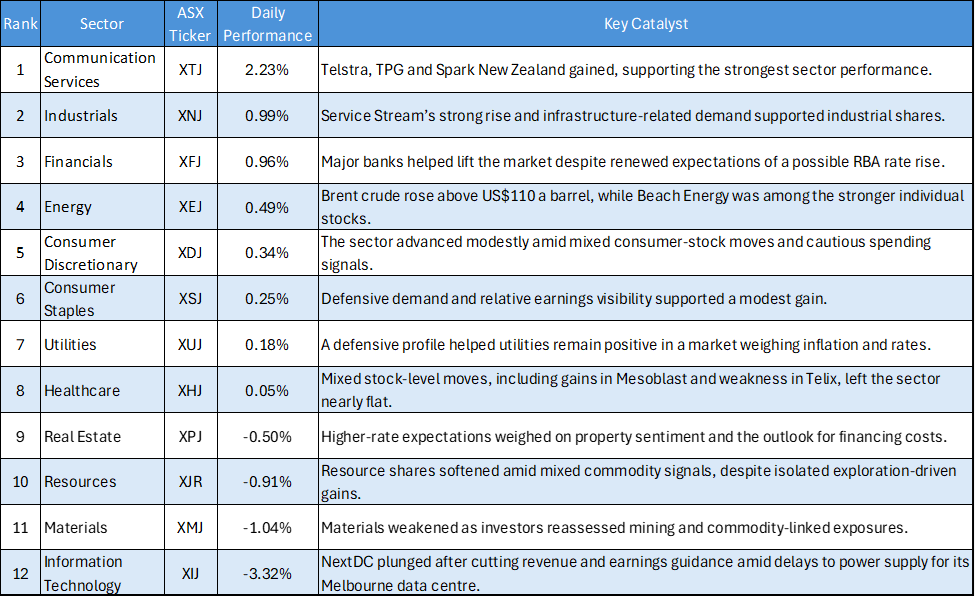
- Communication Services (XTJ) led the supplied sector indices, gaining 2.23% on 21 October 2026.
- Industrials (XNJ) rose 0.99%, while Financials (XFJ) advanced 0.96%.
- Energy (XEJ) gained 0.49%, followed by Consumer Discretionary (XDJ), up 0.34%.
- Consumer Staples (XSJ), Utilities (XUJ) and Healthcare (XHJ) recorded smaller gains.
- Real Estate (XPJ) fell 0.50%, while Resources (XJR) declined 0.91% and Materials (XMJ) lost 1.04%.
- Information Technology (XIJ) was the weakest supplied index, dropping 3.32%, with NextDC’s sharp sell-off weighing on technology sentiment.
Australian shares edged higher on 21 October, with the S&P/ASX 200 rising 0.16% to 8,831.3 points. The supplied sector figures show a split market: Communication Services, Industrials and Financials led the advance, while technology and materials-related shares weakened. Telco and bank gains helped support the benchmark, but NextDC’s sharp fall after cutting guidance highlighted the risks facing capital-intensive technology businesses. A hawkish Reserve Bank of Australia warning also lifted expectations of a possible November rate increase, keeping rate-sensitive sectors in focus.
Daily ASX Sector Performance Summary
Communication Services, Industrials and Financials Lead
Communication Services was the strongest supplied index, rising 2.23%. Market reporting pointed to gains in Telstra, TPG and Spark New Zealand, helping communications stocks provide Leadership as the broader market struggled to build a stronger advance. The sector’s relative resilience may appeal to investors seeking established businesses and recurring revenue, although competition, Capital expenditure and regulatory settings remain important considerations.
Industrials gained 0.99%, with Service Stream among the notable individual performers. The company’s rise was associated with infrastructure-related activity, which can support Demand for maintenance and network services. Financials advanced 0.96% as major banks contributed to the market’s positive close. However, comments from the RBA’s deputy governor raised the prospect of a November rate increase as Inflation remained a concern. Higher rates may affect bank margins in different ways, while also increasing pressure on borrowers and the housing market.
Energy rose 0.49% as Brent Crude traded above US$110 a barrel. Beach Energy was among the stronger stocks, supporting the sector’s positive result. Higher oil prices can improve revenue expectations for producers, but they also reflect Supply risks and can be volatile. Consumer Discretionary gained 0.34%, while Consumer Staples added 0.25%. These modest advances indicate selective buying rather than a decisive shift towards either growth or defensive consumer stocks. Utilities rose 0.18%, and Healthcare edged up 0.05%, leaving both sectors close to flat.
Technology, Materials and Resources Weigh on Performance
Information Technology was the weakest supplied index, falling 3.32%. The main news catalyst was NextDC, whose shares plunged after it cut revenue and Earnings guidance because of delays to power supply for its Melbourne data centre. The company said the next increase in grid supply had been deferred, affecting the timing of contracted revenue and planned development. The episode highlighted the execution risks faced by data-centre operators, even when long-term demand for digital infrastructure and artificial intelligence remains a prominent Investment theme.
Materials declined 1.04%, while Resources fell 0.91%. The declines suggest investors remained cautious towards commodity-linked exposures, although individual exploration companies moved sharply on company-specific announcements. Commodity prices were mixed, with iron ore little changed and oil higher. This divergence underlines that broad sector returns can conceal significant differences between commodities, producers and exploration-stage businesses. Investors still need to consider operational delivery, demand from China and the sensitivity of earnings to commodity prices.
Real Estate slipped 0.50%, the only other sector to record a notable decline beyond resources and materials. Expectations of tighter Monetary Policy can weigh on property valuations through higher financing costs and discount rates. Healthcare’s near-flat return also concealed divergent stock-level moves, reinforcing that sector labels alone do not capture company-specific risks. Across the market, the day’s performance reflected a rotation towards communications, industrials and banks while investors reassessed technology and commodity-linked exposures.
Bottom Line
The 21 October 2026 session delivered a modest 0.16% gain for the S&P/ASX 200, but sector performance was uneven. Communication Services led with a 2.23% rise, followed by Industrials at 0.99% and Financials at 0.96%. Information Technology fell 3.32%, driven by NextDC’s guidance downgrade, while Materials and Resources also declined. The 5.55-percentage-point gap between the strongest and weakest supplied indices highlights selective leadership rather than a broad-based rally. Investors are likely to monitor NextDC’s project outlook, commodity prices, bank performance and the RBA’s evolving inflation assessment.


 Nov 12, 2026





 Please wait processing your request...