
 CA
 NZ
 UK
 US
 IND

 AU

 Share
 X (Formerly Twitter)
 Whatsapp
 Facebook
 LinkedIn
 Telegram
 Email This Article
 Copy Link
 Summarize with AI
 Chat GPT
 Perplexity

Key Highlights
- Utilities Lead the Market: Utilities (XUJ) gained 0.59%, recording the strongest performance among the twelve sectors.
- Health Care Advances: Health Care (XHJ) rose 0.45%, ranking second.
- Energy Remains Positive: Energy (XEJ) increased 0.22%, supported by elevated oil prices.
- Only Three Sectors Gain: Three of the twelve sectors finished higher, highlighting weak market breadth.
- Consumer Discretionary Leads Declines: Consumer Discretionary (XDJ) fell 1.88%, recording the largest decline.
- Technology Under Pressure: Information Technology (XIJ) dropped 1.76%, reflecting broad selling pressure across growth stocks.
- Financials Weaken: Financials (XFJ) declined 1.63% as expectations of further RBA rate increases pressured the sector.
- Defensive Rotation: Utilities and Health Care outperformed as investors favoured defensive exposures during a broad market sell-off.
The Australian Equity market experienced broad-based weakness on 8 September 2026, with only three of the twelve sectors recording gains. Utilities led with a 0.59% advance, followed by Health Care at 0.45% and Energy at 0.22%. The S&P/ASX 200 declined 1.00% to 8,920.80, reaching its lowest closing level in six weeks as higher oil prices, weaker consumer sentiment and renewed interest-rate concerns weighed on investor confidence.
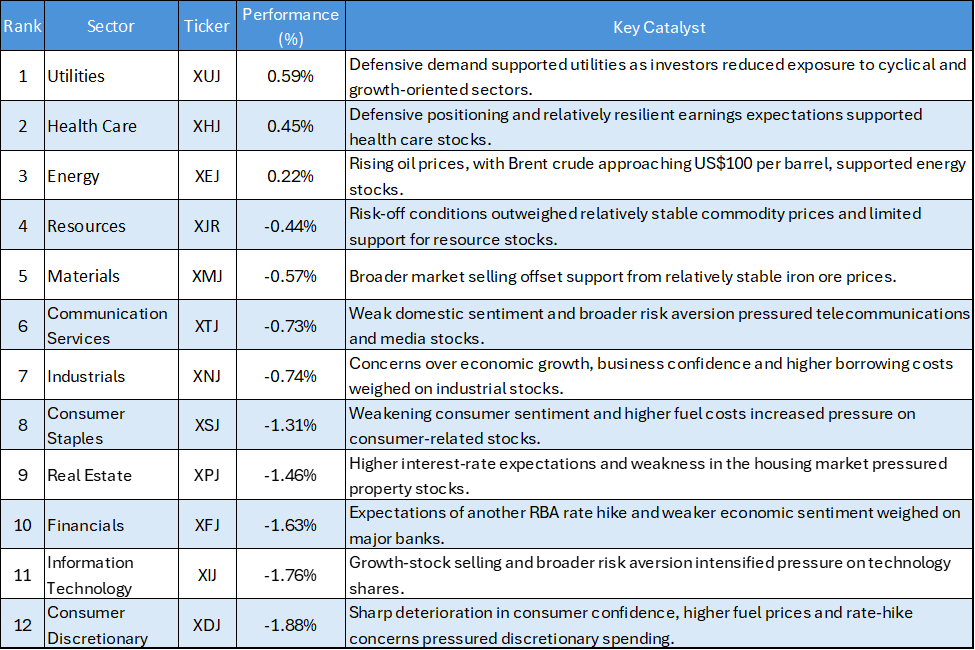
Daily ASX Sector Performance Summary
Utilities and Health Care Take the Lead
Utilities (XUJ) gained 0.59%, making it the strongest-performing sector, while Health Care (XHJ) advanced 0.45%. Energy (XEJ) was the only other sector to finish higher, gaining 0.22%.
The Leadership of Utilities and Health Care points to a defensive shift in investor positioning. With the broader ASX 200 falling 1%, investors appeared to favour sectors with relatively defensive Earnings characteristics while reducing exposure to more economically sensitive areas.
Energy remained resilient despite the broader market weakness. Rising Crude Oil prices provided support to the sector, with Brent Crude trading near US$98 per barrel amid heightened geopolitical tensions. The combination of higher energy prices and defensive positioning helped Energy remain one of only three sectors in positive territory.
Consumer Discretionary and Technology Under Pressure
Consumer Discretionary (XDJ) recorded the largest decline, falling 1.88%, followed by Information Technology (XIJ), which dropped 1.76%. Financials (XFJ) also came under significant pressure, declining 1.63%.
Consumer Discretionary stocks were particularly vulnerable as Australian consumer sentiment deteriorated sharply. The Westpac-Melbourne Institute consumer sentiment index fell 5.2% in September to 84.4, with higher fuel prices and expectations of further interest-rate increases weighing on household finances and spending intentions.
Technology stocks also faced significant selling pressure. Higher interest-rate expectations and a broader reduction in risk appetite created a challenging environment for growth-oriented companies, contributing to the sector's position near the bottom of the daily ranking.
Financials and Real Estate Face Rate Pressure
Financials (XFJ) declined 1.63%, while Real Estate (XPJ) fell 1.46%. Both sectors remained sensitive to expectations for higher interest rates.
Westpac became the latest major Australian bank to forecast another RBA rate increase, with the bank expecting the cash rate to reach 4.60% in November. Markets were also pricing a meaningful probability of an earlier rate increase as Inflation remained above the RBA's comfort zone.
The rate outlook was particularly negative for property stocks. Weakening housing conditions, elevated borrowing costs and concerns about household finances added further pressure to the Real Estate sector.
Resource Sectors Lose Momentum
Resources (XJR) declined 0.44%, while Materials (XMJ) fell 0.57%. This represented a clear Reversal from the previous session, when Resources and Materials were among the strongest-performing sectors.
Energy was the exception, advancing 0.22% as higher oil prices provided direct support. The divergence suggests that the latest commodity-related strength was concentrated in energy rather than reflecting broad-based buying across resource sectors.
The shift is significant because the previous session had been characterised by strong performance from Energy, Resources and Materials. The latest data instead showed defensive Utilities and Health Care moving to the top of the ranking.
Bottom Line
The Australian equity market experienced a broad-based decline on 8 September 2026, with nine of the twelve sectors finishing lower. Utilities led the market with a 0.59% gain, followed by Health Care at 0.45% and Energy at 0.22%.
Consumer Discretionary recorded the largest decline at 1.88%, followed by Information Technology at 1.76% and Financials at 1.63%. The weakness reflected deteriorating consumer confidence, higher oil prices, renewed RBA rate-hike expectations and broad risk aversion.
The key feature of the session was the shift toward defensive leadership. Utilities and Health Care outperformed, while consumer, technology, financial and property sectors experienced heavier selling pressure. Continued outperformance from defensive sectors alongside further weakness in cyclical and growth-oriented areas would strengthen the case for an ongoing defensive rotation.


 Nov 12, 2026





 Please wait processing your request...