
 CA
 NZ
 UK
 US
 IND

 AU

 Share
 X (Formerly Twitter)
 Whatsapp
 Facebook
 LinkedIn
 Telegram
 Email This Article
 Copy Link
 Summarize with AI
 Chat GPT
 Perplexity

Key Highlights
- Utilities Take the Lead: Utilities (XUJ) surged 1.77%, emerging as the strongest-performing sector as investors increased exposure to defensive assets.
- Energy Rebounds Strongly: Energy (XEJ) climbed 1.66%, recovering from the previous session's sharp decline.
- Technology Extends Gains: Technology (XTJ) advanced 1.62%, continuing to attract buying interest for a second consecutive session.
- Consumer Staples and Communication Services Strengthen: Consumer Staples (XSJ) and Communication Services (XPJ) gained 1.06% and 1.02%, respectively, reflecting broad market participation.
- Materials Remain Under Pressure: Materials (XMJ) fell 2.91%, making it the weakest-performing sector of the session.
- Real Estate Continues to Lag: Real Estate (XJR) declined 2.38%, extending its recent weakness following the previous day's losses.
- Market Breadth Remains Positive: Eight sectors finished higher while four sectors closed lower, indicating healthy buying interest despite continued weakness in several cyclical industries.
The Australian equity market delivered a broadly positive performance on July 17, 2026, with investors rotating back into defensive sectors while selectively maintaining exposure to growth-oriented industries. Utilities, Energy, and Technology led the advance, whereas Materials and Real Estate remained under selling pressure. The session highlighted continued sector rotation rather than broad market weakness, as investors balanced defensive positioning with selective growth opportunities.
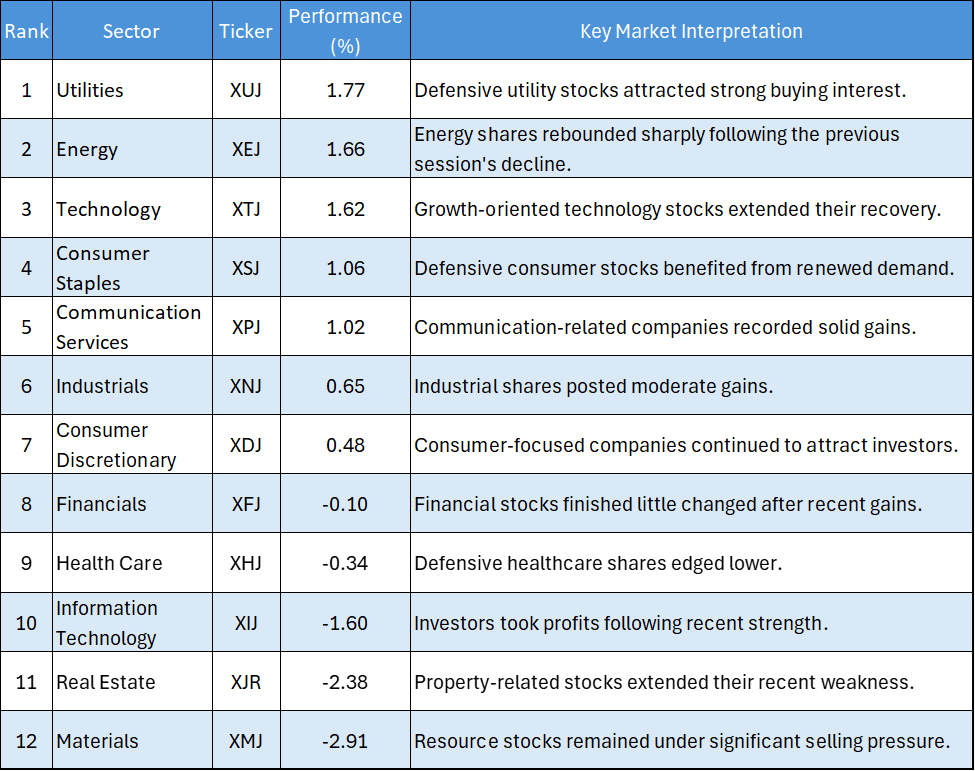
Daily ASX Sector Performance Summary
Key Market Themes
Utilities Move Back into Favour
Utilities (XUJ) delivered the strongest performance of the session, climbing 1.77%. The rebound suggests investors increased exposure to defensive sectors, reflecting a more balanced approach to portfolio positioning after recent rotations between cyclical and growth-oriented industries.
Energy Stages a Strong Recovery
Energy (XEJ) advanced 1.66%, recovering much of the previous session's decline. The sharp rebound indicates investors remain constructive on the sector despite recent volatility, suggesting the earlier weakness was likely driven by short-term profit-taking rather than a deterioration in underlying sentiment.
Technology Continues Its Recovery
Technology (XTJ) gained 1.62%, extending the strong rebound that began in the previous session. Consecutive gains indicate investors continue to favour growth-oriented companies, reinforcing confidence in the sector following recent volatility.
Consumer Staples and Communication Services Participate
Consumer Staples (XSJ) rose 1.06%, while Communication Services (XPJ) added 1.02%. The broad participation across both defensive and growth sectors suggests buying interest remained well diversified rather than concentrated in a single market theme.
Materials and Real Estate Continue to Underperform
Materials (XMJ) fell 2.91%, making it the weakest-performing sector of the day, while Real Estate (XJR) lost 2.38%. The continued weakness suggests investors remain cautious toward resource and property-related companies despite improving sentiment elsewhere in the market.
Mixed Performance Across Remaining Sectors
Industrials (XNJ) and Consumer Discretionary (XDJ) recorded moderate gains, while Financials (XFJ) finished little changed. Meanwhile, Health Care (XHJ) and Information Technology (XIJ) experienced modest declines, highlighting ongoing sector rotation as investors selectively repositioned portfolios.
Bottom Line
The July 17 trading session highlighted continued sector rotation within the Australian market. Utilities, Energy, and Technology led the advance, while Consumer Staples and Communication Services also posted solid gains. In contrast, Materials and Real Estate remained under sustained selling pressure, extending their recent underperformance.
With eight of the twelve sectors closing higher, overall market breadth remained constructive. Going forward, investors will be watching whether the rebound in Utilities, Energy, and Technology can be sustained and whether Materials and Real Estate begin to stabilise after consecutive sessions of weakness.


 Nov 12, 2026





 Please wait processing your request...