
 CA
 NZ
 UK
 US
 IND

 AU

 Share
 X (Formerly Twitter)
 Whatsapp
 Facebook
 LinkedIn
 Telegram
 Email This Article
 Copy Link
 Summarize with AI
 Chat GPT
 Perplexity

Key Highlights
- Utilities Lead the Market: Utilities (XUJ) gained 2.64%, ranking first among all ASX sectors and providing the only significant source of positive momentum.
- Information Technology Holds Marginally Higher: Information Technology (XIJ) advanced 0.16%, becoming the only other sector to finish in positive territory.
- Broad Sector Weakness: Ten of the remaining sectors declined, highlighting a sharp deterioration in Market Breadth compared with the previous session.
- Consumer Discretionary Leads the Declines: Consumer Discretionary (XPJ) fell 1.02%, recording the largest sector loss.
- Defensive and Growth Sectors Diverge: Utilities outperformed strongly, while Telecommunications, Consumer Staples, Communication Services and other sectors came under selling pressure.
- Market Breadth Deteriorates: Only two of the twelve ASX sectors finished higher, while ten sectors declined, indicating a broadly negative trading session.
The Australian Equity market displayed a significantly weaker sector performance on 12 August 2026, with Utilities emerging as the clear standout after gaining 2.64%. Information Technology also edged higher by 0.16%, but the broader market remained under pressure as the other ten sectors finished lower.
The deterioration in market breadth represents a notable change from the previous session, when eight of the twelve ASX sectors advanced. The sharp rotation towards Utilities suggests investors favoured defensive exposure, while weakness across cyclical, consumer and communication-related sectors pointed to more cautious market sentiment.
Daily ASX Sector Performance Summary
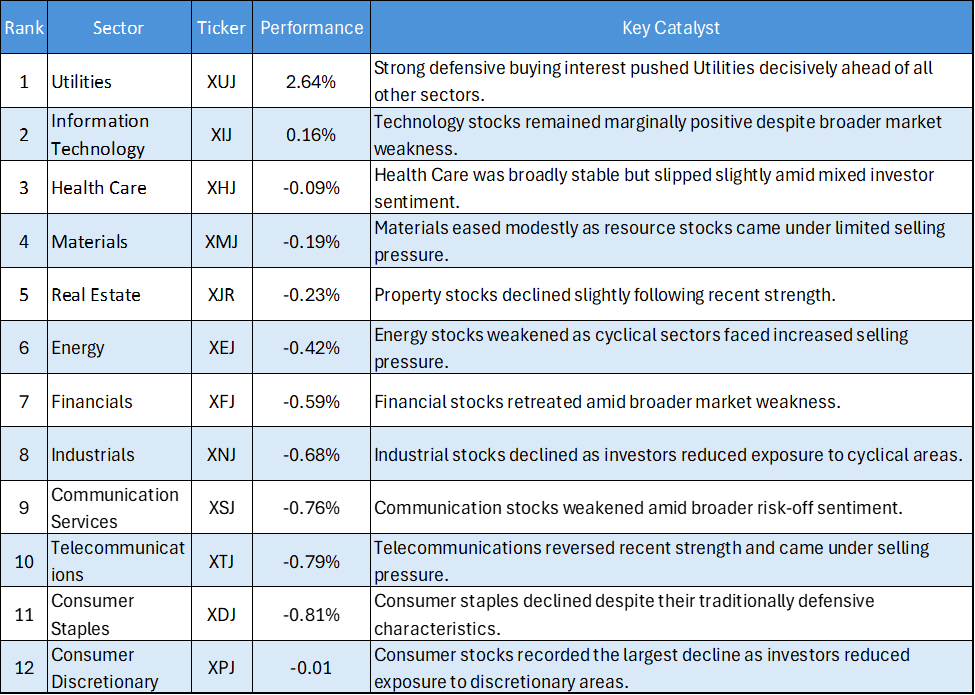
Utilities Take the Lead as Market Breadth Deteriorates
- Utilities (XUJ) surged 2.64%, ranking first among all ASX sectors and significantly outperforming the broader market.
- Information Technology (XIJ) gained 0.16%, providing only limited additional support.
- Health Care (XHJ) declined just 0.09%, remaining relatively resilient compared with most other sectors.
- Materials (XMJ) and Real Estate (XJR) also recorded relatively modest declines of 0.19% and 0.23%, respectively.
The strong performance of Utilities stands out against the widespread weakness elsewhere in the market. Unlike the previous session, when gains were distributed across several sectors, the latest session was characterised by a narrow defensive Leadership pattern. The fact that only two sectors finished higher indicates that buying interest was highly concentrated rather than broad-based.
Technology and Defensive Sectors Provide Limited Support
Information Technology (XIJ) gained 0.16%, remaining marginally positive despite the broader deterioration in market breadth. Health Care also showed relative resilience, declining only 0.09%, while Materials and Real Estate recorded relatively contained losses.
However, the performance of these sectors was insufficient to offset widespread declines elsewhere. Energy fell 0.42%, Financials declined 0.59%, and Industrials eased 0.68%, reflecting weaker participation across several economically sensitive areas.
Telecommunications, Communication Services and Consumer Staples also came under pressure, declining 0.79%, 0.76% and 0.81%, respectively. This broad-based weakness suggests that investors were becoming more selective and increasingly favoured the strongest defensive area of the market rather than maintaining broad exposure.
Consumer and Cyclical Sectors Become the Main Laggards
Consumer Discretionary (XPJ) recorded the largest decline, falling 1.02%, making it the weakest-performing sector of the session. Consumer Staples (XDJ) also declined 0.81%, while Telecommunications (XTJ) fell 0.79%.
The weakness extended across several cyclical sectors, with Industrials, Financials and Energy all finishing lower. This indicates that selling pressure was not limited to a single segment and instead affected a broad range of market exposures.
The contrast with Utilities was particularly notable. While Utilities gained 2.64%, the other eleven sectors either declined or, in the case of Information Technology, posted only a marginal gain. This divergence points to a pronounced defensive rotation during the session.
Bottom Line
The Australian equity market experienced a broadly negative sector session on 12 August 2026, with only two of the twelve ASX sectors finishing higher. Utilities dominated performance with a 2.64% gain, while Information Technology added a modest 0.16%. The remaining ten sectors declined, marking a significant deterioration in market breadth from the previous session.
The strong advance in Utilities suggests that investors shifted towards defensive exposure amid increased caution across the broader market. At the same time, weakness in Consumer Discretionary, Consumer Staples, Telecommunications, Industrials and Financials indicates that selling pressure was relatively widespread rather than concentrated in one sector.
Looking ahead, the sustainability of the Utilities-led advance will be important for assessing market sentiment. A broader recovery across cyclical and growth sectors would provide stronger confirmation of renewed market momentum, while continued weakness across most sectors would indicate that the defensive rotation remains dominant.


 Nov 12, 2026





 Please wait processing your request...