
 CA
 NZ
 UK
 US
 IND

 AU

 Share
 X (Formerly Twitter)
 Whatsapp
 Facebook
 LinkedIn
 Telegram
 Email This Article
 Copy Link
 Summarize with AI
 Chat GPT
 Perplexity

Key Highlights
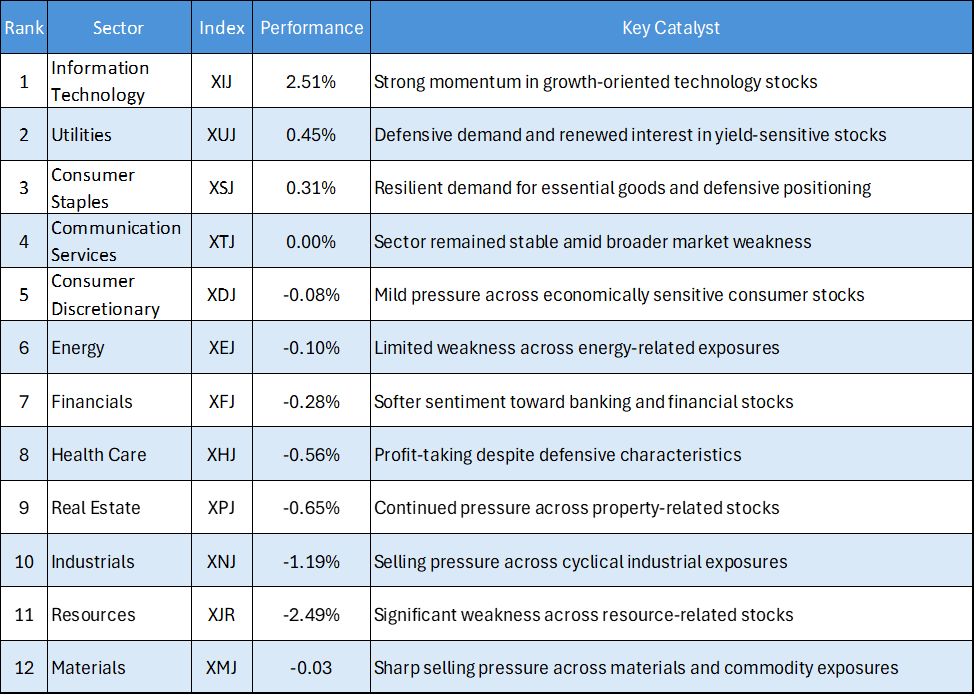
- Information Technology (XIJ) surged 2.51%, ranking first among all ASX sectors and emerging as the strongest source of positive momentum.
- Utilities (XUJ) gained 0.45%, while Consumer Staples (XSJ) rose 0.31%, providing additional support.
- Eight of the twelve ASX sectors declined, indicating a significant deterioration in Market Breadth compared with the previous session.
- Materials (XMJ) fell 2.82%, while Resources (XJR) declined 2.49%, recording the two largest sector losses.
- Industrials (XNJ) dropped 1.19%, adding to weakness across cyclical and commodity-linked sectors.
The Australian Equity market showed a sharp divergence in sector performance on 14 August 2026, with Information Technology emerging as the clear standout after gaining 2.51%. Utilities and Consumer Staples also finished higher, advancing 0.45% and 0.31%, respectively.
However, the overall market breadth weakened considerably, with only three of the twelve sectors advancing and one remaining unchanged. Resources and Materials recorded the largest declines, falling 2.49% and 2.82%, respectively, while Industrials also came under significant pressure. The contrast between strong Technology performance and widespread weakness elsewhere points to a more selective sector rotation.
Daily ASX Sector Performance Summary
Technology Takes the Lead as Market Breadth Deteriorates
The strong performance of Information Technology was the most significant feature of the session. Its 2.51% advance substantially exceeded the gains recorded by Utilities and Consumer Staples, making Technology the dominant source of positive momentum.
At the same time, the fact that only three sectors advanced highlights a significant deterioration in market breadth. Compared with the previous session, when six of twelve sectors gained, the latest performance indicates that buying interest became much more concentrated.
Technology Provides Strong Growth Support
Information Technology gained 2.51%, making it by far the best-performing sector and significantly strengthening its contribution to the broader market. The advance suggests that investors continued to favour growth-oriented technology stocks despite weakness across most cyclical and commodity-related sectors.
Utilities also advanced 0.45%, while Consumer Staples gained 0.31%. Together, these gains indicate that investors maintained exposure to defensive areas alongside the strong Technology performance.
The combination of Technology Leadership and gains in defensive sectors points to a selective rotation rather than a broad-based improvement in risk appetite. Investors appeared willing to add exposure to Growth Stocks while maintaining positions in relatively defensive segments.
Resources and Materials Become the Main Laggards
Materials (XMJ) recorded the largest decline, falling 2.82%, making it the weakest-performing sector of the session. Resources (XJR) also came under heavy pressure, declining 2.49%.
Industrials (XNJ) fell 1.19%, while Real Estate (XPJ) declined 0.65% and Health Care (XHJ) eased 0.56%. Financials (XFJ) also finished lower, slipping 0.28%.
The contrast between Information Technology and the commodity-related sectors was particularly notable. While Technology surged more than 2.5%, Materials and Resources both declined by more than 2%, highlighting a pronounced rotation away from resource and Commodity exposures.
The weakness was also broader than the previous session, with eight sectors finishing lower. This suggests that the strength in Technology, Utilities and Consumer Staples was insufficient to offset selling pressure across the majority of the market.
Bottom Line
The Australian equity market experienced a significant deterioration in sector breadth on 14 August 2026, with only three of the twelve sectors advancing compared with six in the previous session. Information Technology dominated performance with a 2.51% gain, followed by Utilities at 0.45% and Consumer Staples at 0.31%.
The combination of strong Technology performance and modest gains in defensive sectors suggests that investors were selectively increasing exposure rather than participating in a broad-based market advance. At the same time, the sharp declines in Materials and Resources indicate continued pressure across commodity-related segments.
Looking ahead, the sustainability of Technology's leadership and whether participation broadens beyond a small group of sectors will be important for assessing the strength of the market. A recovery in Resources, Materials and Industrials would provide stronger confirmation of improving market breadth, while continued weakness across these sectors could limit broader market momentum.


 Nov 12, 2026





 Please wait processing your request...