
 CA
 NZ
 UK
 US
 IND

 AU

 Share
 X (Formerly Twitter)
 Whatsapp
 Facebook
 LinkedIn
 Telegram
 Email This Article
 Copy Link
 Summarize with AI
 Chat GPT
 Perplexity

Key Highlights
- Technology Ignites a High-Beta Recovery Surge: Information Technology (XIJ) exploded +2.15%, decisively leading the ASX sector leaderboard as institutional Capital aggressively rotated back into growth exposure. The magnitude of the rally strongly suggests active managers are rapidly unwinding prior defensive overcrowding and re-entering high-duration Assets.
- Energy Stages Tactical Rebound: Energy (XEJ) advanced +1.14%, marking the sector’s first meaningful recovery attempt after suffering persistent structural Liquidation in recent sessions. The rebound indicates that deeply oversold Commodity-linked exposures are beginning to attract selective bottom-fishing flows.
- Defensive Complex Suffers Violent Profit-Taking: Utilities (XUJ) collapsed -1.87%, while Real Estate (XPJ) dropped -1.50% and Consumer Staples (XSJ) lost -0.44%. The synchronized breakdown across defensive Yield sectors confirms that institutional desks are actively harvesting profits from crowded safety trades.
- Financials and Materials Continue Structural Weakness: Financials (XFJ) fell another -0.63%, while Materials (XMJ) extended their deterioration with a sharp -1.32% decline. The market’s traditional heavyweight anchors remain under persistent distribution pressure despite the broader recovery in growth appetite.
The ASX session on June 9, 2026, delivered a dramatic Reversal in market Leadership dynamics. Following multiple sessions dominated by defensive capital preservation, institutional flows aggressively rotated back toward high-beta growth and cyclical recovery themes. The session reflected a major reduction in immediate macro panic, with active managers selectively reintroducing risk exposure into oversold segments of the market.
Importantly, this was not a broad-based “risk-on everything” rally. Instead, the tape displayed highly selective capital deployment. Technology and Energy attracted concentrated buying interest, while defensive yield proxies simultaneously experienced violent de-risking. The resulting structure points toward an increasingly tactical, rotational market environment rather than a fully synchronized bull phase.
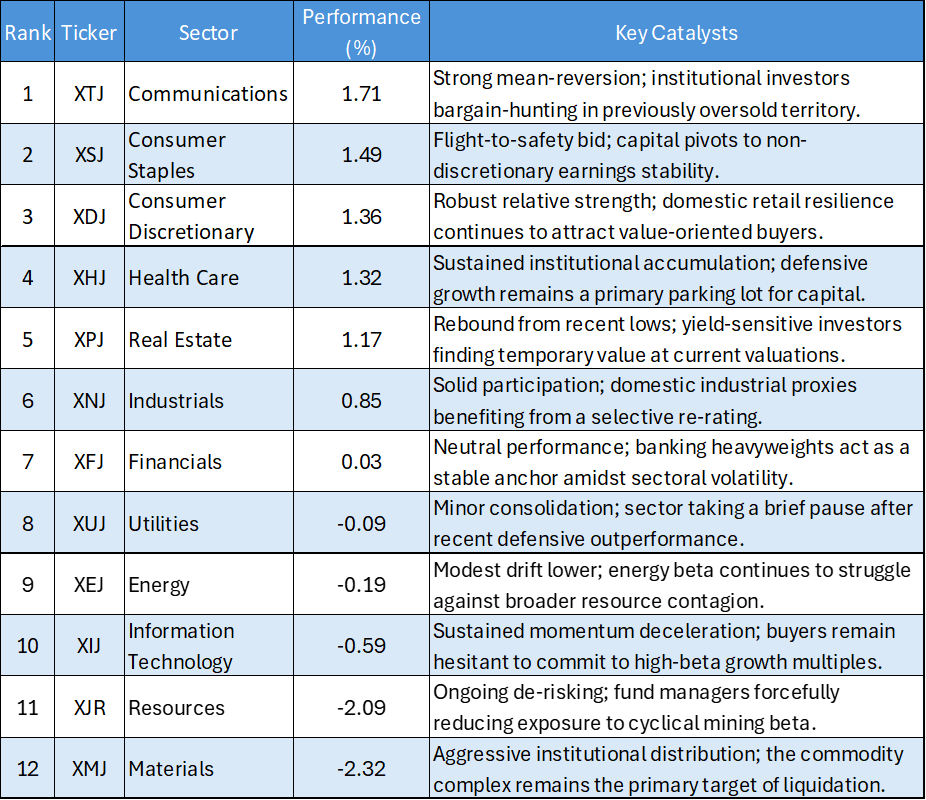
Daily ASX Sector Performance Summary
The following table summarizes the session’s sector performance rankings from strongest to weakest return:
Key Market Themes
Technology Reclaims Institutional Sponsorship
- The defining structural event of the session was the explosive rebound in Information Technology (XIJ). After enduring significant Volatility and aggressive de-risking in prior weeks, the sector suddenly reclaimed institutional sponsorship in force. A +2.15% surge at the sector level reflects more than short-covering activity, it signals active re-engagement by growth-oriented funds seeking high-beta upside participation following the recent correction cycle.
- Importantly, the recovery in XIJ occurred simultaneously with heavy selling across Utilities and Real Estate. This confirms that managers were not simply deploying fresh Liquidity but actively rotating capital away from crowded defensive sanctuaries and back into duration-sensitive growth assets.
Defensive Crowding Begins to Collapse
- The prior defensive trade finally showed clear signs of exhaustion. Utilities (XUJ), Real Estate (XPJ), and Consumer Staples (XSJ) all suffered coordinated declines as institutional desks aggressively harvested gains from sectors that had become heavily overcrowded during the recent volatility spike.
- Utilities’ sharp -1.87% decline was particularly important from a structural perspective. The sector had previously functioned as one of the market’s primary volatility shelters. Its sudden breakdown indicates that institutional capital is becoming increasingly comfortable reintroducing cyclical exposure into portfolios.
Energy Attempts a Structural Recovery
- Energy (XEJ) delivered one of the strongest performances of the session, rallying +1.14% after suffering severe prior weakness. While a single-day rebound does not confirm a durable bottoming process, the magnitude of the move suggests active managers are beginning to test selective re-entry opportunities within deeply discounted commodity-linked assets.
- However, Materials (XMJ) failed to participate in the recovery bid, continuing their structural deterioration with another heavy decline. This divergence implies that institutional desks currently favor energy-specific tactical rebounds over broad-based Mining reaccumulation.
Financials Remain a Structural Liability
- Despite improving risk appetite elsewhere in the market, Financials (XFJ) remained under persistent pressure, declining another -0.63%. The banking complex continues operating as a primary liquidity source for rotational capital flows, highlighting weakening institutional conviction toward the sector.
- The inability of Financials to stabilize during a broader growth rebound raises concerns regarding the benchmark’s underlying structural durability. Historically, sustained market advances become increasingly difficult when the banking complex remains trapped under active distribution pressure.
The June 9 session marked a significant rotational shift within the ASX landscape. Institutional capital aggressively rotated away from crowded defensive sectors and back into high-beta growth exposure, with Information Technology (XIJ) emerging as the session’s dominant leadership engine.
However, the tape remains highly selective rather than universally bullish. Technology and Energy attracted concentrated recovery flows, while Financials and Materials continued exhibiting structural fragility. This divergence confirms that the market is transitioning toward a tactical stock-picker’s environment rather than a synchronized macro expansion.
Active managers should maintain exposure to validated growth leadership while remaining highly disciplined around structurally broken sectors. Technology (XIJ) and selective cyclical recovery themes Warrant increasing attention, but ongoing weakness in Financials (XFJ) and Materials (XMJ) continues limiting the probability of a broad-based market breakout.
In the current environment, flexibility, tactical rotation management, and disciplined sector selection remain critical for navigating the rapidly evolving institutional flow structure.


 Nov 12, 2026





 Please wait processing your request...