
 CA
 NZ
 UK
 US
 IND

 AU

 Share
 X (Formerly Twitter)
 Whatsapp
 Facebook
 LinkedIn
 Telegram
 Email This Article
 Copy Link
 Summarize with AI
 Chat GPT
 Perplexity

Key Highlights
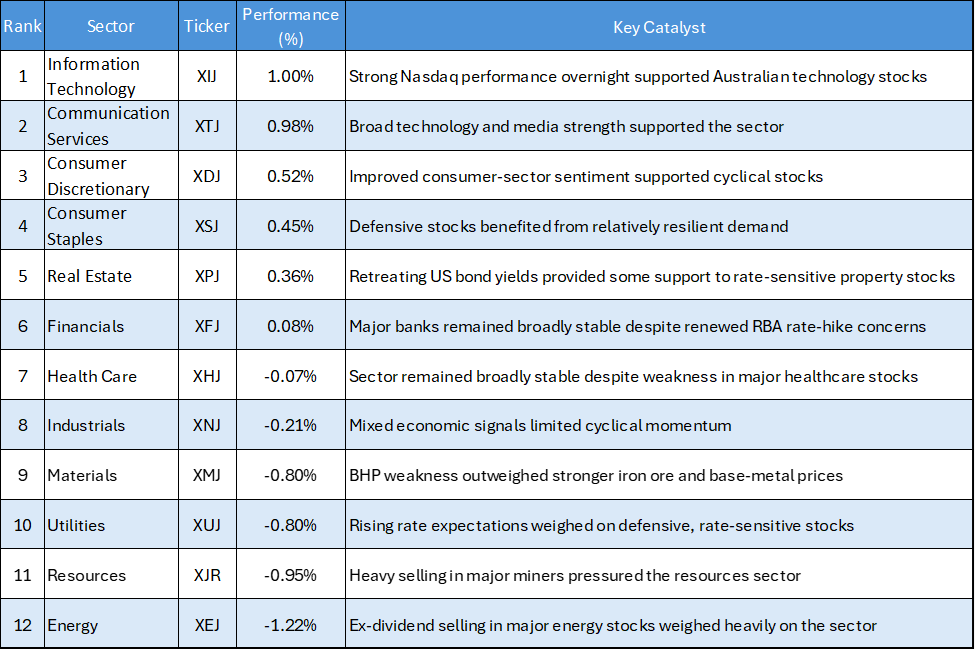
- Information Technology Leads the Market: Information Technology (XIJ) gained 1.00%, recording the strongest performance among all ASX sectors.
- Communication Services Advances: Communication Services (XTJ) rose 0.98%, ranking second.
- Consumer Sectors Strengthen: Consumer Discretionary (XDJ) gained 0.52%, while Consumer Staples (XSJ) added 0.45%.
- Real Estate and Financials Edge Higher: Real Estate (XPJ) advanced 0.36%, while Financials (XFJ) gained 0.08%.
- Six Sectors Finish Higher: Half of the twelve ASX sectors recorded gains, indicating mixed but selective market participation.
- Resources and Utilities Lag: Resources (XJR) and Utilities (XUJ) each declined 0.80%, while Materials (XMJ) fell 0.80%.
- Energy Records the Largest Decline: Energy (XEJ) dropped 1.22%, recording the weakest performance of the session.
- Technology Shows Strong Rebound: The ASX technology sector gained 1.00% after the local technology index had declined sharply over the previous four sessions.
The Australian Equity market displayed mixed sector performance on 4 September 2026, with Information Technology emerging as the strongest sector after gaining 1.00%. Communication Services followed with a 0.98% advance, while Consumer Discretionary and Consumer Staples also recorded solid gains. In contrast, Energy, Resources, Materials and Utilities remained under pressure. The S&P/ASX 200 declined 0.16% to 9,005.9, despite six of the eleven major sectors recording gains.
Daily ASX Sector Performance Summary
Information Technology Takes the Lead
- Information Technology (XIJ) gained 1.00%, clearly outperforming most other ASX sectors.
- Communication Services (XTJ) followed closely with a 0.98% gain.
- Consumer Discretionary (XDJ) advanced 0.52%, while Consumer Staples (XSJ) rose 0.45%.
- Real Estate (XPJ) added 0.36%, while Financials (XFJ) was almost unchanged at 0.08%.
The session's Leadership shifted decisively toward technology and communication-related stocks. The All Technology Index gained 1.05%, supported by a 1.40% overnight rise in the Nasdaq. Technology stocks including WiseTech Global, Megaport and Life360 recorded strong gains.
The rebound was particularly notable because the local technology index had fallen approximately 6.1% over the previous four sessions. The recovery therefore represented an important short-term Reversal in momentum.
Communication Services also gained 0.98%, although the sector remained highly divergent at the stock level. Nine Entertainment fell 8.50% after Bruce Gordon's Birketu vehicle disclosed that it had increased its voting power to 25.94%.
Consumer Sectors and Real Estate Show Relative Strength
Consumer Discretionary (XDJ) gained 0.52%, while Consumer Staples (XSJ) advanced 0.45%. The gains indicate relatively resilient consumer-sector performance despite the broader weakness in the S&P/ASX 200.
Real Estate (XPJ) also advanced 0.36%, benefiting from a modest retreat in benchmark US bond yields. Lower yields provided some relief for rate-sensitive assets, although renewed expectations for further RBA tightening remained a constraint on domestic rate-sensitive sectors.
Financials were almost unchanged, gaining only 0.08%. Major banks provided little support, with the big four banks recording a median move of approximately -0.08%. Meanwhile, forecasts from NAB, Deutsche Bank and UBS pointed toward a potential RBA cash-rate increase to 4.60% later in September.
Resources, Materials and Utilities Lag
The weakest part of the market was concentrated in Resources, Materials, Utilities and Energy.
Resources (XJR) declined 0.95%, while Materials (XMJ) fell 0.80%. Major Mining stocks were responsible for much of the weakness, with BHP falling 2.40% and extending its decline from its recent record high. This occurred despite iron ore and copper prices strengthening, highlighting that the selling pressure was driven more by individual-stock and market-positioning factors than by underlying Commodity prices.
Utilities (XUJ) also declined 0.80%, reflecting pressure on rate-sensitive stocks as investors continued to consider the possibility of further Australian interest-rate increases.
Energy Records the Largest Decline
Energy (XEJ) fell 1.22%, recording the largest sector decline.
The weakness was heavily influenced by ex-dividend trading. Energy stocks including Ampol and Viva Energy traded ex-dividend, contributing materially to the sector's decline. MarketIndex noted that ex-dividend adjustments accounted for much of the sector's 1.22% fall.
The sector's weakness therefore needs to be interpreted carefully because part of the decline reflected mechanical Dividend adjustments rather than purely negative investor sentiment.
Bottom Line
The Australian equity market displayed mixed sector momentum on 4 September 2026, with Information Technology leading the gains at 1.00%, followed closely by Communication Services at 0.98%. Consumer Discretionary, Consumer Staples and Real Estate also recorded positive performance.
However, the underlying market remained fragile. The S&P/ASX 200 declined 0.16%, while Resources, Materials, Utilities and Energy recorded substantial losses.
The key feature of the session was the rotation toward technology and communication stocks, supported by strong overnight Nasdaq performance, while mining and energy stocks weighed on the broader index. Technology's rebound was particularly significant after its sharp decline during the preceding four sessions.
Looking ahead, sustained strength in Information Technology and Communication Services could improve overall market momentum. However, a recovery in Resources, Materials and Energy would be important to confirm a broader sector rotation rather than a narrow rebound concentrated in technology-related stocks.


 Nov 12, 2026





 Please wait processing your request...