
 CA
 NZ
 UK
 US
 IND

 AU

 Share
 X (Formerly Twitter)
 Whatsapp
 Facebook
 LinkedIn
 Telegram
 Email This Article
 Copy Link
 Summarize with AI
 Chat GPT
 Perplexity

Key Highlights
- Materials (XMJ) gained 1.76%, ranking first among all ASX sectors and emerging as the strongest source of positive momentum.
- Resources (XJR) advanced 1.73%, while Energy (XEJ) rose 0.93%, providing strong support from commodity-related sectors.
- Four of the twelve ASX sectors advanced, an improvement from the three advancing sectors in the previous session.
- Consumer Discretionary (XDJ) fell 3.00%, recording the largest sector decline, while Financials (XFJ) dropped 1.76%.
- Real Estate (XPJ) and Health Care (XHJ) also weakened significantly, declining 1.04% and 0.85%, respectively.
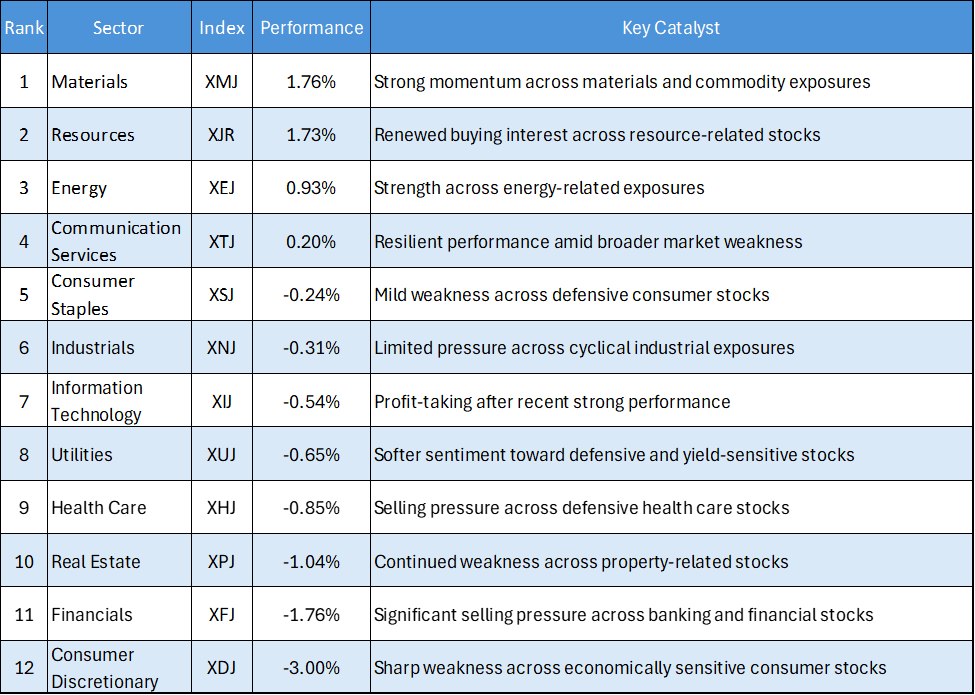
The Australian Equity market showed a pronounced rotation toward commodity-related sectors on 17 August 2026, with Materials emerging as the strongest performer after gaining 1.76%. Resources and Energy also recorded solid gains of 1.73% and 0.93%, respectively.
However, overall Market Breadth remained weak, with only four of the twelve sectors advancing. Consumer Discretionary recorded the largest decline at 3.00%, followed by Financials at 1.76%. The contrast between strong Materials and Resources performance and widespread weakness across consumer, financial and defensive sectors points to a notable shift in sector leadership.
Daily ASX Sector Performance Summary
Materials and Resources Lead as Sector Rotation Accelerates
The strong performance of Materials and Resources was the most significant feature of the session. Materials gained 1.76%, narrowly outperforming Resources at 1.73%, while Energy added another 0.93%.
The combined strength of these three commodity-related sectors represents a notable change from the previous session, when Materials and Resources were among the weakest performers. The latest rebound therefore suggests a short-term rotation back toward resource and Commodity exposures.
At the same time, only four sectors advanced, indicating that the recovery remained concentrated rather than broad-based.
Commodity Sectors Provide Strong Support
Materials gained 1.76%, making it the best-performing sector and the strongest contributor to the market's positive momentum. Resources followed closely with a 1.73% advance, while Energy rose 0.93%.
The strength across these three sectors suggests that investors increased exposure to commodity-related areas despite continued weakness across much of the broader market.
Communication Services was the only other sector to finish higher, gaining a modest 0.20%.
The contrast between commodity-sector strength and weakness across Technology, Financials, Real Estate and Consumer Discretionary points to a clear shift in short-term sector preference.
Consumer Discretionary and Financials Become the Main Laggards
Consumer Discretionary (XDJ) recorded the largest decline, falling 3.00%, making it the weakest-performing sector of the session. Financials (XFJ) also came under significant pressure, declining 1.76%.
Real Estate (XPJ) fell 1.04%, while Health Care (XHJ) declined 0.85% and Utilities (XUJ) eased 0.65%. Information Technology (XIJ) also finished lower, slipping 0.54% after its strong performance in the previous session.
The contrast between Materials and Resources and the consumer and financial sectors was particularly notable. While commodity-related sectors gained strongly, economically sensitive consumer stocks and financials experienced substantial selling pressure.
Market Breadth Shows Modest Improvement
Although the majority of sectors remained negative, the number of advancing sectors increased from three to four compared with the previous session. This represents a modest improvement in breadth, but it is not yet sufficient to indicate a broad-based market recovery.
The composition of the gains is also important. Materials, Resources and Energy accounted for three of the four advancing sectors, meaning that the improvement was heavily concentrated in commodity-related exposures.
The weakness across seven sectors also indicates that investors remained selective. Sustained gains across additional cyclical and growth sectors would be required to confirm a broader improvement in market participation.
Bottom Line
The Australian equity market experienced a significant sector rotation on 17 August 2026, with Materials leading the market at 1.76%, followed closely by Resources at 1.73% and Energy at 0.93%. Four of the twelve sectors advanced, representing a modest improvement from the previous session.
The strong rebound in Materials and Resources is particularly notable given their sharp declines in the previous session, suggesting that commodity-related sectors regained investor interest. However, the weakness across Consumer Discretionary, Financials, Real Estate and Health Care indicates that market breadth remains relatively weak.
Looking ahead, the sustainability of Materials and Resources Leadership and whether gains broaden into Technology, Financials, Consumer Discretionary and other cyclical sectors will be important for assessing the strength of the market. Continued strength in commodity-related sectors alongside improving participation elsewhere would provide stronger confirmation of a broader recovery, while persistent weakness across the majority of sectors could continue to limit overall market momentum.


 Nov 12, 2026





 Please wait processing your request...