
 CA
 NZ
 UK
 US
 IND

 AU

 Share
 X (Formerly Twitter)
 Whatsapp
 Facebook
 LinkedIn
 Telegram
 Email This Article
 Copy Link
 Summarize with AI
 Chat GPT
 Perplexity

Key Highlights
- Materials Leads the Market: Materials (XMJ) surged 1.70%, emerging as the strongest-performing sector as investors increased exposure to resource-related stocks.
- Real Estate Extends Its Strength: Real Estate (XJR) gained 1.35%, reflecting growing confidence in property-related assets.
- Defensive Sectors Remain Resilient: Utilities (XUJ), Information Technology (XIJ), and Communication Services (XPJ) all finished modestly higher despite a mixed market environment.
- Financials Hold Firm: Financials (XFJ) advanced 0.15%, maintaining positive momentum and continuing to support the broader market.
- Technology Becomes the Largest Laggard: Technology (XTJ) fell 1.20%, making it the weakest-performing sector of the session as investors reduced exposure to growth-oriented shares.
- Energy Loses Momentum: Energy (XEJ) declined 0.57%, reversing part of its strong gains from the previous session.
- Market Breadth Remains Balanced: Seven sectors closed higher while five sectors finished lower, highlighting selective sector rotation rather than broad-based buying.
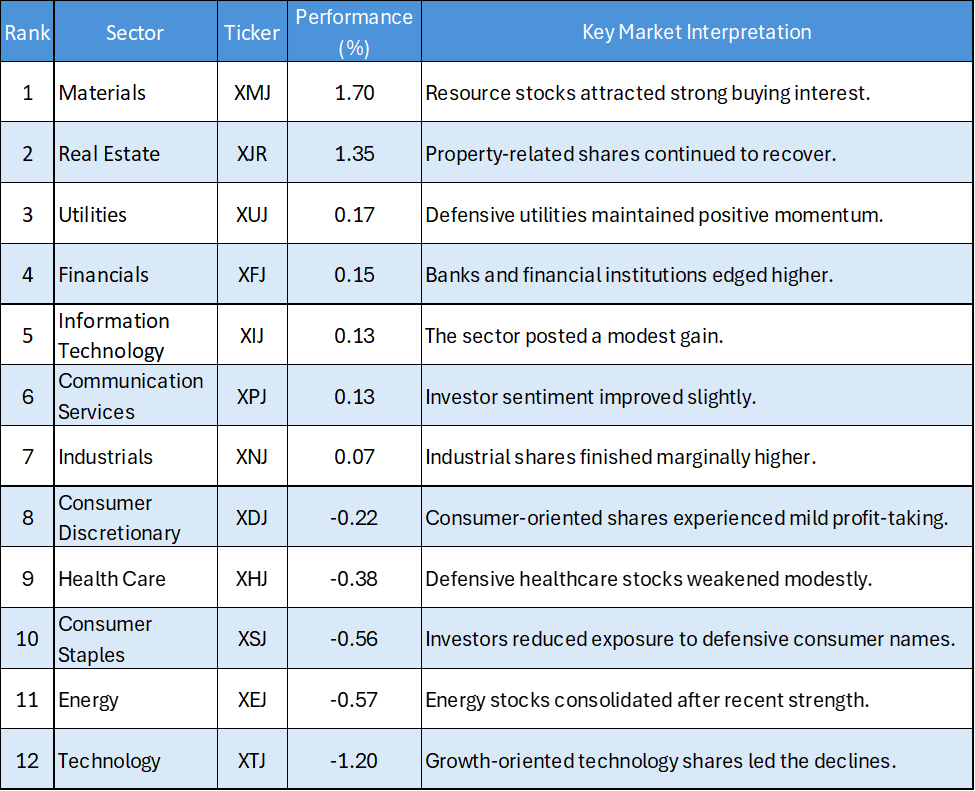
The Australian equity market delivered a mixed performance on July 15, 2026, as investors rotated away from Technology and Energy while increasing exposure to Materials and Real Estate. Strong gains in resource and property-related sectors helped offset weakness across Technology, Consumer Staples, and Health Care. The session highlighted a more balanced market environment following the strong cyclical rally seen in the previous trading session, with investors selectively targeting sectors offering attractive valuation and recovery opportunities.
Daily ASX Sector Performance Summary
Key Market Themes
Materials Takes the Lead
- Materials (XMJ) delivered the strongest performance of the session, rising 1.70%. The sharp gain reflects renewed investor interest in resource-related companies and commodity-linked opportunities. The sector's leadership suggests investors remain optimistic about economic activity and infrastructure-related demand despite recent market volatility.
Real Estate Continues to Recover
- Real Estate (XJR) advanced 1.35%, making it the second-best performer of the day. The strong gain indicates improving confidence toward property-related assets and income-generating investments. Continued strength in the sector suggests investors are becoming more comfortable with the outlook for interest rates and asset valuations.
Financials and Defensive Sectors Hold Steady
- Financials (XFJ) rose 0.15%, while Utilities (XUJ), Information Technology (XIJ), and Communication Services (XPJ) also recorded modest gains. The positive performances across these sectors indicate that investors remain willing to maintain diversified exposure despite ongoing sector rotation.
Technology Experiences Profit-Taking
- Technology (XTJ) fell 1.20%, making it the weakest-performing sector of the session. The decline follows recent gains and appears consistent with short-term profit-taking rather than a significant deterioration in sector fundamentals. Nevertheless, the move highlights investor caution toward higher-growth areas of the market.
Energy Gives Back Recent Gains
- Energy (XEJ) declined 0.57% after leading the market higher in the previous session. The weakness suggests investors locked in profits following the sector's strong advance. While near-term momentum has softened, Energy remains one of the market's key cyclical sectors and continues to benefit from supportive long-term fundamentals.
Consumer Staples and Health Care Underperform
- Consumer Staples (XSJ) lost 0.56%, while Health Care (XHJ) slipped 0.38%. The declines indicate investors reduced exposure to traditional defensive sectors in favour of areas offering stronger recovery potential. Despite the weakness, both sectors continue to provide defensive characteristics that may attract buyers during periods of heightened uncertainty.
Bottom Line
The July 15 trading session highlighted a rotation toward Materials and Real Estate, while Technology and Energy experienced profit-taking after recent strength. The strong performances from resource and property-related sectors suggest investors remain constructive on areas tied to economic activity and asset values.
Although market leadership shifted during the session, overall market breadth remained healthy, with seven of the twelve sectors finishing higher. Going forward, investors will be watching whether Materials and Real Estate can sustain their momentum and whether the weakness in Technology and Energy represents a temporary pause or the beginning of a broader consolidation phase.


 Nov 12, 2026





 Please wait processing your request...