
 CA
 NZ
 UK
 US
 IND

 AU

 Share
 X (Formerly Twitter)
 Whatsapp
 Facebook
 LinkedIn
 Telegram
 Email This Article
 Copy Link
 Summarize with AI
 Chat GPT
 Perplexity

Key Highlights
- Materials Lead the Market: Materials (XMJ) surged 1.37%, emerging as the strongest-performing sector as investors continued to favour resource-related stocks.
- Real Estate Maintains Momentum: Real Estate (XJR) gained 1.24%, extending its recent recovery as confidence in property-related companies remained firm.
- Energy Continues to Advance: Energy (XEJ) rose 0.98%, reinforcing its position as one of the market's strongest-performing sectors.
- Utilities and Communication Services Finish Higher: Utilities (XUJ) and Communication Services (XPJ) climbed 0.65% and 0.51%, respectively, reflecting continued selective buying across defensive and growth-oriented sectors.
- Information Technology Leads the Declines: Information Technology (XIJ) fell 3.32%, making it the weakest-performing sector following the previous session's strong rally.
- Consumer Discretionary and Health Care Remain Under Pressure: Consumer Discretionary (XDJ) declined 1.52%, while Health Care (XHJ) lost 1.43%, indicating continued sector rotation away from these industries.
- Market Breadth Remains Evenly Balanced: Six of the twelve sectors finished higher, while the remaining six closed lower, highlighting continued selective sector rotation rather than broad-based buying.
The Australian equity market delivered another rotational trading session on 23 July 2026, with investors maintaining strong exposure to Materials, Real Estate, and Energy while reducing positions in Information Technology and several consumer-oriented sectors. Resource-related companies continued to attract buying interest, whereas the sharp decline in Information Technology suggests investors took profits following the sector's recent outperformance. Overall, the session reflected continued sector rotation as capital flowed into cyclical industries while previously strong growth sectors experienced renewed selling pressure.
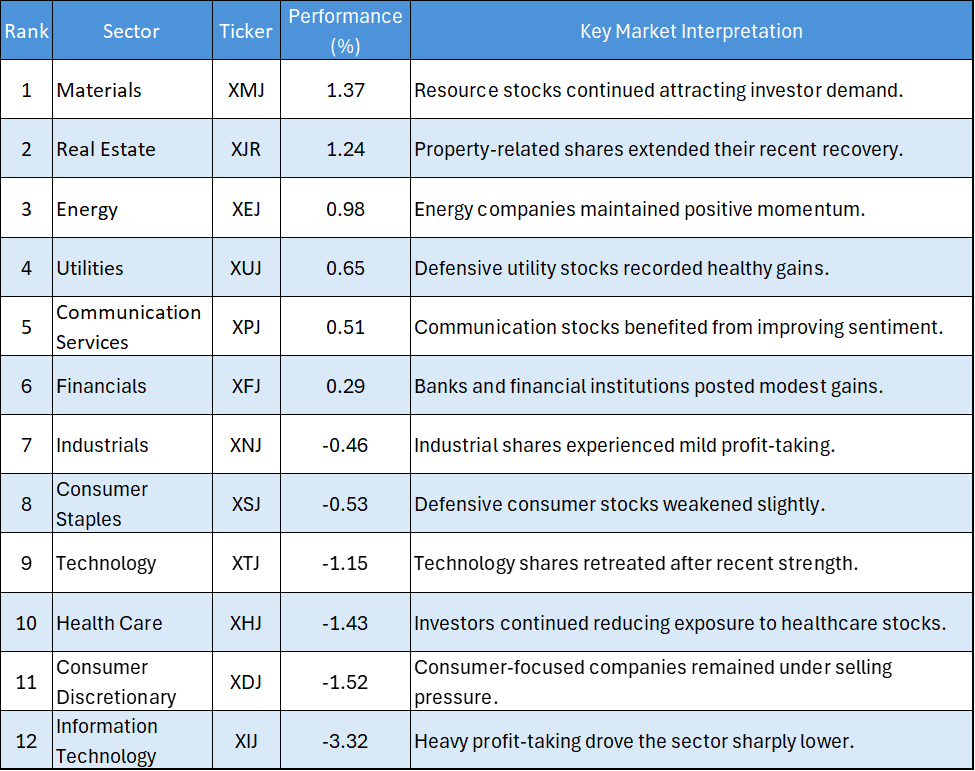
Daily ASX Sector Performance Summary
Key Market Themes
Materials and Real Estate Continue to Outperform
- Materials (XMJ) delivered the strongest performance of the session, advancing 1.37%. The continued strength suggests investors remain optimistic about mining and commodity-related companies, with capital continuing to flow into resource stocks despite recent market volatility.
- Real Estate (XJR) climbed 1.24%, making it the second-best-performing sector. The gain indicates improving confidence toward property-related companies and suggests investors continue to favour interest rate-sensitive sectors amid expectations of a stable monetary policy outlook.
Energy Maintains Its Leadership
- Energy (XEJ) gained 0.98%, extending its recent run of positive performance. The sector continues to benefit from sustained investor demand and remains one of the market's strongest-performing cyclical industries. Its consistent outperformance suggests institutional investors continue allocating capital to energy-related companies.
Utilities and Communication Services Record Solid Gains
- Utilities (XUJ) rose 0.65%, reflecting renewed interest in defensive income-generating assets. The sector's positive performance indicates investors continue balancing exposure between cyclical growth opportunities and defensive holdings.
- Communication Services (XPJ) added 0.51%, suggesting improving investor confidence toward selected communication and media companies despite weakness across several other growth-oriented sectors.
Information Technology Suffers Heavy Profit-Taking
- Information Technology (XIJ) dropped 3.32%, making it the weakest-performing sector of the day. The sharp decline follows the sector's strong rally in the previous session and suggests investors locked in profits after recent gains rather than signalling a broad deterioration in long-term sentiment.
- Technology (XTJ) also declined 1.15%, reinforcing the view that growth-oriented sectors experienced broad-based profit-taking during the session.
Consumer-Oriented and Defensive Sectors Continue to Lag
- Consumer Discretionary (XDJ) fell 1.52%, while Health Care (XHJ) declined 1.43%, reflecting continued weakness across both consumer-focused and defensive industries.
- Consumer Staples (XSJ) eased 0.53%, indicating investors remained cautious toward traditionally defensive sectors as capital continued rotating into resources and property-related companies.
Bottom Line
The Australian market continued to exhibit clear signs of sector rotation on 23 July 2026, with investors maintaining a preference for Materials, Real Estate, and Energy, while reducing exposure to Information Technology, Consumer Discretionary, and Health Care. The sharp decline in Information Technology appears consistent with profit-taking following the sector's previous strength, rather than a widespread deterioration in market sentiment.
Looking ahead, sustained leadership from cyclical sectors such as Materials, Energy, and Real Estate would reinforce the market's constructive outlook. However, investors should continue monitoring whether selling pressure in growth-oriented sectors stabilises, as renewed participation from Technology and Information Technology would likely broaden the current market rally.


 Nov 12, 2026





 Please wait processing your request...