
 CA
 NZ
 UK
 US
 IND

 AU

 Share
 X (Formerly Twitter)
 Whatsapp
 Facebook
 LinkedIn
 Telegram
 Email This Article
 Copy Link
 Summarize with AI
 Chat GPT
 Perplexity

Key Highlights
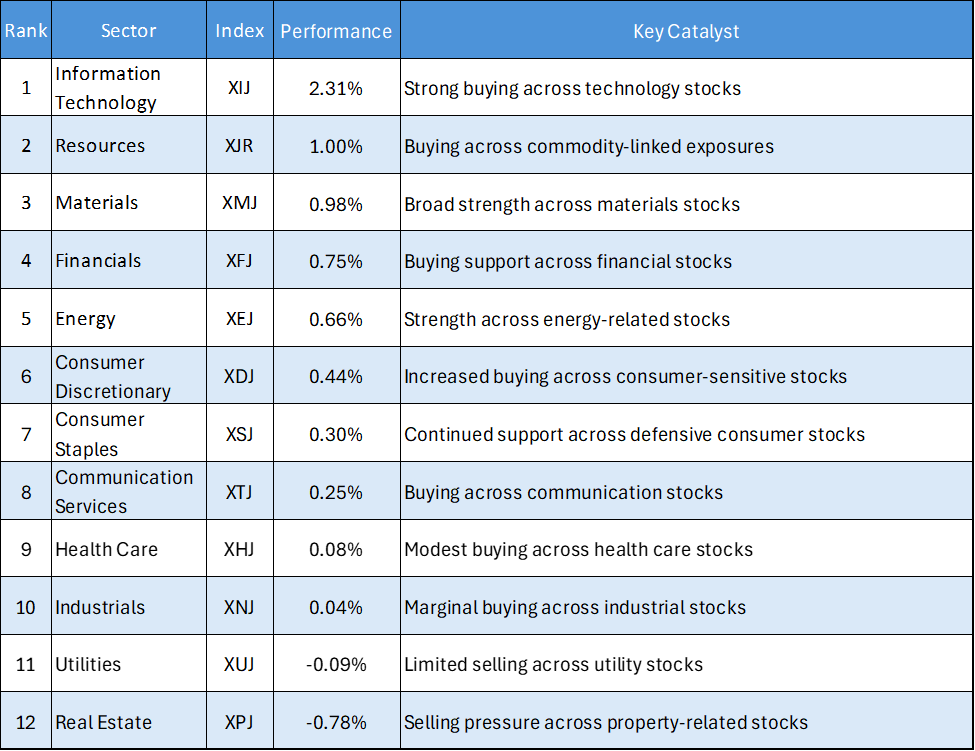
- Information Technology Leads the Market: Information Technology (XIJ) surged 2.31%, recording the strongest performance among all ASX sectors.
- Resources and Materials Advance Strongly: Resources (XJR) gained 1.00%, while Materials (XMJ) rose 0.98%.
- Financials and Energy Move Higher: Financials (XFJ) increased 0.75%, while Energy (XEJ) advanced 0.66%.
- Consumer Discretionary and Consumer Staples Gain: Consumer Discretionary (XDJ) rose 0.44%, while Consumer Staples (XSJ) added 0.30%.
- Most Sectors Finish Higher: Communication Services (XTJ), Health Care (XHJ) and Industrials (XNJ) also recorded modest gains.
- Utilities and Real Estate Decline: Utilities (XUJ) slipped 0.09%, while Real Estate (XPJ) fell 0.78%.
- Very Strong Market Breadth: Ten of the twelve ASX sectors advanced, while only two declined, highlighting broad-based buying support across the market.
The Australian Equity market delivered a broadly stronger sector performance on 28 August 2026, with Information Technology emerging as the strongest sector after gaining 2.31%. Resources and Materials also recorded gains of around 1%, while most other sectors finished higher. Only Utilities and Real Estate declined, indicating broad participation on the upside.
Daily ASX Sector Performance Summary
Information Technology Takes the Lead
- Information Technology (XIJ) gained 2.31%, clearly outperforming all other ASX sectors.
- Resources (XJR) advanced 1.00%, reaching the second-strongest position.
- Materials (XMJ) rose 0.98%, also posting a strong performance.
- Financials (XFJ) increased 0.75%, adding further support to the broader market.
The session's Leadership was concentrated in Information Technology, which recorded a substantially stronger gain than the other sectors. The 2.31% advance indicates strong buying interest in technology stocks and represents a notable improvement in market participation.
Resources and Materials also performed strongly, with gains of 1.00% and 0.98%, respectively. Their strength suggests that buying interest extended beyond growth-oriented technology stocks into commodity-linked sectors.
Most Sectors Finish Higher
Ten of the twelve ASX sectors advanced during the session, indicating very strong market breadth.
Energy and Financials gained 0.66% and 0.75%, respectively, while Consumer Discretionary and Consumer Staples increased 0.44% and 0.30%. Communication Services, Health Care and Industrials also finished higher, although their gains were more modest.
The broad participation on the upside indicates that buying pressure extended across most major areas of the Australian equity market rather than being concentrated in a small number of sectors. The fact that ten sectors advanced represents a significant improvement in breadth compared with the previous session, when only two sectors gained.
Real Estate and Utilities Lag
Weakness was limited to Real Estate and Utilities. Real Estate (XPJ) declined 0.78%, recording the largest decline of the session, while Utilities (XUJ) slipped 0.09%.
The underperformance of Real Estate was particularly notable because it was the only sector to record a decline approaching 1%. However, the weakness remained relatively isolated and was insufficient to offset the broad gains across the remaining sectors.
The strong performance of Information Technology, combined with gains across Resources, Materials, Financials and Energy, points to a much more balanced and positive sector structure.
Bottom Line
The Australian equity market displayed very strong sector momentum on 28 August 2026, with Information Technology leading the gains at 2.31%. Resources and Materials also performed strongly, gaining 1.00% and 0.98%, respectively.
With ten of the twelve sectors finishing higher, Market Breadth was clearly positive. The broad-based gains across technology, resources, materials, financials and energy indicate widespread buying support rather than a narrowly driven market rally.
Looking ahead, continued strength across Information Technology, Resources and Materials would support the broader market trend. A recovery in Real Estate and Utilities would further improve sector participation and create an even more balanced market structure.


 Nov 12, 2026





 Please wait processing your request...