
 CA
 NZ
 UK
 US
 IND

 AU

 Share
 X (Formerly Twitter)
 Whatsapp
 Facebook
 LinkedIn
 Telegram
 Email This Article
 Copy Link
 Summarize with AI
 Chat GPT
 Perplexity

Key Highlights
- Heavyweight Distribution: The Australian market's two foundational pillars, Materials (XMJ) and Financials (XFJ), suffered synchronized capital outflows, closing at -0.55% and -0.50% respectively, creating a severe structural anchor for the broader index.
- Energy Defends the Upside: Energy (XEJ) managed to capture the highest relative strength of the session, establishing the upper bound with a 0.89% gain.
- Constricted Performance Spread: The session was characterized by extremely low volatility and narrow dispersion, with the absolute performance spread across all 12 sectors contained within a tight 1.44% range.
- Fractured Market Breadth: The tape was split almost evenly, with seven sectors printing modest positive returns while five sectors recorded outright distribution.
The ASX equity market session on May 5, 2026, delivered a heavily suppressed tape. Unlike the aggressive upside skew witnessed earlier in the month, this session lacked definitive directional thrust. The mathematical reality of the ASX index structure dictates that when both the Materials and Financials complexes print synchronous negative returns, the broader benchmark is effectively paralyzed. Capital flows were highly selective, favoring fragmented pockets of strength in Energy and Technology while actively distributing traditional heavyweight risk.
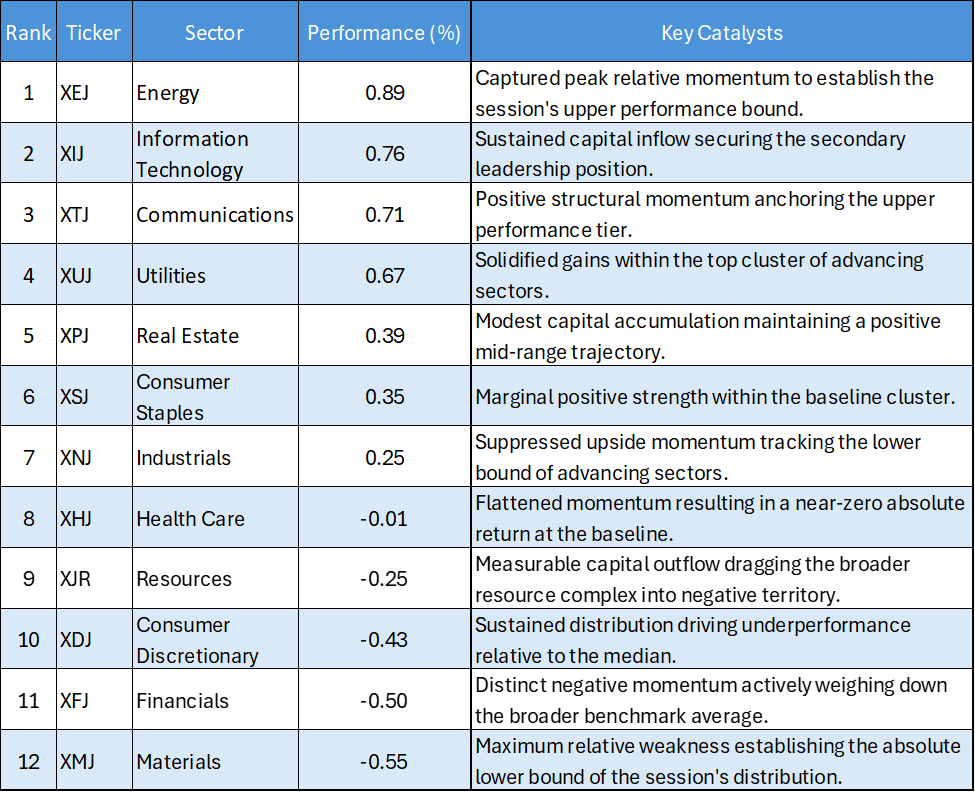
Daily ASX Sector Performance Summary (05/05/2026)
The following table summarizes the day's performance across the major ASX sectors, ordered by highest recorded return.
Key Market Themes
The Suppressed Upper Bound (Returns Under 1.00%)
The most defining statistical footprint of the May 5 session is the complete absence of a +1.00% print anywhere on the board. The leadership cohort—comprising Energy (XEJ), Information Technology (XIJ), Communications (XTJ), and Utilities (XUJ)—all clustered within a tight 0.22% band at the top. This indicates an environment devoid of aggressive breakout momentum, where advancing sectors were merely treading water rather than executing structural advances.
The Mid-Range Baseline
Sectors such as Real Estate (XPJ), Consumer Staples (XSJ), and Industrials (XNJ) operated as pure statistical noise during the session. Generating returns between 0.25% and 0.39%, these sectors experienced low-velocity capital flows, effectively holding neutral patterns while the primary tug-of-war occurred at the extremes of the distribution.
The Synchronized Heavyweight Drag
The primary catalyst for the session's overall weakness was the alignment of the laggards. Consumer Discretionary (XDJ), Financials (XFJ), and Materials (XMJ) formed a distinct cluster of underperformance at the bottom of the table. Because Materials and Financials account for the lion's share of the ASX's market capitalization, their combined negative skew of -0.55% and -0.50% mathematically overwhelmed the modest, sub-one-percent gains achieved by the session's leaders.
Bottom Line
The empirical data from May 5 outlines a tape defined by structural drag. The inability of any single sector to breach the 1.00% upside threshold confirms a lack of aggressive institutional accumulation. Furthermore, the synchronized distribution in the index's core engines, Materials and Financials, creates a mathematically hostile environment for broad market continuation. Until these primary pillars arrest their current downward trajectories and cross back above the zero-line, the benchmark remains highly vulnerable to continued downward drift.


 Nov 12, 2026





 Please wait processing your request...