
 CA
 NZ
 UK
 US
 IND

 AU

 Share
 X (Formerly Twitter)
 Whatsapp
 Facebook
 LinkedIn
 Telegram
 Email This Article
 Copy Link
 Summarize with AI
 Chat GPT
 Perplexity

Key Highlights
- Health Care Outperforms the Market: Health Care (XHJ) gained 0.77%, emerging as the strongest-performing sector as investors returned to defensive growth opportunities amid a mixed market environment.
- Utilities and Real Estate Advance: Utilities (XUJ) rose 0.52% while Real Estate (XJR) added 0.37%, highlighting renewed demand for defensive and interest-rate-sensitive sectors.
- Resources and Energy Show Resilience: Energy (XEJ) and Materials (XMJ) posted modest gains, indicating selective buying interest across commodity-related sectors.
- Financials and Consumer Staples Under Pressure: Financials (XFJ) fell 1.67% and Consumer Staples (XSJ) declined 2.14%, making them the weakest-performing sectors of the session.
The Australian equity market delivered a mixed performance on July 1, 2026, as investors rotated away from recent market leaders and toward defensive sectors such as Health Care, Utilities, and Real Estate. While gains across Energy and Materials provided additional support, weakness in Financials, Consumer Staples, Industrials, and Technology weighed on overall sentiment.
The session reflected a more cautious market tone, with investors favouring sectors offering earnings resilience and defensive characteristics while reducing exposure to areas that had previously attracted strong capital inflows.
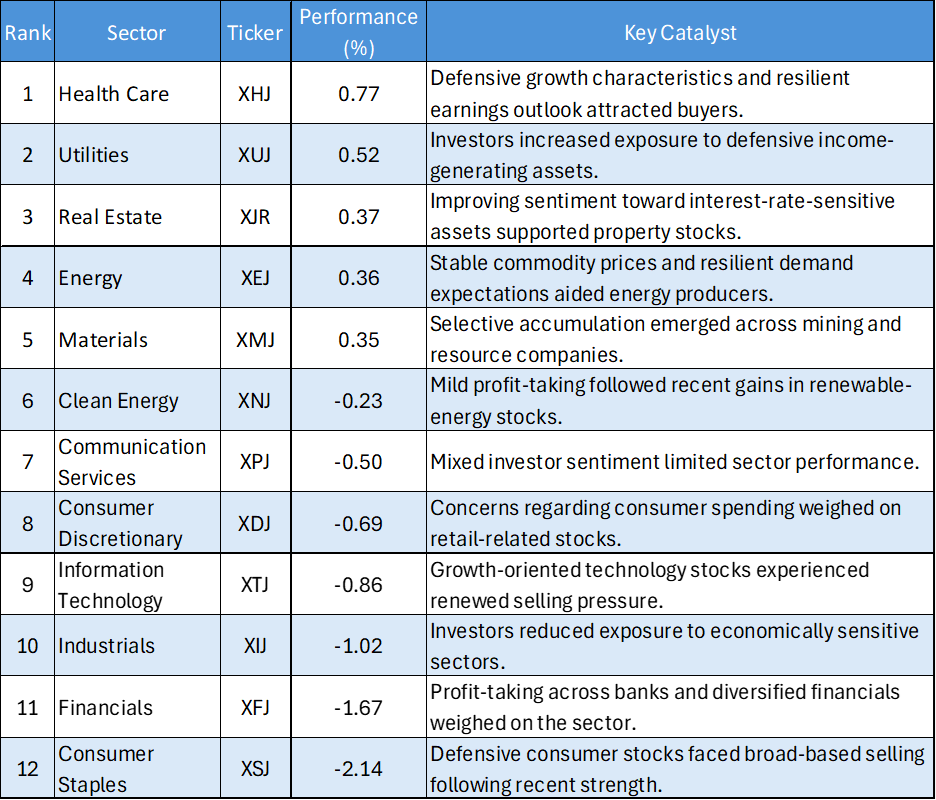
Daily ASX Sector Performance Summary
Key Market Themes
Defensive Sectors Regain Leadership
- Health Care (XHJ) led the market higher with a gain of 0.77%, while Utilities (XUJ) and Real Estate (XJR) also delivered solid performances. The strength across these sectors suggests investors are becoming more cautious and increasingly favouring businesses with stable earnings and lower economic sensitivity.
- The renewed demand for defensive sectors contrasts with the stronger risk appetite observed in previous sessions and may indicate growing uncertainty regarding the near-term economic outlook.
Resources and Energy Provide Support
- Materials (XMJ) and Energy (XEJ) both finished in positive territory, rising 0.35% and 0.36%, respectively. The gains suggest investors remain comfortable maintaining exposure to commodity-related sectors despite broader market weakness.
- The resilience of these sectors reflects ongoing support from commodity markets and expectations of stable demand conditions.
Technology and Consumer Sectors Lose Momentum
- Information Technology (XTJ) fell 0.86%, while Consumer Discretionary (XDJ) declined 0.69%. The weakness indicates investors are becoming more selective toward growth-oriented sectors and may be reducing exposure to areas perceived as more vulnerable to economic uncertainty.
- Communication Services (XPJ) also finished lower, reinforcing the cautious tone across growth-sensitive industries.
Financials and Consumer Staples Face Selling Pressure
- Financials (XFJ) and Consumer Staples (XSJ) were among the weakest sectors of the session, falling 1.67% and 2.14%, respectively.
- The decline in Financials suggests investors may be locking in profits following recent gains, while the weakness in Consumer Staples indicates capital is rotating away from some traditional defensive leaders toward other areas such as Health Care and Utilities.
Bottom Line
The July 1 trading session highlighted a shift toward defensive positioning, with Health Care, Utilities, and Real Estate attracting investor interest while Financials and Consumer Staples experienced significant selling pressure.
Although Resources and Energy remained resilient, weakness across Financials, Industrials, Technology, and Consumer-related sectors suggests investors are adopting a more cautious stance. Going forward, sustained leadership from Health Care and Utilities could provide support for the broader market, while the performance of Financials will be closely monitored as an indicator of overall risk appetite.


 Nov 12, 2026





 Please wait processing your request...