
 CA
 NZ
 UK
 US
 IND

 AU

 Share
 X (Formerly Twitter)
 Whatsapp
 Facebook
 LinkedIn
 Telegram
 Email This Article
 Copy Link
 Summarize with AI
 Chat GPT
 Perplexity

Key Highlights
- Financials Outperform the Market: Financials (XFJ) climbed 0.64%, emerging as the strongest-performing sector as investors increased exposure to banks and diversified financial companies.
- Defensive Sectors Remain Resilient: Consumer Staples (XSJ) rose 0.25% and Utilities (XUJ) gained 0.16%, highlighting continued demand for sectors offering earnings stability amid mixed market conditions.
- Broad-Based Weakness Across Cyclical Sectors: Seven of the twelve sectors closed in negative territory, indicating a cautious investment environment and selective capital allocation.
- Industrials Experience Significant Selling Pressure: Industrials (XIJ) plunged 4.04%, substantially underperforming all other sectors and weighing heavily on overall market sentiment.
The Australian equity market delivered a mixed performance on June 23, 2026, with investors favouring Financials and defensive sectors while reducing exposure to Industrials, Materials, Real Estate, and Energy. Market participation remained selective, reflecting ongoing uncertainty regarding economic growth prospects and corporate earnings momentum.
Although several sectors recorded modest gains, the sharp decline in Industrials overshadowed broader market performance and reinforced a cautious tone across risk-sensitive areas of the market.
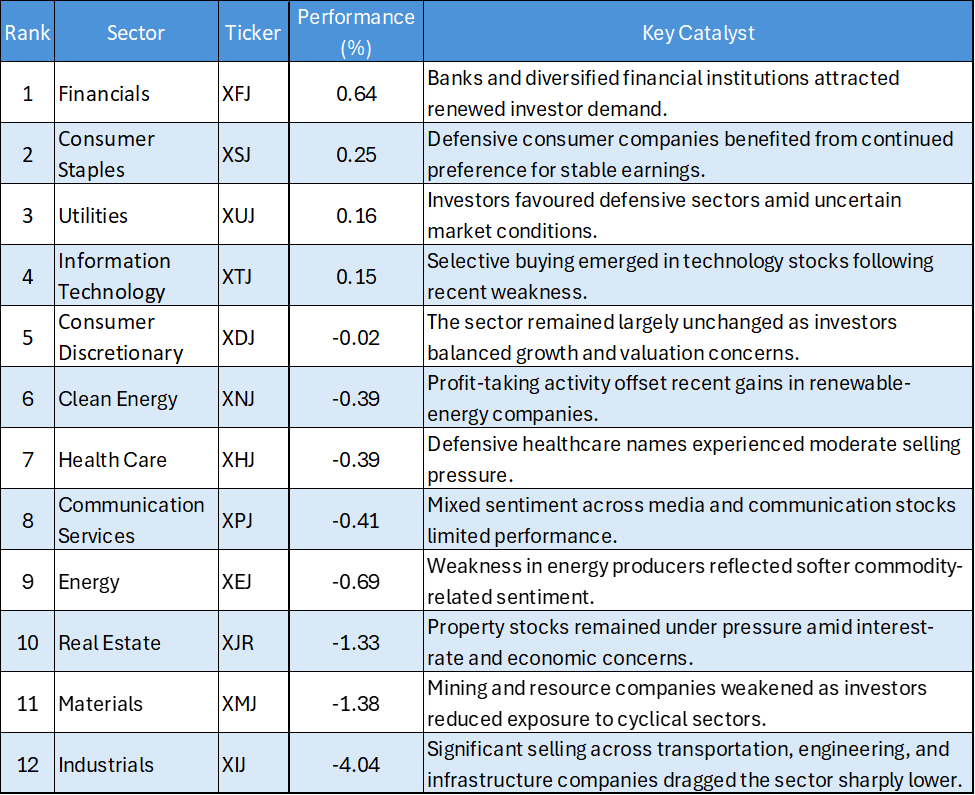
Daily ASX Sector Performance Summary
Key Market Themes
Financials Lead Market Gains
- Financials (XFJ) was the strongest-performing sector, advancing 0.64%. The gains suggest investors remain confident in the earnings outlook for banks and diversified financial companies despite broader market uncertainty.
- The sector's outperformance indicates capital continues to flow toward companies with relatively stable profitability and strong balance sheets.
Defensive Sectors Continue to Attract Support
- Consumer Staples (XSJ) and Utilities (XUJ) ranked among the best-performing sectors, rising 0.25% and 0.16%, respectively.
- The positive performance highlights investor preference for defensive sectors capable of delivering consistent earnings and cash flows during periods of elevated market volatility.
Growth and Renewable Energy Stocks Pause
- Clean Energy (XNJ) slipped 0.39%, while Communication Services (XPJ) declined 0.41%.
- The weakness suggests investors engaged in profit-taking following recent advances, reflecting a more cautious approach toward growth-oriented sectors.
- Information Technology (XTJ) was a notable exception, edging higher by 0.15%, indicating selective interest remains within parts of the technology sector.
Materials and Real Estate Under Pressure
- Materials (XMJ) fell 1.38%, making it one of the weakest-performing sectors of the session. The decline reflects softer sentiment toward mining and commodity-related companies.
- Real Estate (XJR) also struggled, losing 1.33%, as investors continued to assess the impact of interest rates and economic growth expectations on property-related businesses.
Industrials Suffer Heavy Losses
- Industrials (XIJ) was by far the weakest sector, plunging 4.04% and significantly underperforming the broader market.
- The magnitude of the decline points to aggressive selling across transportation, engineering, and infrastructure-related companies, potentially reflecting growing concerns about future economic activity and business investment trends.
- The sharp underperformance also raises the possibility that investors are rotating away from economically sensitive sectors and toward more defensive areas of the market.
Bottom Line
The June 23 trading session highlighted a defensive market environment, with Financials, Consumer Staples, and Utilities attracting investor interest while Industrials, Materials, and Real Estate faced substantial selling pressure.
Although a handful of sectors managed to record gains, the broad weakness across cyclical industries suggests investors remain cautious regarding the economic outlook. Going forward, sustained leadership from Financials and other defensive sectors could help support overall market sentiment, while continued weakness in Industrials may serve as an important indicator of rising risk aversion across Australian equities.


 Nov 12, 2026





 Please wait processing your request...