
 CA
 NZ
 UK
 US
 IND

 AU

 Share
 X (Formerly Twitter)
 Whatsapp
 Facebook
 LinkedIn
 Telegram
 Email This Article
 Copy Link
 Summarize with AI
 Chat GPT
 Perplexity

Key Highlights
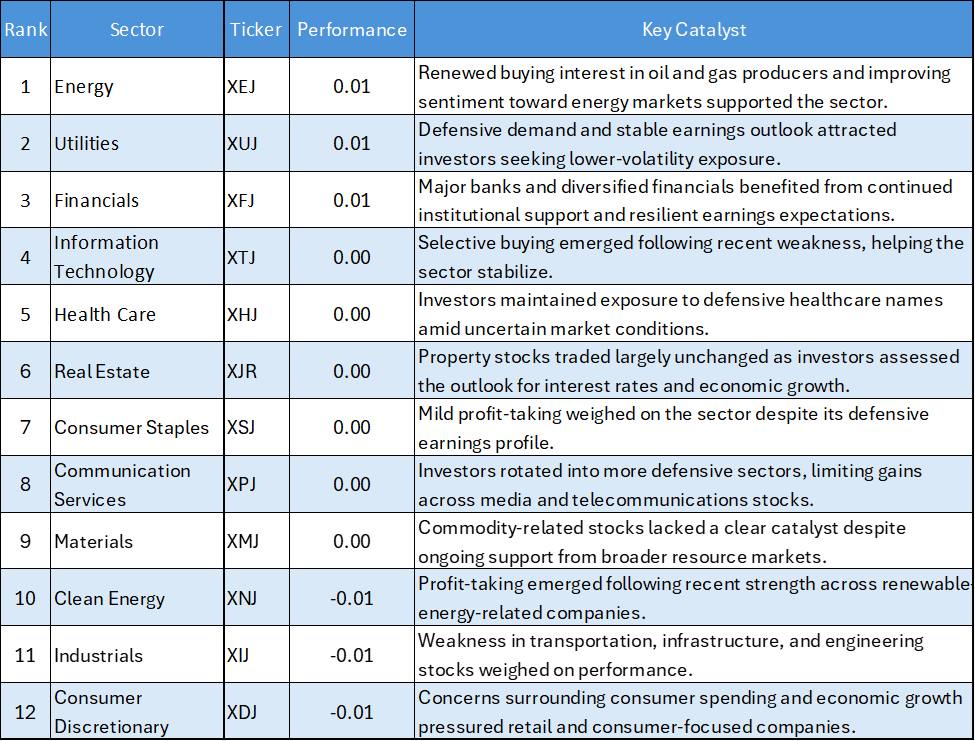
- Energy Tops Sector Performance: Energy (XEJ) rose 1.10%, emerging as the strongest-performing sector as investors returned to oil and gas producers following recent weakness.
- Defensive Sectors Remain Favoured: Utilities (XUJ) gained 0.68% while Financials (XFJ) advanced 0.60%, indicating continued demand for sectors offering stable earnings and defensive characteristics.
- Market Participation Remains Mixed: Five sectors finished in positive territory, while several others closed near unchanged, reflecting a cautious and selective investment environment.
- Consumer Discretionary and Clean Energy Underperform: Consumer Discretionary (XDJ) fell 1.15% and Clean Energy (XNJ) declined 0.69%, highlighting ongoing pressure across growth-sensitive sectors.
The Australian equity market delivered a mixed performance on June 16, 2026, with investors favouring Energy, Utilities, and Financials while reducing exposure to consumer-oriented and economically sensitive sectors. Unlike recent sessions characterised by broad-based rallies, market leadership became increasingly concentrated in defensive and value-oriented areas.
The session reflected a more cautious tone among investors, with capital rotating toward sectors offering earnings stability and income generation while growth-oriented sectors struggled to attract meaningful buying interest.
Daily ASX Sector Performance Summary
Key Market Themes
Energy Reclaims Market Leadership
Energy (XEJ) delivered the strongest performance of the session, advancing 1.10%. The sector's rebound suggests investors are becoming increasingly constructive on the earnings outlook for oil and gas producers after a period of significant underperformance.
The move is particularly noteworthy given the sharp decline recorded by the sector in the previous session. The recovery indicates bargain-hunting activity may be emerging within the energy space as valuations become more attractive.
Defensive Sectors Continue to Attract Capital
Utilities (XUJ) and Financials (XFJ) ranked among the market's strongest performers, reinforcing the ongoing preference for stable earnings and lower-volatility investments.
The strength in these sectors suggests institutional investors remain cautious regarding the broader economic outlook. Rather than aggressively pursuing growth opportunities, market participants appear to favour sectors capable of generating reliable cash flows and dividends.
Consumer and Cyclical Sectors Face Selling Pressure
Consumer Discretionary (XDJ) was the weakest-performing sector, declining 1.15%, while Industrials (XIJ) fell 0.91% and Clean Energy (XNJ) lost 0.69%.
The underperformance of these economically sensitive sectors indicates investors remain reluctant to increase exposure to areas most dependent on robust economic growth. The weakness may also reflect concerns about consumer spending trends and corporate investment activity.
Technology and Health Care Stabilise
Information Technology (XTJ) and Health Care (XHJ) both finished marginally higher, providing evidence that selling pressure across these sectors may be easing.
Although gains were modest, the ability to hold positive territory during a mixed session could indicate improving investor confidence toward selected growth and defensive opportunities.
Materials and Real Estate Remain Directionless
Materials (XMJ) and Real Estate (XJR) finished close to unchanged, reflecting a lack of conviction among investors regarding their near-term outlook.
The subdued performance suggests market participants remain divided on the prospects for mining companies and property-related stocks despite broader stability across financial markets.
Bottom Line
The June 16 session highlighted a continued shift toward defensive and value-oriented sectors, with Energy (XEJ), Utilities (XUJ), and Financials (XFJ) emerging as the primary beneficiaries of investor capital flows.
While the broader market remained relatively balanced, weakness across Consumer Discretionary, Industrials, and Clean Energy suggests investors remain selective in their risk-taking. Going forward, sustained leadership from Energy and Financials could help support overall market sentiment, although continued underperformance among consumer-facing sectors may signal ongoing caution regarding economic growth prospects.


 Nov 12, 2026





 Please wait processing your request...