
 CA
 NZ
 UK
 US
 IND

 AU

 Share
 X (Formerly Twitter)
 Whatsapp
 Facebook
 LinkedIn
 Telegram
 Email This Article
 Copy Link
 Summarize with AI
 Chat GPT
 Perplexity

Key Highlights
- Energy Leads the Market: Energy (XEJ) gained 1.78%, recording the strongest performance among all ASX sectors.
- Resources Advances: Resources (XJR) rose 0.60%, ranking second among the twelve sectors.
- Materials and Industrials Gain: Materials (XMJ) advanced 0.42%, while Industrials (XNJ) added 0.20%.
- Financials Edge Higher: Financials (XFJ) increased 0.15%, remaining marginally positive.
- Five Sectors Finish Higher: Five of the twelve ASX sectors recorded gains, while seven finished lower, indicating negative overall market breadth.
- Consumer and Communication Sectors Weaken: Consumer Discretionary (XDJ) declined 0.46%, Consumer Staples (XSJ) fell 0.60%, and Communication Services (XTJ) dropped 0.76%.
- Utilities and Healthcare Lag: Utilities (XUJ) fell 0.99%, while Health Care (XHJ) declined 0.81%.
- Technology Records the Largest Decline: Information Technology (XIJ) dropped 2.60%, making it the weakest-performing sector of the session.
The Australian Equity market displayed a clear rotation toward resource-related sectors on 7 September 2026, with Energy emerging as the strongest performer after gaining 1.78%. Resources and Materials also advanced, while Industrials and Financials recorded smaller gains. In contrast, Information Technology experienced a significant decline of 2.60%, followed by Utilities, Health Care and Communication Services. Overall, only five of the twelve sectors finished higher, pointing to relatively Narrow Market participation.
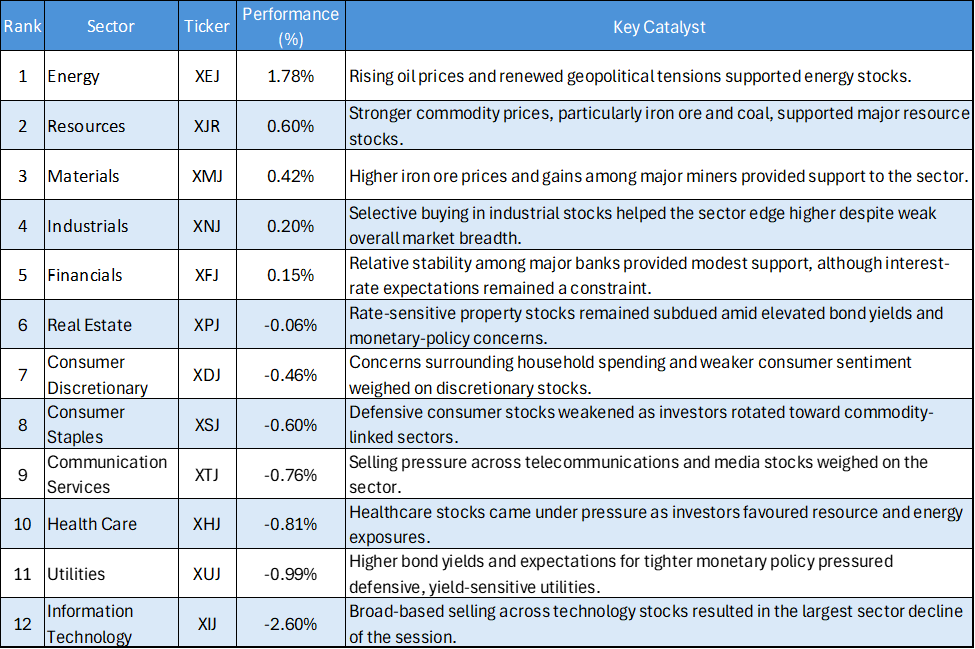
Daily ASX Sector Performance Summary
Energy Takes the Lead
- Energy (XEJ) gained 1.78%, clearly outperforming every other ASX sector.
- Resources (XJR) followed with a 0.60% advance.
- Materials (XMJ) added 0.42%, providing further evidence of strength across resource-related sectors.
- Industrials (XNJ) and Financials (XFJ) also finished higher, although their gains were comparatively modest.
The session's Leadership shifted decisively toward Energy and resource-related stocks. Energy's 1.78% advance represented the strongest sector performance in the dataset by a considerable margin, exceeding the Resources sector's gain by more than one percentage point. The simultaneous gains in Resources and Materials further reinforced the relative strength of the broader commodity-oriented segment.
This performance represents a notable change in sector leadership compared with the previous session, when Energy had been the weakest-performing sector. In the 4 September 2026 analysis, Energy declined 1.22%, while Information Technology led with a 1.00% gain. The Reversal on 7 September therefore highlights a significant short-term shift in sector momentum.
Defensive and Growth Sectors Under Pressure
Information Technology (XIJ) recorded the largest decline, falling 2.60%. The sector's weakness was substantially greater than that of any other sector in the dataset, making technology the clearest source of downside pressure.
Communication Services (XTJ) also declined 0.76%, while Health Care (XHJ) fell 0.81%. Utilities (XUJ) recorded an even larger decline of 0.99%. The weakness across these sectors indicates that the session's selling pressure was not confined to a single industry, although Information Technology was clearly the most heavily affected.
The decline in Information Technology was particularly notable given its leadership in the previous session. XIJ had gained 1.00% on 4 September, ranking first among all twelve sectors. The move to a 2.60% decline on 7 September represents a sharp reversal in short-term relative momentum.
Consumer Sectors and Real Estate Show Limited Weakness
Consumer Discretionary (XDJ) declined 0.46%, while Consumer Staples (XSJ) fell 0.60%. Real Estate (XPJ) was comparatively resilient, declining only 0.06% and effectively finishing flat.
The performance of these sectors suggests that weakness extended beyond technology and communication-related stocks. However, the relatively small decline in Real Estate indicates that the sector remained more stable than several other defensive and consumer-oriented areas.
This contrasts with the previous session, when Consumer Discretionary gained 0.52%, Consumer Staples rose 0.45% and Real Estate advanced 0.36%. The latest figures therefore point to a broader deterioration in sectors that had previously displayed relative strength.
Energy and Resources Strengthen
The strongest feature of the 7 September session was the concentration of gains within resource-related sectors. Energy (XEJ) advanced 1.78%, Resources (XJR) gained 0.60%, and Materials (XMJ) increased 0.42%.
The three sectors collectively occupied the top three positions in the daily performance ranking. This provides a clear indication that investor Demand was concentrated in commodity-linked areas rather than being broadly distributed across the market.
Resources and Materials had previously been among the weakest-performing sectors on 4 September. Resources declined 0.95%, while Materials fell 0.80% during that session. Their subsequent positive performance therefore represents another important reversal in short-term sector momentum.
At the same time, the Energy sector moved from the bottom of the ranking to the top. This sharp change makes Energy the most significant sector rotation signal in the latest data.
Bottom Line
The Australian equity market showed a pronounced rotation toward Energy and resource-related sectors on 7 September 2026. Energy led the market with a 1.78% gain, followed by Resources at 0.60% and Materials at 0.42%. Industrials and Financials also recorded modest gains.
However, Market Breadth remained weak, with only five of the twelve sectors advancing. Information Technology suffered the largest decline at 2.60%, while Utilities, Health Care and Communication Services also recorded notable losses.
The key feature of the session was therefore the sharp reversal in sector leadership. Energy, Resources and Materials strengthened considerably, while Information Technology moved from the strongest sector in the previous session to the weakest in the latest data. Sustained strength in resource-related sectors, combined with stabilization in technology and other growth-oriented sectors, would be important to confirm whether this represents a broader rotation rather than a short-term shift in market leadership.


 Nov 12, 2026





 Please wait processing your request...