
 CA
 NZ
 UK
 US
 IND

 AU

 Share
 X (Formerly Twitter)
 Whatsapp
 Facebook
 LinkedIn
 Telegram
 Email This Article
 Copy Link
 Summarize with AI
 Chat GPT
 Perplexity

Key Highlights
- Energy Leads the Market: Energy (XEJ) gained 1.73%, recording the strongest performance among the twelve ASX sectors.
- Resources and Materials Advance: Resources (XJR) rose 1.65%, while Materials (XMJ) gained 1.51%, placing all three resource-related sectors among the top performers.
- Utilities and Industrials Move Higher: Utilities (XUJ) increased 1.01%, while Industrials (XNJ) edged 0.06% higher.
- Information Technology Remains Resilient: Information Technology (XIJ) declined only 0.71%, performing better than most of the sectors that finished lower.
- Seven Sectors Finish Lower: Seven of the twelve ASX sectors declined, indicating relatively weak overall Market Breadth despite strong gains among resource-related sectors.
- Health Care Records the Largest Decline: Health Care (XHJ) fell 1.50%, recording the weakest performance of the session.
- Financials and Consumer Sectors Weaken: Financials (XFJ) declined 1.02%, while Consumer Discretionary (XDJ) fell 1.14% and Consumer Staples (XSJ) dropped 0.90%.
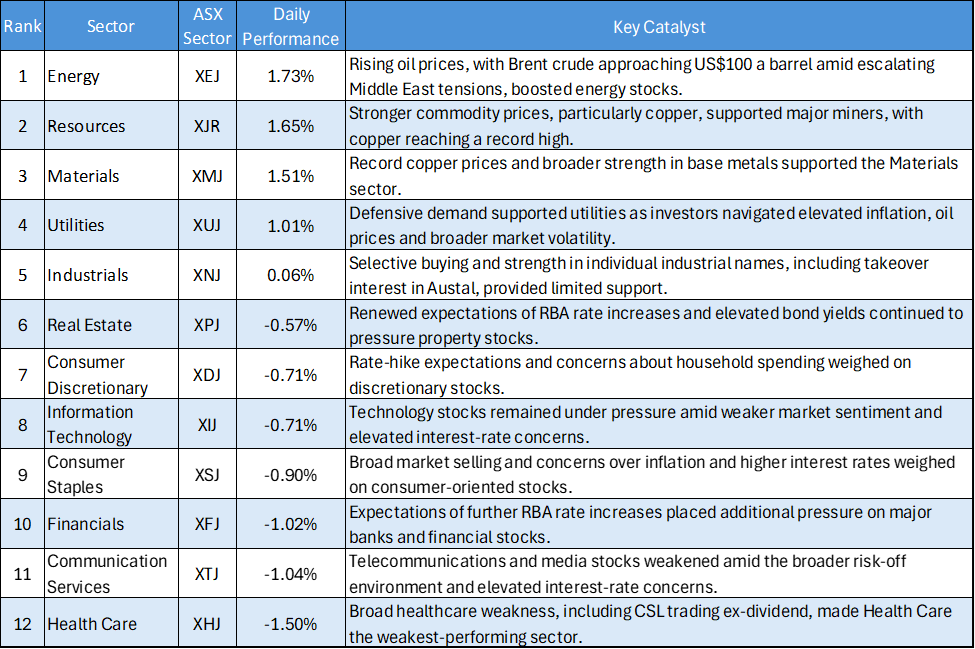
The Australian Equity market displayed a clear rotation toward resource-related sectors on 9 September 2026, with Energy emerging as the strongest performer after gaining 1.73%. Resources and Materials followed closely, rising 1.65% and 1.51%, respectively. Utilities also recorded a strong advance of 1.01%, while Industrials edged higher by 0.06%. In contrast, Health Care experienced the largest decline at 1.50%, followed by Consumer Discretionary, Financials, Real Estate and Communication Services. Overall, seven of the twelve sectors finished lower, indicating that the market's gains were concentrated in a relatively small group of sectors.
Daily ASX Sector Performance Summary
Energy Takes the Lead
The session's Leadership was concentrated in Energy, Resources and Materials, which occupied the top three positions in the daily performance ranking. Energy's 1.73% advance was only slightly ahead of Resources, while Materials also recorded a gain above 1.5%. The simultaneous strength across these three sectors provides a clear indication that Demand was concentrated in resource-oriented areas of the Australian equity market.
The narrow gap between Energy and Resources is also notable. Energy led by only 0.08 percentage points, while Materials remained within 0.22 percentage points of the top-performing sector. This suggests that the positive performance was not isolated to one resource-related segment but extended across several parts of the broader commodity-oriented market.
Utilities also recorded a substantial 1.01% gain, making it the fourth-best-performing sector. The move provided an additional source of market strength outside the resource complex. However, the much smaller 0.06% gain in Industrials indicates that positive performance was not broadly distributed across cyclical sectors.
Resource-Related Sectors Strengthen
The strongest feature of the 9 September session was the collective performance of Energy, Resources and Materials.
Energy gained 1.73%, Resources advanced 1.65% and Materials increased 1.51%. Together, these sectors accounted for the three strongest performances among all twelve sectors.
The relatively similar magnitude of their gains is important because it points to broad strength within resource-related exposures rather than a single-sector move.
The performance also highlights the importance of sector rotation when assessing the broader ASX market. A market can show significant strength in selected areas while still experiencing weakness across a majority of sectors.
With seven sectors finishing lower, the latest session does not represent broad-based market strength. Instead, it reflects strong leadership from a specific group of sectors.
Utilities Post Strong Gain
Utilities (XUJ) advanced 1.01%, placing the sector fourth in the daily ranking.
The gain was notable because Utilities were among the weaker-performing sectors in the previous analysis. The latest result therefore represents a meaningful improvement in short-term relative performance.
Utilities are generally viewed as more defensive and income-oriented exposures. A strong daily advance can therefore provide a different source of market support from the commodity-driven gains recorded by Energy, Resources and Materials.
However, a single session is not sufficient to establish a sustained change in sector leadership. Continued positive performance would be needed to determine whether Utilities are developing stronger relative momentum.
Defensive and Consumer Sectors Under Pressure
The weaker side of the market was led by Health Care, which declined 1.50%.
Communication Services (XTJ) also came under pressure, falling 1.04%, while Financials (XFJ) declined 1.02%. Consumer Staples (XSJ) dropped 0.90%, and both Consumer Discretionary (XDJ) and Information Technology (XIJ) fell 0.71%.
The distribution of these declines shows that selling pressure was spread across several different areas of the market rather than being concentrated entirely within one sector.
Health Care's 1.50% decline was particularly significant because it was more than twice the size of the decline in Consumer Staples and substantially larger than the losses recorded by Real Estate and Information Technology.
This made Health Care the clearest source of downside pressure during the session.
Technology and Real Estate Show Relative Resilience
Information Technology (XIJ) declined 0.71%, placing it in the middle of the twelve-sector ranking despite finishing lower.
The sector's performance was considerably stronger than the declines recorded by Financials, Communication Services and Health Care. This suggests that technology was relatively resilient compared with several other growth-oriented and defensive segments.
Real Estate (XPJ) also demonstrated relative resilience, declining 0.57%. It was the sixth-ranked sector and recorded the smallest decline among the seven sectors that finished lower.
The comparatively modest decline indicates that weakness in the latest session did not affect all sectors equally. Some sectors remained relatively stable despite the broader negative market breadth.
Financials and Consumer Sectors Weaken
Financials (XFJ) declined 1.02%, placing the sector tenth in the daily ranking.
Consumer Discretionary (XDJ) fell 0.71%, while Consumer Staples (XSJ) declined 0.90%. The weakness across both consumer-oriented sectors indicates that selling pressure extended into areas of the market linked to household spending and defensive consumption.
The decline in Financials was also notable because the sector is one of the largest components of the Australian equity market. Continued weakness in Financials could therefore have a meaningful influence on overall market performance if the decline persists.
At the same time, the relatively stronger performance of resource-related sectors helped offset some of the weakness elsewhere in the market.
Bottom Line
The Australian equity market showed a pronounced rotation toward Energy and resource-related sectors on 9 September 2026. Energy led the market with a 1.73% gain, followed closely by Resources at 1.65% and Materials at 1.51%. Utilities also posted a strong 1.01% advance, while Industrials recorded a marginal gain.
However, overall market breadth remained weak, with only five of the twelve sectors advancing. Health Care suffered the largest decline at 1.50%, followed by Communication Services, Financials, Consumer Staples and other consumer-related sectors.
The key feature of the session was therefore the concentration of strength within Energy, Resources and Materials. Sustained gains across these sectors could reinforce the current rotation toward resource-related exposures, while a broader recovery across Financials, Technology, Consumer and Health Care sectors would be needed to confirm a more widespread improvement in market breadth.


 Nov 12, 2026





 Please wait processing your request...