
 CA
 NZ
 UK
 US
 IND

 AU

 Share
 X (Formerly Twitter)
 Whatsapp
 Facebook
 LinkedIn
 Telegram
 Email This Article
 Copy Link
 Summarize with AI
 Chat GPT
 Perplexity

Key Highlights
- Financials Lead the Market: Financials (XFJ) gained 0.42%, emerging as the strongest-performing sector as investors favoured large-cap banks and defensive earnings.
- Utilities and Energy Provide Support: Utilities (XUJ) rose 0.39% and Energy (XEJ) added 0.38%, reflecting demand for stable income-generating and commodity-linked sectors.
- Healthcare and Industrials Show Resilience: Healthcare (XHJ) and Industrials (XIJ) limited losses, highlighting continued investor preference for quality businesses amid broader market weakness.
- Consumer and Resource Sectors Under Pressure: Communication Services (XPJ), Materials (XMJ), Real Estate (XJR), and Consumer Staples (XSJ) recorded the largest declines as investors reduced exposure to growth and economically sensitive sectors.
The Australian equity market experienced a mixed trading session on June 30, 2026, characterised by a rotation toward defensive sectors and away from cyclical growth exposures. Financials, Utilities, Energy, and Healthcare finished in positive territory, providing support to the broader market, while Materials, Real Estate, Consumer Staples, and Communication Services faced notable selling pressure. The divergence between defensive and growth-sensitive sectors suggests investors adopted a more cautious stance following recent market strength, favouring earnings stability and income-generating assets while reducing exposure to sectors more sensitive to economic uncertainty.
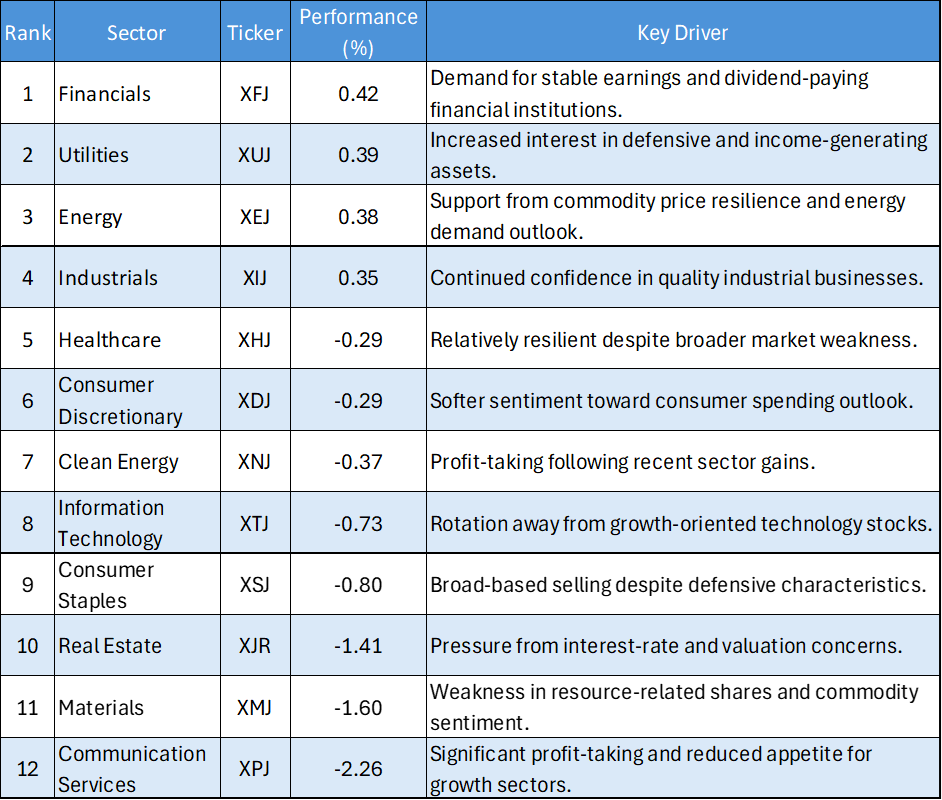
Daily ASX Sector Performance Summary
Key Market Themes
Financials Take Leadership
- Financials (XFJ) delivered the strongest performance of the session, rising 0.42%. The sector's leadership reflects continued investor confidence in Australia's major banks and diversified financial institutions, which benefit from relatively stable earnings profiles and attractive dividend yields. In periods of increased market uncertainty, financial stocks often attract capital due to their defensive characteristics and ability to generate consistent cash flows. The sector's outperformance suggests investors are seeking quality exposures while maintaining participation in the equity market.
Utilities and Energy Attract Defensive Flows
- Utilities (XUJ) and Energy (XEJ) advanced 0.39% and 0.38%, respectively, providing additional support for the market. Utilities benefited from renewed demand for predictable earnings and income-oriented investments, while Energy stocks found support from resilient commodity fundamentals and stable demand expectations. The positive performance of these sectors highlights a preference for businesses with defensive qualities and relatively resilient revenue streams.
Healthcare and Industrials Demonstrate Stability
- Healthcare (XHJ) declined only 0.29%, matching the loss in Consumer Discretionary (XDJ), while Industrials (XIJ) managed to finish higher by 0.35%. The relative resilience of Healthcare suggests investors continue to value the sector's defensive earnings profile and long-term growth potential. Meanwhile, Industrials maintained positive momentum despite broader market weakness, indicating that confidence in Australia's economic outlook remains intact even as investors adopt a more selective approach to risk.
Technology and Consumer Sectors Face Selling Pressure
- Information Technology (XTJ) fell 0.73%, while Consumer Staples (XSJ) declined 0.80%. The weakness in technology stocks likely reflects profit-taking after recent gains and a temporary shift away from higher-growth sectors. Consumer-related sectors also faced pressure as investors reassessed spending expectations and rotated toward areas offering greater earnings certainty. The declines suggest market participants became more cautious toward sectors dependent on strong economic growth and consumer confidence.
Materials, Real Estate, and Communication Services Lag
- The weakest performers were Communication Services (XPJ), Materials (XMJ), and Real Estate (XJR), which fell 2.26%, 1.60%, and 1.41%, respectively. The sharp decline in Communication Services indicates a reduction in risk appetite toward growth-oriented companies, while Materials suffered from softer commodity-related sentiment. Real Estate also came under pressure as investors reduced exposure to interest-rate-sensitive sectors. Together, these declines point to a broad rotation away from cyclical and valuation-sensitive areas of the market.
Bottom Line
The June 30 trading session highlighted a notable shift toward defensive positioning within the Australian market. Financials, Utilities, Energy, and Industrials provided the strongest support, reflecting investor preference for stable earnings, dividend income, and quality businesses. In contrast, Communication Services, Materials, Real Estate, and Technology experienced meaningful selling pressure as investors reduced exposure to growth-sensitive sectors. While the overall market tone became more cautious, the resilience of several defensive sectors suggests investors remain constructive on equities but are increasingly selective in their sector allocation decisions. This defensive rotation will be an important theme to monitor in the coming weeks as market participants assess economic conditions, earnings prospects, and interest-rate expectations.


 Nov 12, 2026





 Please wait processing your request...