
 CA
 NZ
 UK
 US
 IND

 AU

 Share
 X (Formerly Twitter)
 Whatsapp
 Facebook
 LinkedIn
 Telegram
 Email This Article
 Copy Link
 Summarize with AI
 Chat GPT
 Perplexity

Key Highlights
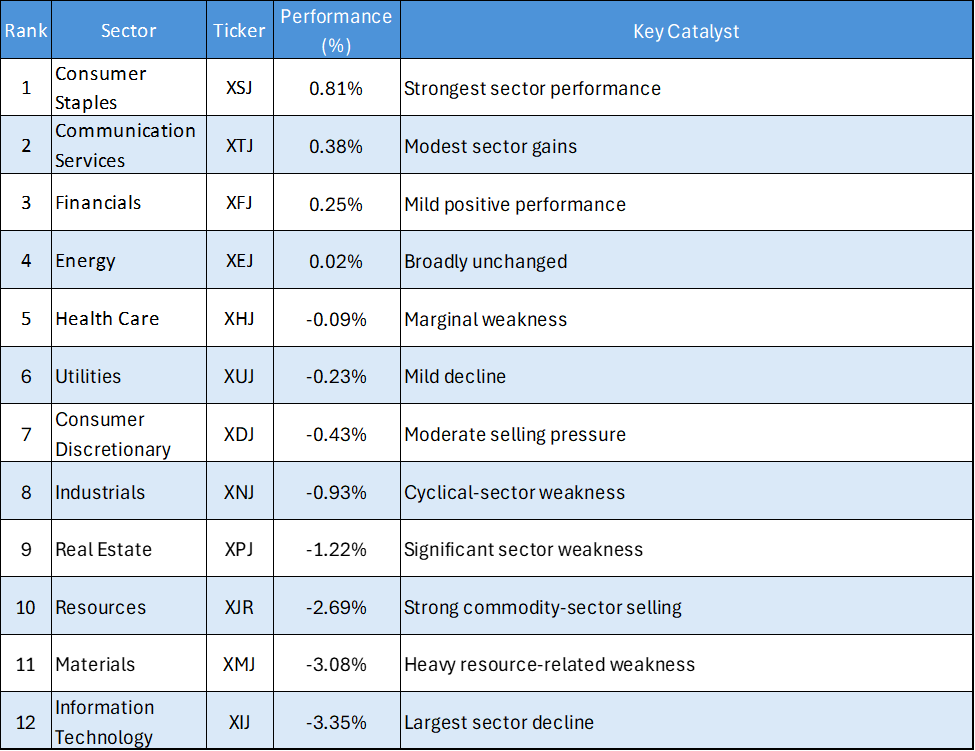
- Consumer Staples Leads the Market: Consumer Staples (XSJ) gained 0.81%, recording the strongest performance among all ASX sectors.
- Communication Services and Financials Advance: Communication Services (XTJ) rose 0.38%, while Financials (XFJ) added 0.25%.
- Energy Holds Steady: Energy (XEJ) edged 0.02% higher, remaining broadly unchanged.
- Most Sectors Finish Lower: Eight of the twelve ASX sectors declined, indicating negative market breadth.
- Technology and Materials Under Pressure: Information Technology (XIJ) dropped 3.35%, while Materials (XMJ) fell 3.08%.
- Resources Also Weaken: Resources (XJR) declined 2.69%, extending significant selling pressure across commodity-linked sectors.
- Real Estate and Industrials Lag: Real Estate (XPJ) fell 1.22%, while Industrials (XNJ) declined 0.93%.
The Australian Equity market displayed predominantly weaker sector performance on 2 September 2026, with Consumer Staples emerging as the strongest sector after gaining 0.81%. Communication Services and Financials also recorded modest gains, while commodity-linked and growth-oriented sectors came under substantial pressure. Eight of the twelve sectors finished lower, highlighting weak market breadth.
Daily ASX Sector Performance Summary
Consumer Staples Takes the Lead
- Consumer Staples (XSJ) gained 0.81%, clearly outperforming all other ASX sectors.
- Communication Services (XTJ) advanced 0.38%, securing the second-strongest position.
- Financials (XFJ) rose 0.25%, while Energy (XEJ) edged 0.02% higher.
- Health Care (XHJ) and Utilities (XUJ) recorded only marginal declines of 0.09% and 0.23%, respectively.
The session's Leadership was concentrated in Consumer Staples, which recorded the strongest gain among all sectors. The 0.81% advance suggests relatively resilient Demand for defensive consumer-oriented stocks as broader market conditions weakened.
Communication Services and Financials also remained among the few sectors to finish higher. However, their gains were modest, indicating that buying interest was relatively selective rather than broad-based.
Most Sectors Finish Lower
Eight of the twelve ASX sectors declined during the session, indicating negative market breadth.
Information Technology (XIJ) fell 3.35%, recording the largest sector decline, while Materials (XMJ) dropped 3.08%. Resources (XJR) also weakened sharply by 2.69%, highlighting substantial selling pressure across commodity-linked sectors.
Industrials (XNJ) declined 0.93%, while Real Estate (XPJ) fell 1.22%. Consumer Discretionary (XDJ) also weakened by 0.43%.
The broad-based weakness indicates that selling pressure extended across several major areas of the Australian equity market. In particular, the declines in Technology, Materials and Resources suggest that both growth-oriented and commodity-linked segments faced significant pressure.
Technology and Materials Lag
Weakness was particularly pronounced in Information Technology and Materials. Information Technology declined 3.35%, recording the largest fall of the session, while Materials dropped 3.08%.
Resources (XJR) also fell sharply by 2.69%, followed by Real Estate (XPJ), which declined 1.22%. Industrials slipped 0.93%, while Consumer Discretionary recorded a comparatively smaller decline of 0.43%.
The contrast between strength in Consumer Staples, Communication Services and Financials and significant weakness across Technology, Materials and Resources points to a cautious market structure, with investors favouring defensive areas while reducing exposure to several growth and cyclical segments.
Bottom Line
The Australian equity market displayed predominantly negative sector momentum on 2 September 2026, with Consumer Staples leading the gains at 0.81%. Communication Services and Financials also recorded modest gains of 0.38% and 0.25%, respectively.
With eight of the twelve sectors finishing lower, Market Breadth was clearly negative. The sharp declines across Information Technology, Materials and Resources indicate substantial selling pressure in both growth-oriented and commodity-linked sectors.
Looking ahead, continued strength in Consumer Staples and other defensive sectors would reinforce a more defensive market structure. A recovery in Technology, Materials and Resources would be important to improve overall sector breadth and signal a return of broader risk appetite.


 Nov 12, 2026





 Please wait processing your request...