
 CA
 NZ
 UK
 US
 IND

 AU

 Share
 X (Formerly Twitter)
 Whatsapp
 Facebook
 LinkedIn
 Telegram
 Email This Article
 Copy Link
 Summarize with AI
 Chat GPT
 Perplexity

Key Highlights
- Communication Services Shows Relative Resilience: Communication Services (XTJ) declined only 0.13%, recording the smallest loss among the twelve ASX sectors.
- Utilities and Real Estate Follow: Utilities (XUJ) fell 0.33%, while Real Estate (XPJ) declined 0.60%, placing both among the relatively stronger sectors.
- All Twelve Sectors Finish Lower: Every ASX sector recorded a negative daily performance, indicating exceptionally weak market breadth.
- Energy and Health Care Under Pressure: Energy (XEJ) declined 0.67%, while Health Care (XHJ) fell 0.71%, despite being among the stronger performers in the previous session.
- Resources and Materials Weaken: Resources (XJR) dropped 1.50%, while Materials (XMJ) declined 1.63%, reversing the strong performance recorded by resource-related sectors previously.
- Information Technology Records the Largest Decline: Information Technology (XIJ) fell 1.74%, making it the weakest-performing sector of the session.
- Financials and Industrials Also Decline: Financials (XFJ) fell 0.90%, while Industrials (XNJ) declined 1.04%, adding to the broad-based selling pressure.
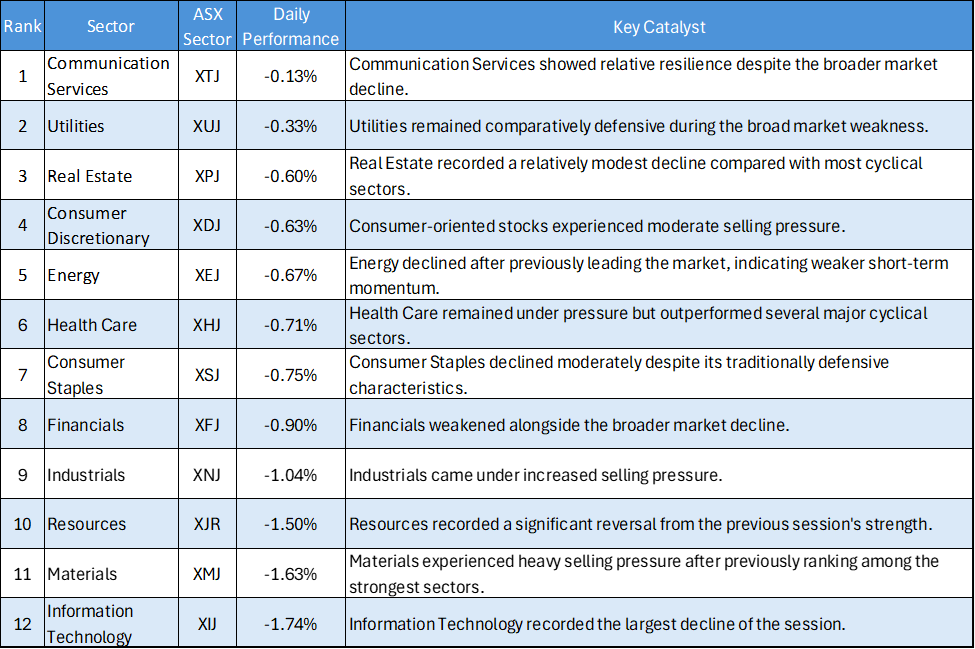
The Australian Equity market experienced a broad-based decline on 10 September 2026, with all twelve sectors finishing lower. Communication Services recorded the smallest loss at 0.13%, followed by Utilities at 0.33% and Real Estate at 0.60%. At the other end of the ranking, Information Technology fell 1.74%, while Materials and Resources declined 1.63% and 1.50%, respectively. The negative performance across every sector indicates that selling pressure was widespread rather than concentrated in a particular area of the market.
Daily ASX Sector Performance Summary
Communication Services Shows Relative Resilience
Communication Services recorded the strongest relative performance on 10 September, although the sector still declined 0.13%. This was the smallest loss among all twelve sectors and therefore represented the clearest area of relative resilience during an otherwise broadly negative session.
The difference between Communication Services and the weakest-performing sector, Information Technology, was 1.61 percentage points. This relatively wide performance gap highlights how uneven the intensity of selling pressure was across individual sectors, even though every sector finished lower.
Utilities also demonstrated defensive characteristics, declining only 0.33%. Real Estate followed with a 0.60% loss, placing both sectors comfortably ahead of most cyclical areas of the market.
Broad-Based Market Weakness
The defining feature of the 10 September session was the absence of any positive-performing sector. All twelve sectors declined, representing a significant deterioration in Market Breadth compared with the previous session.
The weakest performance was concentrated among several sectors that had previously provided leadership. Resources and Materials, in particular, experienced substantial reversals, while Energy also moved lower. This suggests that the strength observed in resource-related sectors during the previous session was not immediately sustained.
The broad nature of the declines is important because weakness across all twelve sectors indicates that selling pressure was not isolated to a particular industry group. Instead, investors reduced exposure across both cyclical and defensive segments of the Australian equity market.
Resource-Related Sectors Reverse Lower
Resources (XJR) declined 1.50%, while Materials (XMJ) fell 1.63%. These performances represent a sharp Reversal from the previous session, when Resources and Materials were among the three strongest sectors.
Energy (XEJ) also declined 0.67%, although its loss was considerably smaller than those recorded by Resources and Materials. The combined weakness across the three resource-related sectors indicates that the previous day's commodity-driven Leadership lost momentum.
The reversal is particularly notable because Energy, Resources and Materials had previously occupied the top three positions in the daily ranking. Their movement into negative territory demonstrates how quickly short-term sector leadership can change.
Technology Records the Largest Decline
Information Technology (XIJ) recorded the weakest performance of the session, falling 1.74%. The sector was followed by Materials at -1.63% and Resources at -1.50%.
Technology's position at the bottom of the ranking indicates that selling pressure was particularly strong among technology-related stocks. The sector's decline was 1.61 percentage points larger than the loss recorded by Communication Services, which was the strongest relative performer.
The weakness in Information Technology also contributed to the broad deterioration in growth-oriented areas of the market.
Financials and Industrials Weaken
Financials (XFJ) declined 0.90%, placing the sector eighth in the daily ranking. Industrials (XNJ) performed slightly worse, falling 1.04%.
The weakness across these sectors indicates that selling pressure extended into major economically sensitive areas of the Australian equity market. Financials are also an important component of the broader market, meaning sustained weakness in the sector could have a meaningful influence on overall index performance.
Consumer-oriented sectors were comparatively more resilient. Consumer Discretionary (XDJ) declined 0.63%, while Consumer Staples (XSJ) fell 0.75%. Both remained ahead of Financials and Industrials in the daily ranking.
Bottom Line
The Australian equity market experienced a clear deterioration in breadth on 10 September 2026, with all twelve sectors recording losses. Communication Services led on a relative basis with a 0.13% decline, followed by Utilities at -0.33% and Real Estate at -0.60%.
The major change from the previous session was the reversal in resource-related sectors. Resources and Materials, which had previously been among the strongest performers, declined 1.50% and 1.63%, respectively. Information Technology recorded the largest loss at 1.74%.
The complete absence of advancing sectors indicates that the latest session represented broad-based market weakness rather than a conventional sector rotation. Further improvement in market breadth would be required to confirm a recovery in overall ASX momentum. The structure and terminology of the attached reference article have been followed for this analysis.


 Nov 12, 2026





 Please wait processing your request...