
 CA
 NZ
 UK
 US
 IND

 AU

 Share
 X (Formerly Twitter)
 Whatsapp
 Facebook
 LinkedIn
 Telegram
 Email This Article
 Copy Link
 Summarize with AI
 Chat GPT
 Perplexity

Key Momentum Shifts
- Utilities Near Leadership: Utilities (XUJ) remains the strongest sector in the Improving quadrant and is approaching the Leading quadrant.
- Consumer Sectors Retain Leadership: Consumer Discretionary (XDJ) and Consumer Staples (XSJ) continue to demonstrate superior relative strength within the Leading quadrant.
- Financials and Technology Strengthen: Financials (XFJ) and Information Technology (XTJ) continue improving and remain potential future market leaders.
- Lagging Sectors Remain Weak: Industrials (XIJ), Energy (XEJ), Materials (XMJ), and Real Estate (XJR) continue to underperform despite modest improvements in momentum.
The Relative Rotation Graph (RRG) for 26 June 2026 highlights continued leadership from consumer-oriented and defensive sectors, while Utilities, Financials, and Information Technology steadily improve their momentum profiles. Meanwhile, resource-related and cyclical sectors remain concentrated in the Lagging quadrant, reflecting ongoing relative weakness versus the broader market.
ASX Sector Momentum Summary
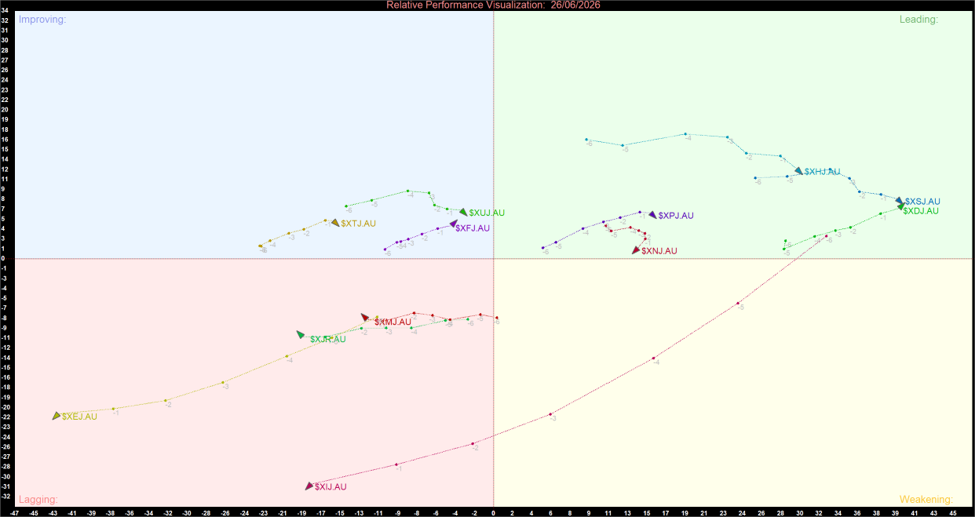
ASX Sector Relative Momentum Chart (at the closing price of 29/06/2026). Powered by: amibroker.com
Momentum Breakdown by Quadrant
The Leading Quadrant (The Market Leaders)
- Consumer Discretionary (XDJ) remains one of the strongest sectors on the Relative Rotation Graph. The sector continues advancing deeper into the Leading quadrant, indicating sustained improvements in both relative strength and momentum. This leadership position reflects investor optimism toward household spending, retail activity, and the broader domestic economic outlook.
- Consumer Staples (XSJ) remains firmly established within the Leading quadrant and continues to display exceptional relative strength. Although momentum has moderated slightly from previous highs, investors continue to favour companies capable of delivering reliable earnings and stable cash flows regardless of economic conditions.
- Health Care (XHJ) remains one of the market's strongest sectors from a relative strength perspective. However, its trajectory has begun rotating slightly south-west, suggesting momentum is gradually easing. Despite this moderation, the sector continues to benefit from defensive earnings characteristics and strong long-term growth prospects.
- Communication Services (XPJ) remains comfortably positioned within the Leading quadrant. Relative strength remains positive as investors continue allocating capital toward telecommunications, digital media, and communication-related businesses that offer both growth and defensive qualities.
- Clean Energy (XNJ) has successfully maintained its position within the Leading quadrant. While still situated near the momentum threshold, the sector continues to benefit from long-term renewable energy investment themes and improving investor sentiment toward sustainability-focused industries.
The Improving Quadrant (The Emerging Leadership Candidates)
- Utilities (XUJ) remains the most impressive sector within the Improving quadrant. Its trajectory continues advancing toward the Leading quadrant, reflecting strengthening momentum and improving relative performance. Investors remain attracted to the sector's defensive earnings profile, stable dividends, and lower volatility characteristics.
- Financials (XFJ) continue progressing steadily higher within the Improving quadrant. Although banking stocks have experienced periods of short-term weakness, the sector's improving momentum profile suggests relative strength is rebuilding. If current trends persist, Financials could soon challenge for a position among the market leaders.
- Information Technology (XTJ) remains on a constructive recovery path. Relative momentum continues improving as investors gradually return to growth-oriented technology companies following a prolonged period of underperformance. The sector remains an emerging candidate for future leadership.
The Lagging Quadrant (The Structural Underperformers)
- Industrials (XIJ) remains firmly entrenched within the Lagging quadrant and currently occupies the weakest position on the Relative Rotation Graph. Despite occasional short-term rallies, the sector has failed to establish sustainable relative strength, indicating institutional investors continue favouring stronger leadership groups elsewhere in the market.
- Materials (XMJ) remains positioned within the Lagging quadrant despite showing signs of stabilisation. Relative momentum has improved modestly, but the sector continues to face headwinds from uncertain commodity demand and fluctuating resource prices.
- Real Estate (XJR) continues to lag the broader market, although recent rotations suggest momentum is gradually improving. Investor concerns regarding interest rates, financing costs, and property valuations remain important constraints on sector performance.
- Energy (XEJ) remains deeply embedded within the Lagging quadrant despite exhibiting some of the strongest recent improvements in momentum. While the sector appears to be forming a recovery base, relative strength remains weak and further confirmation is required before a sustainable turnaround can be declared.
Strategic Summary
The latest RRG continues to favour Consumer Discretionary, Consumer Staples, Healthcare, Communication Services, and Clean Energy as the market's leadership group. Utilities (XUJ) remains the strongest candidate to enter the Leading quadrant, while Financials (XFJ) and Information Technology (XTJ) continue to improve. In contrast, Industrials (XIJ), Energy (XEJ), Materials (XMJ), and Real Estate (XJR) remain laggards, suggesting market leadership is likely to stay concentrated in defensive and consumer-focused sectors in the near term.


 Nov 12, 2026





 Please wait processing your request...