
 CA
 NZ
 UK
 US
 IND

 AU

 Share
 X (Formerly Twitter)
 Whatsapp
 Facebook
 LinkedIn
 Telegram
 Email This Article
 Copy Link
 Summarize with AI
 Chat GPT
 Perplexity

Key Momentum Shifts
- Financials Remain Leading: Financials (XFJ) remain in the Leading quadrant despite declining 0.45% on 22 September.
- Communication Services and Industrials Remain Leading: Communication Services (XTJ) and Industrials (XNJ) continue to occupy Leading, with daily performances of 0.08% and 0.11%, respectively.
- Consumer Discretionary and Property Remain Improving: Consumer Discretionary (XDJ) and Property (XPJ) remain positioned in Improving.
- Energy at the Leading-Weakening Boundary: Energy (XEJ) remains close to the horizontal axis after declining 0.77%.
- Three Sectors Remain Weakening: Consumer Staples (XSJ), Utilities (XUJ) and Health Care (XHJ) remain in Weakening.
- Resources, Materials and Technology Remain Lagging: Resources (XJR), Materials (XMJ) and Information Technology (XIJ) remain positioned in Lagging.
- Technology Records Strong Rebound: Information Technology surged 3.01%, recording the strongest daily gain among the twelve sectors.
- Materials and Resources Strengthen: Materials gained 0.70%, while Resources increased 0.46%, despite both remaining in the Lagging quadrant.
The latest Relative Rotation Graph shows continued divergence across ASX sector momentum. Financials, Communication Services and Industrials remain in the Leading quadrant, while Consumer Discretionary and Property occupy Improving. Consumer Staples, Utilities and Health Care remain in Weakening, while Resources, Materials and Information Technology continue to occupy Lagging. Energy remains close to the boundary between Leading and Weakening. The attached reference article similarly highlights that daily performance can diverge from broader relative momentum, meaning a strong one-day gain does not automatically result in an immediate change of quadrant.
Momentum Breakdown by Quadrant
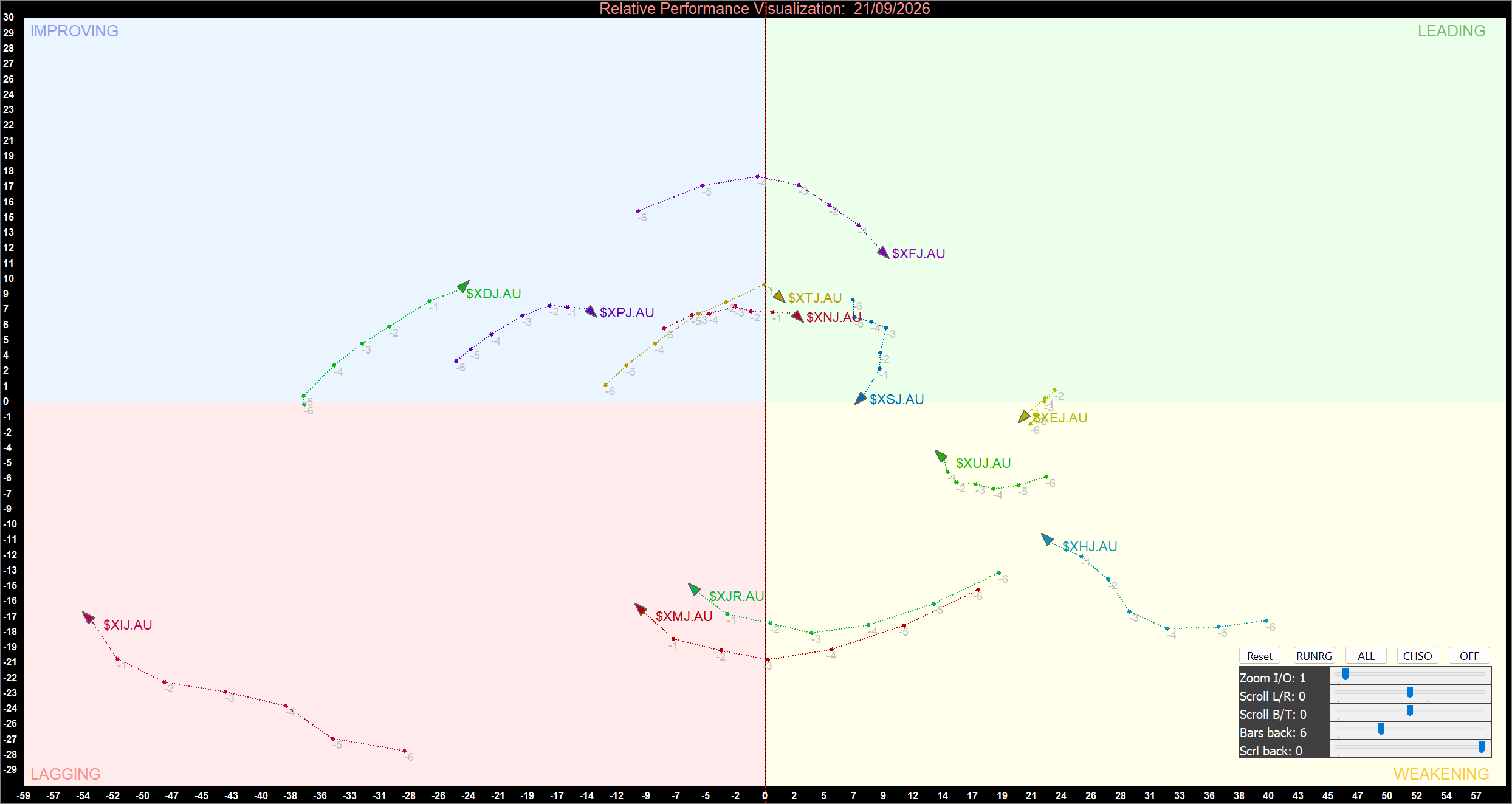
ASX Sector Relative Momentum Chart (at the closing price of 22/09/2026). Powered by: amibroker.com.
Leading Quadrant
Financials (XFJ), Communication Services (XTJ) and Industrials (XNJ) remain positioned in the Leading quadrant. Their locations indicate relatively stronger momentum and relative strength compared with sectors positioned elsewhere on the RRG.
Financials remain the most prominent sector within this group, although the sector declined 0.45% on 22 September. This contrasts with its 0.63% gain during the previous session, demonstrating that the Leading classification reflects a broader momentum cycle rather than simply the latest daily return. The reference RRG also identified Financials as firmly positioned in Leading.
Communication Services gained 0.08%, while Industrials increased 0.11%. Both sectors therefore remained relatively stable during the latest session while retaining their Leading positions.
Industrials is positioned relatively close to the central area of the chart. Continued movement toward the upper-right area would indicate further strengthening, while movement toward the centre could signal a reduction in relative momentum.
Improving Quadrant
Consumer Discretionary (XDJ) and Property (XPJ) remain in the Improving quadrant.
Consumer Discretionary gained 0.84% on 22 September, making it the second-best-performing sector during the session. Its position in Improving indicates that relative momentum is recovering even though the sector has not yet moved into Leading.
Property also strengthened, gaining 0.49%. Both sectors remain positioned in the upper-left portion of the RRG, where continued movement upward and toward the right would provide stronger evidence of improving relative strength and momentum.
Weakening Quadrant
Consumer Staples (XSJ), Utilities (XUJ) and Health Care (XHJ) remain in the Weakening quadrant.
Consumer Staples declined 0.28%, while Utilities fell 1.65%, recording the weakest daily performance among the twelve sectors. Health Care gained 0.45%, but its positive daily performance has not yet changed its broader Weakening classification.
The contrast between Health Care's daily gain and its RRG position again demonstrates that daily returns and broader relative momentum can move in different directions. A sustained movement toward the centre of the chart would provide an indication of improving relative momentum.
Energy at the Leading-Weakening Boundary
Energy (XEJ) remains positioned close to the horizontal axis, placing it near the boundary between Leading and Weakening. The sector declined 0.77% on 22 September.
The current position makes Energy an important transition sector within the RRG structure. Movement above the horizontal axis would support a Leading classification, while movement below the axis would confirm further movement into Weakening. The previous RRG also identified Energy as being almost directly on this boundary.
Lagging Quadrant
Resources (XJR), Materials (XMJ) and Information Technology (XIJ) remain in Lagging.
Information Technology recorded the strongest daily performance on 22 September, surging 3.01%. This represents a significant improvement in one-day performance after the sector had declined 1.60% in the previous session. However, its position in the Lagging quadrant indicates that broader relative momentum remains weaker than the Leading sectors.
Materials gained 0.70%, while Resources increased 0.46%. Both sectors remain in the lower-left area of the RRG. Continued upward movement toward the centre would provide an early indication of recovering relative momentum, but their current positions remain within Lagging.
Bottom Line
The latest ASX Relative Rotation Graph continues to show significant divergence across sector momentum. Financials, Communication Services and Industrials remain in Leading, while Consumer Discretionary and Property occupy Improving. Consumer Staples, Utilities and Health Care remain in Weakening, Energy sits near the Leading-Weakening boundary, and Resources, Materials and Information Technology remain in Lagging.
The most notable daily development was the 3.01% surge in Information Technology, followed by gains of 0.84% in Consumer Discretionary and 0.70% in Materials. However, the RRG positions indicate that these daily gains have not yet translated into a confirmed change in broader relative momentum.
Meanwhile, Utilities and Energy recorded the largest declines, while Financials also weakened after its strong performance in the previous session. Overall, the RRG continues to highlight an evolving rotation between sectors, with the future trajectories of Energy, Information Technology, Materials and Resources particularly important for determining whether their current momentum classifications begin to change.


 Nov 12, 2026





 Please wait processing your request...