
 CA
 NZ
 UK
 US
 IND

 AU

 Share
 X (Formerly Twitter)
 Whatsapp
 Facebook
 LinkedIn
 Telegram
 Email This Article
 Copy Link
 Summarize with AI
 Chat GPT
 Perplexity

Key Momentum Shifts
- Five Sectors Remain in Leading: Health Care (XHJ), Utilities (XUJ), Energy (XEJ), Resources (XJR) and Materials (XMJ) continue to occupy the Leading quadrant.
- Health Care Maintains Leadership: XHJ remains the strongest sector in the RRG, although its trajectory is moving lower, signalling some moderation in relative momentum.
- Utilities Remains Strong: XUJ continues to sit firmly in Leading, supported by strong relative strength and momentum.
- Energy Holds Leadership: XEJ remains in Leading, although its position is closer to the centre, suggesting less established momentum than Health Care and Utilities.
- Resources and Materials Remain in Leading: XJR and XMJ continue to hold positions above the RRG midlines, despite recent weakness in their daily performance.
- Consumer Staples Remains Improving: XSJ is the only sector in Improving, indicating that its relative momentum continues to strengthen.
- Information Technology Remains Weakening: XIJ continues to occupy Weakening, showing that its previous relative strength is deteriorating.
- Five Sectors Remain Lagging: Consumer Discretionary (XDJ), Communication Services (XTJ), Industrials (XNJ), Financials (XFJ) and Real Estate (XPJ) remain in the Lagging quadrant.
- Momentum Structure Remains Selective: The RRG continues to show five sectors in Leading, one in Improving, one in Weakening and five in Lagging.
The latest Relative Rotation Graph for 31 August 2026 continues to show a polarised momentum structure across the ASX sectors. Five sectors remain in Leading, indicating established relative strength, while Consumer Staples is the only sector showing improving momentum outside the Leading group. Information Technology remains in Weakening, while five sectors continue to occupy Lagging.
Momentum Breakdown by Quadrant
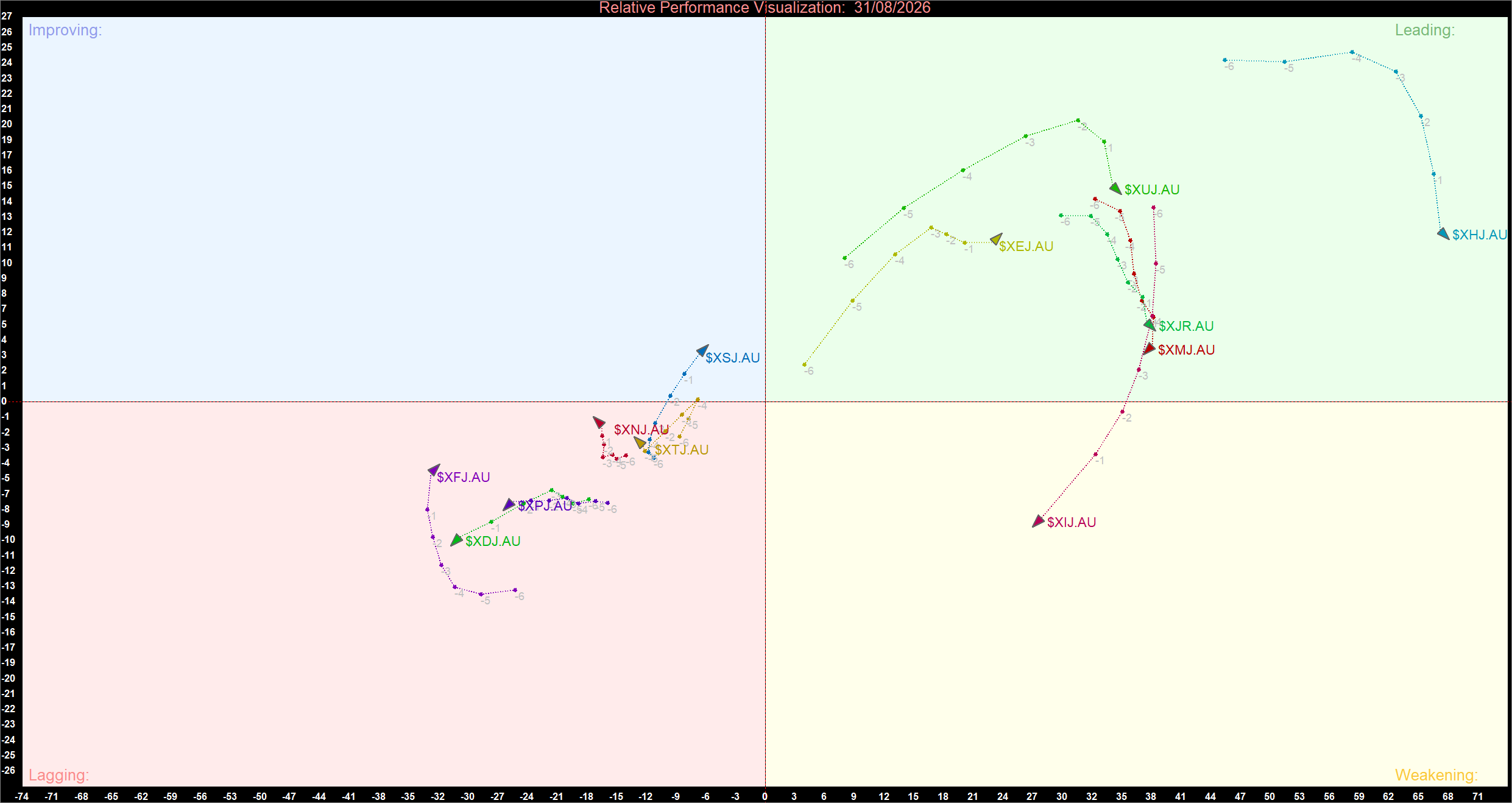
ASX Sector Relative Momentum Chart (at the closing price of 31/08/2026). Powered by: amibroker.com.
Leading Quadrant
Health Care (XHJ), Utilities (XUJ), Energy (XEJ), Resources (XJR) and Materials (XMJ) remain in the Leading quadrant.
Health Care continues to occupy the strongest position within the Leading group. Its location deep in the upper-right portion of the RRG indicates strong relative strength and momentum. However, its trajectory is moving lower, suggesting that momentum is beginning to moderate. Continued downward movement could eventually signal a transition toward Weakening.
Utilities (XUJ) also remains firmly positioned in Leading and continues to demonstrate strong relative momentum. Its position well above the horizontal midline confirms that the sector remains one of the established momentum leaders, although its trajectory should be monitored for any movement toward the centre.
Energy (XEJ) remains in Leading but is positioned closer to the centre of the RRG. This indicates that its relative momentum remains positive, although its Leadership is less pronounced than that of Health Care and Utilities.
Resources (XJR) and Materials (XMJ) also remain in Leading. Their positions above the RRG midlines continue to indicate positive relative momentum. However, both sectors have moved considerably closer to the centre than the strongest leaders, making their trajectories important to monitor for any further deterioration.
Improving Quadrant
Consumer Staples (XSJ) remains the only sector in the Improving quadrant.
Its position indicates that relative momentum is strengthening, although the sector has not yet moved into Leading. The current trajectory suggests that Consumer Staples is one of the more important sectors to watch for further momentum improvement.
A continued movement toward the upper-right portion of the RRG would strengthen the signal that Consumer Staples is transitioning from an improving sector into an established momentum leader. Conversely, a Reversal toward the centre would weaken the current improvement signal.
Weakening Quadrant
Information Technology (XIJ) remains in the Weakening quadrant.
The sector's current position indicates that its previous relative strength is losing momentum. Although XIJ remains on the positive side of the relative-strength axis, its position below the horizontal midline indicates deterioration in its momentum profile.
The sector's latest trajectory remains an important signal. Continued movement downward and toward the left would increase the likelihood of a rotation into Lagging. A reversal toward the upper-right would instead suggest that relative momentum is stabilising and potentially returning toward Leading.
Lagging Quadrant
Consumer Discretionary (XDJ), Communication Services (XTJ), Industrials (XNJ), Financials (XFJ) and Real Estate (XPJ) remain in the Lagging quadrant.
These sectors continue to sit below the key RRG midlines, indicating weaker relative momentum compared with the broader market. Their current positions suggest that there has not yet been sufficient improvement to trigger a rotation into Improving.
Among the group, the direction of each sector's trajectory remains more important than its current position alone. Sustained movement toward the centre would indicate that relative momentum is recovering, while continued movement away from the centre would reinforce their Lagging status.
Bottom Line
The latest RRG continues to indicate selective rather than broad-based sector momentum. Health Care and Utilities remain the strongest established leaders, while Energy, Resources and Materials continue to occupy the Leading quadrant but require monitoring for signs of momentum deterioration.
Consumer Staples is the key emerging momentum sector, as its position in Improving indicates continued strengthening relative performance. In contrast, Information Technology remains the key weakening sector, with its trajectory suggesting that previous relative strength is fading.
The five sectors in Lagging — Consumer Discretionary, Communication Services, Industrials, Financials and Real Estate — have yet to demonstrate sufficient relative momentum improvement to move into Improving. Overall, the RRG structure remains constructive, but the concentration of leadership and the contrasting trajectories across the quadrants suggest that sector rotation remains an important consideration for the broader ASX market.


 Nov 12, 2026





 Please wait processing your request...