
 CA
 NZ
 UK
 US
 IND

 AU

 Share
 X (Formerly Twitter)
 Whatsapp
 Facebook
 LinkedIn
 Telegram
 Email This Article
 Copy Link
 Summarize with AI
 Chat GPT
 Perplexity

Key Momentum Shifts
- Financials Extend Leadership: Financials (XFJ) remain firmly positioned within the Leading quadrant and continue to display improving relative strength despite short-term price weakness.
- Consumer Sectors Lose Momentum: Consumer Staples (XSJ) and Consumer Discretionary (XDJ) have both rotated into the Weakening quadrant, signalling a deterioration in momentum after extended periods of leadership.
- Utilities and Technology Continue Improving: Utilities (XUJ) and Information Technology (XTJ) remain in the Improving quadrant, with both sectors showing constructive momentum profiles and potential future leadership characteristics.
- Communication Services and Clean Energy Weaken Further: Communication Services (XPJ) and Clean Energy (XNJ) remain trapped in the Weakening quadrant as institutional momentum continues to fade.
- Cyclical Sectors Remain Laggards: Industrials (XIJ), Materials (XMJ), Real Estate (XJR), and Energy (XEJ) continue to occupy the Lagging quadrant, reflecting ongoing relative underperformance.
The Relative Rotation Graph (RRG) for 1 July 2026 highlights a notable shift in ASX sector leadership. While Financials and Health Care continue to exhibit leadership characteristics, both Consumer Staples and Consumer Discretionary have lost momentum and rotated into the Weakening quadrant. Meanwhile, Utilities and Technology continue to strengthen within Improving, suggesting investors may be gradually repositioning toward sectors showing renewed momentum. At the same time, Materials, Real Estate, Industrials, and Energy remain entrenched in Lagging despite occasional short-term rebounds.
ASX Sector Momentum Summary
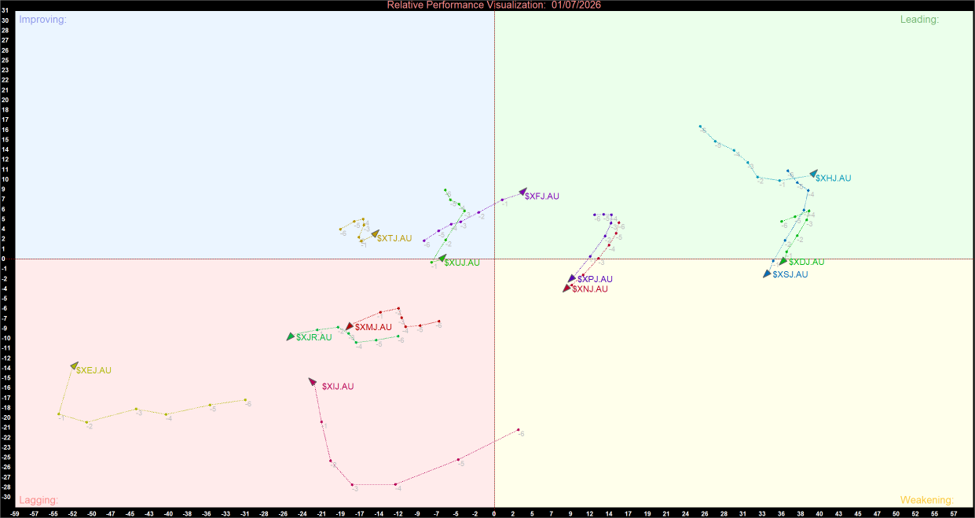
ASX Sector Relative Momentum Chart (at the closing price of 01/07/2026). Powered by: amibroker.com
Momentum Breakdown by Quadrant
The Leading Quadrant (The Market Leaders)
- Health Care (XHJ) remains the strongest sector on the Relative Rotation Graph, maintaining a prominent position within the Leading quadrant. Although momentum has moderated from earlier peaks, relative strength remains exceptionally robust. The sector's defensive earnings profile and long-term structural growth drivers continue to attract institutional support.
- Financials (XFJ) continue to strengthen within the Leading quadrant and remain one of the most important sources of market leadership. Despite the sector's decline during the latest trading session, the broader relative trend remains positive. The sector's strong weighting within the ASX means continued leadership from Financials provides meaningful support for the broader market.
The Improving Quadrant (The Emerging Leadership Candidates)
- Utilities (XUJ) have successfully established themselves within the Improving quadrant. The sector's improving trajectory suggests momentum is strengthening following a prolonged period of underperformance. Continued improvement could eventually support a move back into the Leading quadrant.
- Information Technology (XTJ) remains within Improving and continues to display encouraging momentum characteristics. While recent price action has been volatile, the sector's north-easterly rotation suggests investors are gradually rebuilding exposure to growth-oriented technology companies.
The Weakening Quadrant (Losing Momentum)
- Consumer Staples (XSJ) have rotated from Leading into Weakening, confirming a loss of momentum. While relative strength remains positive, investors appear to be reducing their reliance on traditional defensive consumer businesses. Unless momentum stabilises, the sector could continue drifting toward Lagging.
- Consumer Discretionary (XDJ) has also crossed into the Weakening quadrant. Although relative strength remains above benchmark levels, the loss of momentum suggests investors are becoming more cautious toward consumer-related sectors after a period of strong performance.
- Communication Services (XPJ) remain within Weakening and continue to lose momentum. The sector's trajectory indicates leadership characteristics are fading as capital rotates toward sectors exhibiting stronger relative trends.
- Clean Energy (XNJ) remains firmly within Weakening and continues to rotate south-west. Investor enthusiasm toward renewable-energy and sustainability themes appears to have moderated, increasing the risk of a future move into Lagging.
The Lagging Quadrant (The Structural Underperformers)
- Industrials (XIJ) remain deeply embedded within the Lagging quadrant and continue to exhibit weak relative performance. Despite occasional periods of stabilisation, the sector remains one of the weakest areas of the market.
- Materials (XMJ) continue to struggle within Lagging. Relative strength remains weak despite modest short-term recoveries, reflecting ongoing caution toward resource-related sectors.
- Real Estate (XJR) remains firmly positioned within Lagging as investors continue to favour sectors with stronger momentum characteristics. While recent gains have improved sentiment marginally, the broader relative trend remains weak.
- Energy (XEJ) remains the weakest sector from a relative-strength perspective. However, the sector's trajectory has begun turning north-east, suggesting the early stages of a recovery process. A sustained improvement in relative performance will be required before a meaningful turnaround can be confirmed.
Strategic Summary
The latest RRG highlights a narrowing leadership structure within the ASX. Health Care (XHJ) and Financials (XFJ) remain the market's primary leadership sectors, while Utilities (XUJ) and Technology (XTJ) continue to strengthen within Improving and remain candidates for future leadership. Meanwhile, Consumer Staples (XSJ) and Consumer Discretionary (XDJ) have lost momentum after rotating into Weakening, joining Communication Services (XPJ) and Clean Energy (XNJ). Materials (XMJ), Real Estate (XJR), Industrials (XIJ), and Energy (XEJ) remain structurally weak, suggesting investors continue to favour sectors exhibiting stronger relative strength and improving momentum. Overall, leadership is becoming increasingly concentrated in Health Care and Financials as previously dominant consumer sectors begin to fade.


 Nov 12, 2026





 Please wait processing your request...