
 CA
 NZ
 UK
 US
 IND

 AU

 Share
 X (Formerly Twitter)
 Whatsapp
 Facebook
 LinkedIn
 Telegram
 Email This Article
 Copy Link
 Summarize with AI
 Chat GPT
 Perplexity

Key Highlights
- The Financial Turnaround: Financials (XFJ) have officially transitioned into the Improving quadrant, signaling a potential bottom in relative momentum despite recent price pressure.
- Staples’ Paradox: While Consumer Staples (XSJ) posted a dominant +1.07% price gain, the momentum chart reveals it remains trapped in the Lagging quadrant, indicating it has yet to overcome its long-term relative downtrend.
- Tech’s Lone Stand: Info Tech (XIJ) remains the sole undisputed leader, maintaining the highest momentum and relative strength in the Leading quadrant.
- The Resource Weight: Materials (XMJ) and Resources (XJR) maintain their Leading status, but their sharply downward-sloping tails warn of a rapid bleed-off in relative momentum.
The trading session on April 22, 2026, revealed a starkly polarized Australian equity market, characterized by extreme dispersion between sector price action and underlying momentum. While a violent capitulation in Health Care (XHJ) and aggressive selling in Financials (XFJ) weighed heavily on the benchmark, a critical structural shift emerged as the banking sector officially transitioned into the Improving quadrant on the relative rotation graph. This move, occurring amidst a narrowing "safe haven" flight into Consumer Staples (XSJ), suggests that institutional capital is beginning to reset its internal risk parameters, favoring a bottoming out of momentum in heavyweights over the deteriorating trends seen in the broader defensive complex.
ASX Sector Performance Table (22/04/2026)
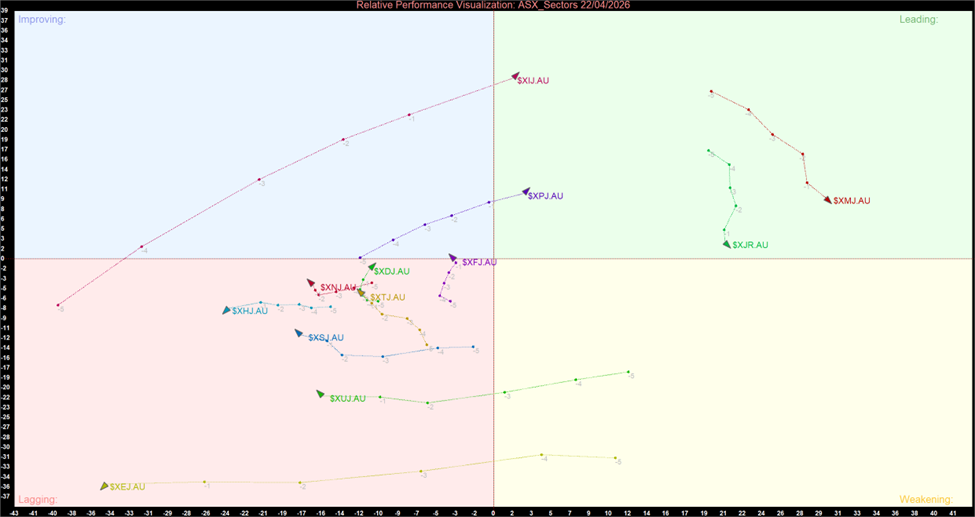
ASX Sector Relative Momentum Chart (at the closing price of 22/04/2026). Powered by: amibroker.com
Daily ASX Sector Momentum Summary Table
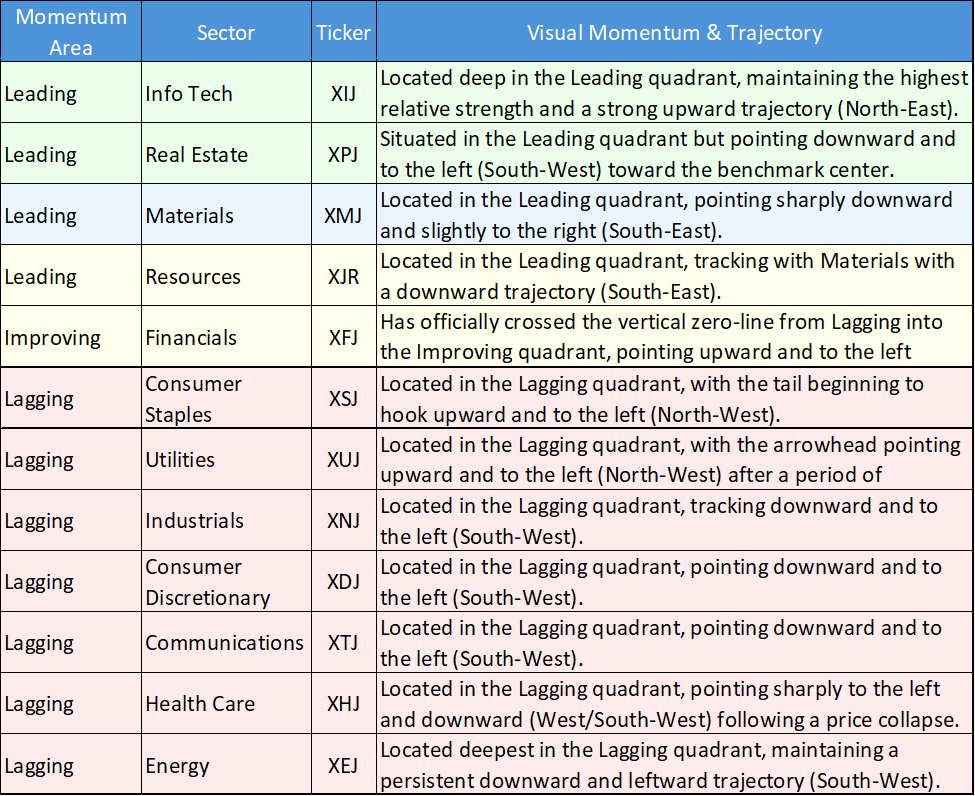
Sector Performance Breakdown
The Improving Rotation
- Financials (XFJ | -2.26% Price | Improving Momentum): In a significant structural shift, the banking sector has crossed the vertical axis into the Improving quadrant. While the daily price action remains weak, the north-west trajectory of the tail suggests that the "slow-moving distribution" phase is ending, as institutional models begin to price in a relative recovery against the benchmark.
The Leading Guard
- Info Tech (XIJ | +0.34% Price | Leading Momentum): Tech continues to untether itself from broader economic anxieties, remaining deep in the top-right quadrant. It represents the most reliable structural trend currently on the board.
- Materials (XMJ | +0.12% Price | Leading Momentum): Despite today’s fragile consolidation, the RRG shows a "Weakening" trajectory within the Leading quadrant. The sector has not yet crossed into the bottom-right, but the momentum decay is evident as the primary uptrend matures.
- Real Estate (XPJ | -0.47% Price | Leading Momentum): Property remains a leader but is showing signs of exhaustion. Its vector is pointing directly toward the benchmark center, suggesting its period of aggressive outperformance is stalling.
The Lagging Complex
- Energy (XEJ | -0.74% Price | Lagging Momentum): Situated furthest in the bottom-left, Energy remains the market’s primary laggard. There is zero evidence of a mean-reversion bounce in either price or momentum.
- Health Care (XHJ | -6.01% Price | Lagging Momentum): The catastrophic price plunge is reflected in a violent tail extension deeper into the Lagging quadrant, confirming a total systematic capitulation.
- Consumer Staples (XSJ | +1.07% Price | Lagging Momentum): Despite today’s flight-to-safety bid, the RRG confirms that Staples are still fighting a multi-week trend of underperformance. Until the tail hooks toward the "Improving" quadrant, this price action is viewed as a tactical hedge rather than a structural trend shift.
Strategic Summary
The momentum data from April 22, 2026, presents a polarized market with no sectors currently in the "Weakening" phase, assets are either performing or they aren't. The most critical takeaway for active traders is the rotation of Financials (XFJ) into the Improving quadrant. While the price sell-off looks ugly on the surface, the momentum shift suggests that institutional "smart money" may be quietly stabilizing the banking sector. Conversely, the "Defensive" safety seen in Staples and Health Care remains technically broken on a relative basis, urging caution for those looking for long-term protection in these traditional havens.


 Nov 12, 2026





 Please wait processing your request...