
 CA
 NZ
 UK
 US
 IND

 AU

 Share
 X (Formerly Twitter)
 Whatsapp
 Facebook
 LinkedIn
 Telegram
 Email This Article
 Copy Link
 Summarize with AI
 Chat GPT
 Perplexity

Key Highlights
- Information Technology (XIJ) and Consumer Discretionary (XDJ) are positioned in the Leading quadrant.
- Materials (XMJ), Resources (XJR) and Real Estate (XPJ) are positioned in Improving.
- Health Care (XHJ), Consumer Staples (XSJ), Industrials (XNJ) and Financials (XFJ) are positioned in Weakening.
- Communication Services (XTJ), Energy (XEJ) and Utilities (XUJ) remain in Lagging.
- The momentum structure shows a relatively balanced rotation, with sectors distributed across all four quadrants.
- XIJ maintains one of the strongest relative momentum positions on the chart, while XDJ also remains firmly within Leading.
- XMJ, XJR and XPJ are the key sectors attempting to strengthen their relative momentum.
- The Weakening group is relatively large, highlighting deterioration in momentum across Health Care, Consumer Staples, Industrials and Financials.
- The current configuration indicates continued sector rotation rather than a broad-based improvement in relative momentum.
The ASX sector momentum structure on 7 October 2026 remained mixed, with Information Technology and Consumer Discretionary positioned in Leading while Materials, Resources and Real Estate moved within Improving. Health Care, Consumer Staples, Industrials and Financials were positioned in Weakening, while Communication Services, Energy and Utilities remained in Lagging. The configuration indicates that relative momentum continues to favour selected sectors, while several previously stronger areas are experiencing deterioration.
ASX Sector Momentum Quadrants
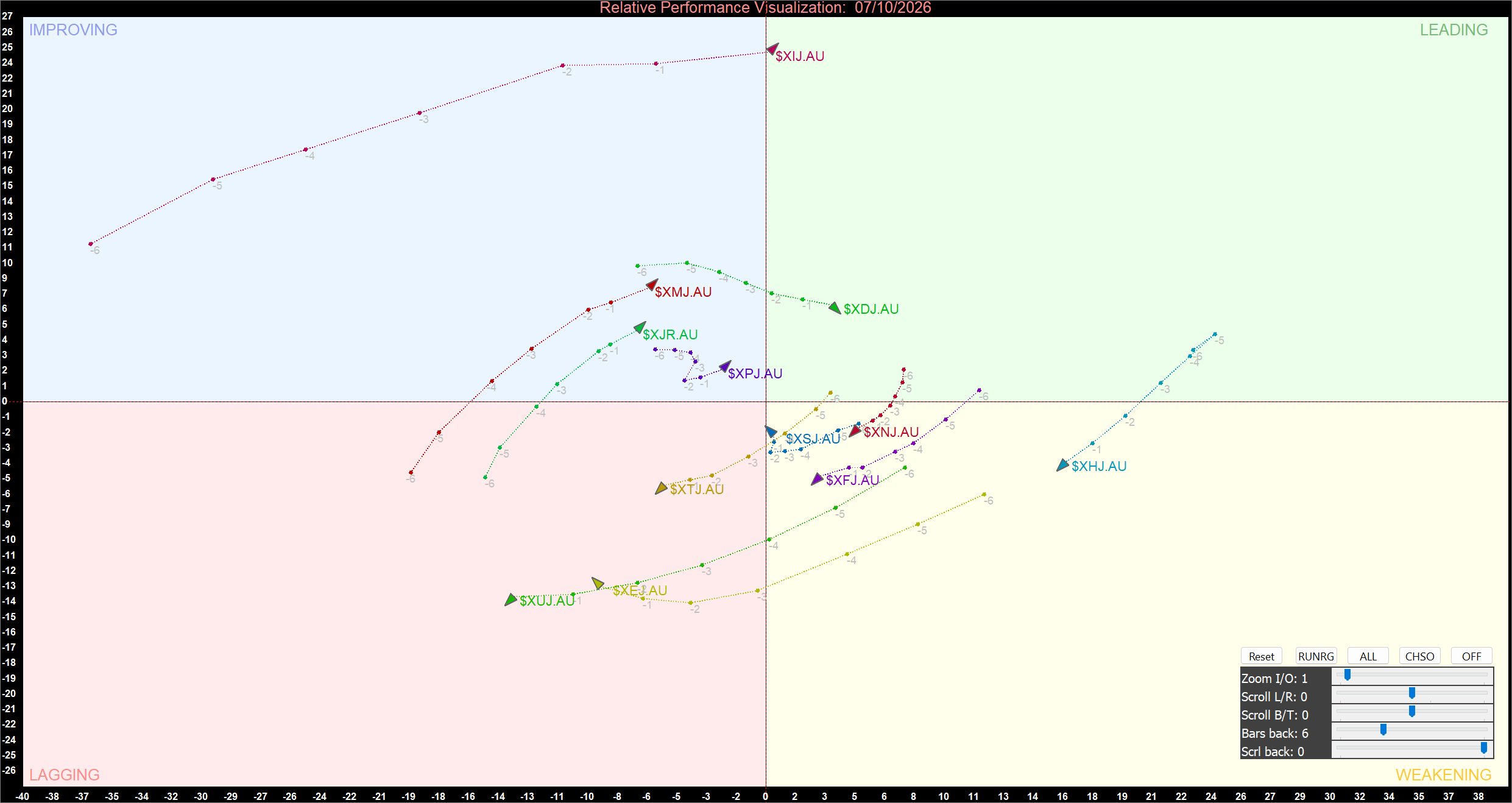
ASX Sector Relative Momentum Chart at the closing price of 07/10/2026. Powered by: amibroker.com
Technology and Consumer Discretionary Remain in Leading
Information Technology (XIJ) and Consumer Discretionary (XDJ) were positioned in the Leading quadrant on the latest relative momentum chart. Their locations indicate that both sectors continue to combine relatively strong performance with positive momentum characteristics.
XIJ remained one of the strongest positions on the chart, with its trajectory showing sustained relative strength over the latest observations. The sector's position well inside the Leading area suggests that its momentum structure remains more constructive than most other sectors.
Consumer Discretionary was also positioned in Leading, although closer to the centre of the chart than Information Technology. Its position indicates that the sector retains positive relative momentum, but continued movement further into the upper-right area would provide stronger confirmation of sustained leadership.
The separation between the Leading sectors and much of the remaining market highlights the selective nature of current sector momentum. Only two sectors have established Leading classifications, meaning Leadership remains relatively narrow.
Materials, Resources and Real Estate Improve
Materials (XMJ), Resources (XJR) and Real Estate (XPJ) were positioned in the Improving quadrant. Their locations indicate that relative momentum is strengthening, although these sectors have not yet established the combination of relative strength and momentum required for a Leading classification.
Materials was positioned relatively high within the Improving quadrant, indicating a stronger momentum trajectory than several other sectors in the group. Continued movement toward the vertical centre line would be important because a transition into Leading would signal a more substantial improvement in relative performance.
Resources was also positioned in Improving, with its trajectory indicating a recovery in relative momentum. The sector remains below the Leading threshold, but continued upward movement could strengthen its momentum classification.
Real Estate was positioned closer to the centre of the chart. Its Improving classification suggests that the sector's relative momentum is becoming more constructive, although sustained movement into the upper-right quadrant would be required to confirm a transition into stronger leadership.
Health Care, Consumer Staples, Industrials and Financials Move Into Weakening
Health Care (XHJ), Consumer Staples (XSJ), Industrials (XNJ) and Financials (XFJ) were positioned in the Weakening quadrant. Their locations indicate that these sectors retain varying degrees of relative positioning but are experiencing deterioration in momentum.
Health Care was positioned relatively far to the right while remaining below the horizontal centre line. This indicates relatively strong positioning on the horizontal dimension but weakening momentum. A continued downward trajectory would increase the risk of a move into Lagging.
Consumer Staples (XSJ) was also classified as Weakening. Its trajectory indicates that momentum has deteriorated despite the sector maintaining relatively strong positioning. A recovery toward the centre line would be required to stabilise the current weakening signal.
Industrials and Financials were both positioned below the horizontal axis, indicating negative momentum conditions. Financials was particularly notable because its position shows continued weakness in relative momentum, making a recovery toward the centre line important for any improvement in its classification.
Three Sectors Remain in Lagging
Communication Services (XTJ), Energy (XEJ) and Utilities (XUJ) remained in the Lagging quadrant. Their positions indicate that both relative performance and momentum remain comparatively weak.
Energy and Utilities were positioned deeper within Lagging, suggesting more persistent relative momentum pressure. Their trajectories will need to turn upward before a transition into Improving becomes likely.
Communication Services was positioned closer to the centre of the chart than some of the other Lagging sectors. This leaves the sector with greater potential to improve if its trajectory turns higher, although it has not yet produced sufficient momentum to move into Improving.
The Lagging group therefore remains an important area to monitor. A sustained upward movement from these sectors would provide evidence that the broader market rotation is becoming more constructive.
Momentum Rotation Remains Uneven
The current quadrant structure demonstrates that daily performance and relative momentum can produce different signals. A sector can record a positive daily return while remaining in Weakening or Lagging if its broader relative momentum remains under pressure.
This distinction is particularly important for interpreting the latest ASX structure. Health Care was the strongest daily performer on 7 October, yet XHJ remains in Weakening. Similarly, Consumer Staples recorded a positive daily performance but remains in Weakening. Conversely, Materials and Resources recorded negative daily performances while their relative momentum positions remain in Improving.
The chart therefore points to a market where momentum leadership is selective. Technology and Consumer Discretionary have established Leading positions, while Materials, Resources and Real Estate are attempting to improve. At the same time, the relatively large Weakening group indicates that several sectors are losing momentum.
Bottom Line
The ASX sector momentum structure on 7 October 2026 remains characterised by selective leadership and uneven sector rotation. Information Technology (XIJ) and Consumer Discretionary (XDJ) are positioned in Leading, while Materials (XMJ), Resources (XJR) and Real Estate (XPJ) form the Improving group.
Health Care (XHJ), Consumer Staples (XSJ), Industrials (XNJ) and Financials (XFJ) are positioned in Weakening, while Communication Services (XTJ), Energy (XEJ) and Utilities (XUJ) remain in Lagging.
From a momentum perspective, Technology remains one of the clearest areas of relative strength, while Consumer Discretionary also maintains a constructive position. Materials, Resources and Real Estate are the key sectors to monitor for further improvement, particularly if their trajectories continue toward the Leading quadrant.
Conversely, the four sectors in Weakening require stabilisation before their momentum outlook becomes more constructive. The overall configuration therefore continues to favour selective sector leadership rather than a broad-based momentum advance.


 Nov 12, 2026





 Please wait processing your request...