
 CA
 NZ
 UK
 US
 IND

 AU

 Share
 X (Formerly Twitter)
 Whatsapp
 Facebook
 LinkedIn
 Telegram
 Email This Article
 Copy Link
 Summarize with AI
 Chat GPT
 Perplexity

Key Highlights
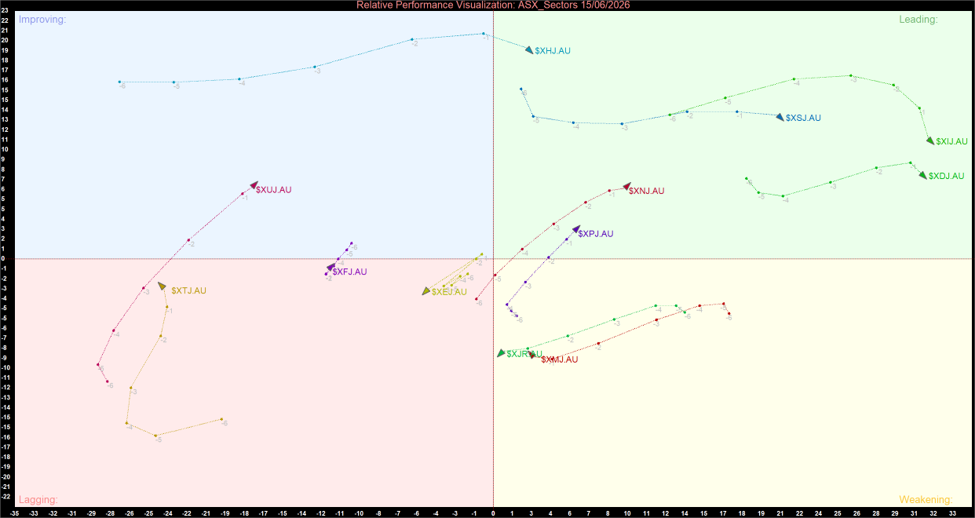
- Health Care Emerges as the Strongest Momentum Leader: Health Care (XHJ) advanced deeper into the Leading quadrant and remains the highest-positioned sector on the momentum axis, highlighting accelerating relative momentum versus the broader market.
- Communication Services and Clean Energy Maintain Leadership: Communication Services (XPJ) and Clean Energy (XNJ) remained firmly within the Leading quadrant, reflecting continued institutional preference for sectors exhibiting both positive relative strength and momentum.
- Utilities Shows Improving Relative Momentum: Utilities (XUJ) remained in the Improving quadrant and continued advancing toward positive relative strength, suggesting a potential transition into market leadership in the coming weeks.
- Materials and Real Estate Remain in Weakening: Materials (XMJ) and Real Estate (XJR) continued to occupy the Weakening quadrant despite recent strong price performances, indicating their relative leadership continues to deteriorate.
The Australian equity market's sector rotation profile remained broadly constructive on June 15, 2026, with six sectors positioned in the Leading quadrant and several additional sectors showing improving relative momentum characteristics. The latest Relative Rotation Graph (RRG) suggests investors continue rotating capital toward sectors demonstrating sustainable relative strength while reducing exposure to areas that have begun losing momentum.
The current rotation structure reflects healthy market participation across a diverse range of industries, including cyclical, defensive, and growth-oriented sectors. Such broad leadership is often associated with a more durable and sustainable market advance.
ASX Sector Momentum Summary
Key Market Themes
Health Care Strengthens Its Leadership Position
- Health Care (XHJ) remains the standout momentum story on the chart. Positioned at the highest level on the momentum axis and firmly inside the Leading quadrant, the sector continues to exhibit accelerating relative momentum while maintaining positive relative strength.
- The sector's strong RRG positioning suggests institutional investors are increasingly allocating capital toward companies with defensive earnings profiles and resilient growth characteristics. As long as momentum remains elevated, Health Care could continue outperforming the broader market.
Communication Services and Clean Energy Maintain Positive Trends
- Communication Services (XPJ) and Clean Energy (XNJ) remained comfortably within the Leading quadrant, confirming that both sectors continue to benefit from improving relative strength and momentum.
- The sustained leadership displayed by these sectors suggests investor confidence remains strong, with capital continuing to flow toward industries perceived as offering superior growth opportunities and long-term structural tailwinds.
Industrials and Consumer Sectors Remain Market Leaders
- Industrials (XIJ) continued to hold one of the strongest positions within the Leading quadrant, while Consumer Discretionary (XDJ) maintained a healthy leadership profile. Consumer Staples (XSJ) also remained in the Leading quadrant, although its momentum has started to moderate.
- The presence of both cyclical and defensive sectors among market leaders highlights the broad-based nature of current market participation and reflects confidence across multiple segments of the economy.
Utilities Continue to Improve
- Utilities (XUJ) remained firmly in the Improving quadrant and displayed one of the most constructive trajectories on the chart. Although relative strength remains below benchmark levels, momentum has improved considerably over recent periods.
- Historically, sectors progressing through the Improving quadrant often represent the early stages of institutional accumulation. Continued improvement could eventually see Utilities transition into the Leading quadrant.
Materials and Real Estate Continue Losing Relative Momentum
- Materials (XMJ) and Real Estate (XJR) remained positioned in the Weakening quadrant despite posting some of the strongest absolute price performances in recent sessions.
- This divergence highlights an important distinction between price performance and relative performance. While both sectors may continue advancing in absolute terms, their relative leadership characteristics have deteriorated as investors increasingly favor sectors exhibiting stronger momentum profiles.
- The fact that Materials recorded the strongest daily sector gain yet remains in Weakening suggests recent price strength has not translated into improving relative momentum.
Financials Attempt Recovery While Energy Remains Weak
- Financials (XFJ) remained near the border between Lagging and Improving, indicating early signs of stabilization. The sector's recent trajectory suggests selling pressure may be easing, although further improvement is needed before a more constructive outlook can be justified.
- Energy (XEJ) remained in the Lagging quadrant and continues to exhibit weak relative strength despite some modest momentum improvement. The sector's positioning aligns with its sharp underperformance during the latest trading session and suggests investors remain cautious toward traditional energy stocks.
Bottom Line
The June 15 sector rotation profile continues to paint a constructive picture for the Australian market. Leadership remains broad-based, with Health Care (XHJ), Industrials (XIJ), Consumer Discretionary (XDJ), Consumer Staples (XSJ), Clean Energy (XNJ), and Communication Services (XPJ) all occupying the Leading quadrant.
The most notable development remains the continued strength in Health Care, which now possesses the highest relative momentum reading among all sectors. Meanwhile, Utilities (XUJ) continues progressing through the Improving quadrant and could emerge as a future leader.
Conversely, Materials (XMJ) and Real Estate (XJR) remain trapped in the Weakening quadrant despite recent price gains, suggesting their relative leadership continues to fade. Overall, the current RRG structure indicates investor sentiment remains constructive, with market leadership spread across multiple sectors rather than concentrated in a narrow group of stocks.


 Nov 12, 2026





 Please wait processing your request...