
 CA
 NZ
 UK
 US
 IND

 AU

 Share
 X (Formerly Twitter)
 Whatsapp
 Facebook
 LinkedIn
 Telegram
 Email This Article
 Copy Link
 Summarize with AI
 Chat GPT
 Perplexity

Key Highlights
- ANZ Group continues to face acute macroeconomic headwinds, with peaking interest rates and fierce mortgage competition structurally compressing Net Interest Margins (NIM) across the sector.
- As the broader market rigorously scrutinizes the extreme valuation multiples of the "Big Four" banks, institutional capital is actively distributing shares and unwinding exposure.
- The technical price action is flashing severe warning signs, characterized by the development of a massive, multi-month Potential Head & Shoulders distribution pattern.
While ANZ Group Holdings Limited (ASX:ANZ) spent the vast majority of the past year riding a relentless primary uptrend, the technical landscape has recently undergone a definitive shift toward structural exhaustion. As the broader market scrutinizes the elevated valuation multiples of the major banks against a backdrop of peaking interest rates and sticky inflation, ANZ appears to be succumbing to a severe phase of institutional distribution. The recent deterioration in price action confirms that the long-term mark-up phase has thoroughly exhausted, threatening to unleash a dynamic new cyclical downtrend.
Margin Compression and Valuation Reality
ANZ’s fundamental investment thesis is heavily anchored to the domestic credit cycle and its position within the highly concentrated Australian banking sector:
- Net Interest Margin (NIM) Squeeze: The primary profit engine for retail banks is facing acute pressure. While higher interest rates initially boosted margins, intense, margin-destroying competition for both home loans and customer deposits has forced the bank to absorb higher funding costs, structurally compressing core profitability.
- Credit Quality Deterioration: In a "higher-for-longer" interest rate environment, household and corporate balance sheets are increasingly stressed. The market is pre-emptively pricing in a highly probable uptick in bad and doubtful debt provisions as borrowers transition off fixed-rate mortgages and business insolvencies rise.
- Valuation Exhaustion: The massive prior rally pushed ANZ's Price-to-Earnings (P/E) and Price-to-Book (P/B) multiples to extreme historical premiums. Institutional capital is increasingly hesitant to pay flawless growth valuations for a mature, cyclical banking asset facing a slowing macroeconomic environment.
Associated Risks
The primary risk for ANZ, and the broader Australian banking sector, is a "hard landing" economic scenario. If a severe domestic recession triggers a sudden and aggressive spike in unemployment, the resulting wave of mortgage defaults and business bankruptcies would devastate the bank's balance sheet. Furthermore, any unexpected regulatory interventions by APRA (Australian Prudential Regulation Authority) requiring banks to hold even higher capital buffers would directly compress Return on Equity (ROE) and threaten the sustainability of its lucrative dividend payout ratio.
Technical Outlook
The daily chart for ANZ Group Holdings reveals a rapid deterioration in market structure, highlighting a transition from a distribution phase into a highly vulnerable technical posture.
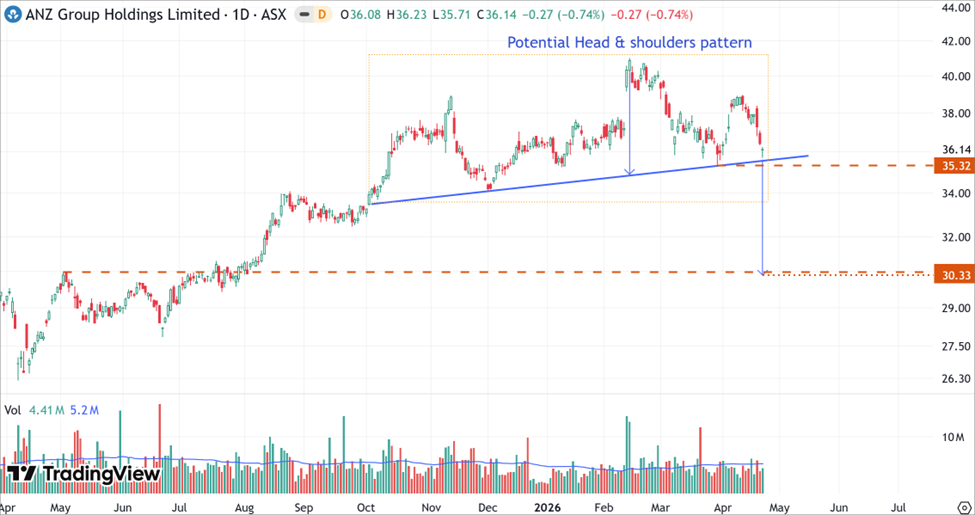
BOQ’s Daily Price Chart (at the closing price of 23rd April 2026). Powered by: tradingview.com
- On the daily chart, ANZ’s stock price is forming a potential Head & Shoulders pattern dating back to October 2025, indicating a negative bias.
- The critical structural pivot is positioned at the pattern’s neckline of $35.32. A decisive structural breakdown and daily close below this support zone opens the door to the pattern's full measured move. This move projects a primary downside target of $30.33, marked by the lower horizontal dashed line.
Bottom Line
ANZ Group Holdings (ASX:ANZ) is currently exhibiting the classic hallmarks of an impending cyclical breakdown. The stock is actively rolling over to carve out the right shoulder of a massive Head & Shoulders distribution pattern. While the structural breakdown is not yet confirmed, the technical posture is highly vulnerable. Investors and active traders should exercise extreme caution and closely monitor the critical $35.32 support zone. A confirmed fracture of this neckline would definitively end the multi-year bull cycle and heavily favor a continued, devastating descent toward the $30.33 measured move target.


 Nov 12, 2026





 Please wait processing your request...